Dosidicus Giygas asks:

Can you recommend any good resources for learning about Aegean depictions of cephalopods?

That’s a… concerningly specific request

and this is coming from a guy whose thesis is on Roman window glass

So, uh… I mean, there’s nothing off the top of my head that isn’t ludicrously dry and technical; like, if you have JSTOR access or similar you could search for some of Penelope Mountjoy’s articles on the Late Minoan IB “Marine Style” but they’re, um… not exactly page-turners.  They probably won’t make a lot of sense without a fairly thorough grounding in Minoan archaeology, and honestly I’m not even sure they’ll tell you what you want to know, if you’re interested in, like, the accuracy of anatomical details.  Is the Marine Style what you mean?  Because that’s where my mind instantly goes on hearing “Aegean depictions of cephalopods,” but without context that phrasing is… kinda broad.  There’s a bunch of Attic black and red figure pots with octopuses(-pi/-podes) on them that you can find by searching the Beazley Archive database (type “octopus” into the “decoration description” field and hit “list” at the bottom of the page); I dunno if anyone’s ever written anything about them and at a glance it looks like a lot of them just have the octopus as a shield device or a generic ocean-themed ornament, but… I mean, they’re there if you want ‘em, I guess.

Alolan Raichu, Marowak and Exeggutor

The regional variant Pokémon we’re looking at today all evolve from Pokémon that do not have regional variant forms of their own – a Pikachu, Cubone or Exeggcute caught or hatched in Alola will look much the same as a Pikachu, Cubone or Exeggcute caught or hatched anywhere else.  In fact, they don’t just look the same, they are the same; an Alolan Pikachu that is sent to Galar will evolve into a standard Raichu (even though Sword and Shield do know what an Alolan Raichu is, and Pokémon games do track each individual Pokémon’s region of origin), while a Pikachu that arrives in Alola from anywhere else will evolve into an Alolan Raichu.  That’s weird, because other regional forms don’t work this way (with the exception of two Galarian forms, Weezing and Mr. Mime); you can take an Alolan Rattata to any region of the world and keep it there for as long as you like, it’ll still evolve into an Alolan Raticate.  Let’s see if we can figure out what’s going on here.

Continue reading “Alolan Raichu, Marowak and Exeggutor”

Cosmic Crunch asks:

Should Hannibal have gone for Rome?

Well… to my mind, he did.  I mean, that’s what he was doing in Italy.  It’s just that the Romans’ strategy after Cannae was to ensure that a direct assault on the city would always be prohibitively difficult and dangerous.  I’m not a military historian or an expert on the Middle Republic, and maybe I’d have stronger opinions about this if I were, but I just don’t think our sources for the Second Punic War give us a good enough picture of the overall strategic situation for there to be any profit in second-guessing the moves of a general who was there on the ground.  Like, clearly he thought attacking the city wouldn’t have worked, and he knew a lot more about the capabilities of both the Roman and Carthaginian armies than anyone alive today.  Jim the Editor thinks Hannibal probably saw attacking Rome as too big a gamble, risking his entire army and his foothold in Italy when he could just keep wearing the Romans down and demoralising them until they eventually capitulated.  That’s not actually what happened, of course, but it’s very difficult to know whether the alternative strategy would have produced better results.

Alicent Hightower asks:

Which Pokemon would you choose for your personal sigil and why?

Should this just be my favourite Pokémon?  Is there a reason for it not to be my favourite Pokémon; should I have a better reason than that?

Well, my favourite Pokémon is Vileplume (for reasons discussed herein).  The Pokémon that represents me, that really is who I am and aspire to be deep down, is Druddigon, who lives in a cave being surly and irritable, occasionally emerging to terrorise a village and eat people.  So I guess it’s one of those two (or both; I could have my arms quartered or something, right?).  I hope that answers your question.

Larry asks:

Hey, so I know you’re an utter madman and would like to eliminate types from the chart. That sounds really unnecessary but. If you got to rebalance the type chart a bit, change some of the dynamics, what would you do? How will you help the poor ice types? Will you finally stop the steel types?

I think you’ve maybe misunderstood me, because to me these are two unrelated issues.  I don’t think the 18-type chart is, in principle, impossible to balance (I do think that 900 Pokémon are, in principle, impossible to balance, but that’s another whole thing).  I don’t want to cut down the number of types because I think it would make the game more balanced (I mean, it might, but I don’t think it’s the only or best way to do that, and it wouldn’t be enough on its own).  I want to cut it down… as weird as this will sound, basically for aesthetic reasons – to whit, I think it’s an ugly, overcomplicated mess that doesn’t actually need to exist.  Beautiful or elegant game mechanics, to me, are ones where complex gameplay and strategy arise from the interactions of simple rules and principles.  The type chart means that Pokémon does this in reverse: the fundamental rules are complicated and counterintuitive, but the resulting gameplay is not particularly any more interesting than it would be using a greatly reduced system.

I will admit, having said all this, that (like many things) I say this stuff partly just to be contrary.  I’m not even all that committed to it; I just want to force everyone to think about it.  I mean, people talk all the time about what new types they’d want to add, from time to time people ask me to talk about types I’d like to add; so clearly no one thinks the type chart is sacred and can’t be changed.  Why is it so much more uncomfortable to talk about getting rid of some of it; why is anyone bothered when I say that I think that might be a good idea?  It’s an uncontroversial axiom of good design that you should leave out or trim down elements that are unnecessary or bloated, but after last year’s… invigorating discussions… about Sword and Shield, I get the impression that a good chunk of the Pokémon fan community is pretty strongly opposed to what I think is a fairly obvious principle.  I’d like people to consider, when they talk about game design in Pokémon and all the cool ideas they want to add, whether there are also things they’d like to remove – because that can also improve a game.

Anyway, to the question you actually asked… whatever, Steel should have a lot of resistances but maybe it could do with one more weakness (Water?), Grass and Bug are comically shafted and shouldn’t be resisted by so many things (maybe lose Flying for Grass and Ghost for Bug), thematically I just think it would be really neat for Normal to be strong against Fairy (it should really be strong against something)… and at that point I guess you should probably stop and playtest for a bit before tinkering any further. Something like that.

Anonymous asks:

Hey, longtime fan, do you think you would ever do another speed nuzlocke like you did for fire red a few years ago?

That was… sort of a unique situation.  Jim the Editor and I normally live on different continents, but for New Year’s Eve at the end of 2017 we were together, with no other company, in a Scottish winter with not a lot else to do.  So, precisely like that, no, absolutely not, or at least not in the next few years.  But I won’t rule out doing some lowish effort write-ups of Pokémon playthroughs in the nearer future. Which, uh… knowing me, will transition seamlessly into high effort write-ups that I can’t possibly finish. Che será, será.

Regional Variant Pokémon: Alolan Golem and Dugtrio

Alolan Geodude

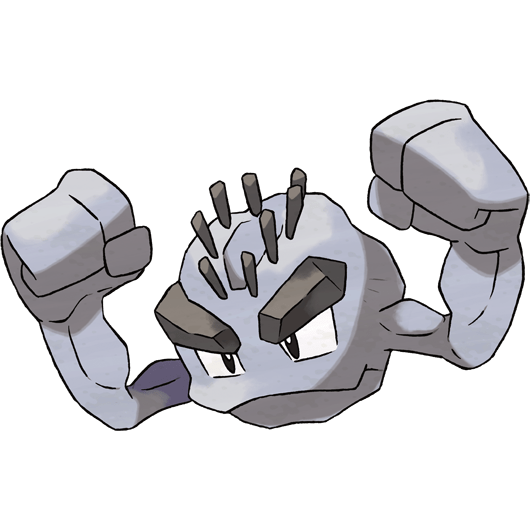
In the second instalment of my exploration of regional variant Pokémon, we’re going to deal with two Pokémon whose regional forms are related to Alola’s geology: Alolan Geodude/Graveler/Golem and Alolan Diglett/Dugtrio.  Geology, like archaeology and ecology, has always been in the background of Pokémon, but these games have never been the kind of stories that need a whole lot of scientific verisimilitude in those areas – or, to put it another way, who really gives a $#!t whether or not there are actually Cretaceous fossil deposits in the part of western France that corresponds to Ambrette Town?  I could tell you that I care, and you’d probably believe me because, frankly, I give off a certain vibe, but the truth is I haven’t looked it up, and I’m not going to.  Alola, in my opinion, cares more about the fact that it is Hawai‘i than any of the previous Pokémon regions cared about being each of those places, and at a guess maybe half of Alola’s new Pokémon are in some way influenced by that, but there are still limits – no one cares that there aren’t actually toucans or koalas in Hawai‘i, for instance, because Alola is also just a pastiche tropical paradise that should have whatever Pokémon, locations, characters and rocks seem fun.  Today we have one Pokémon that cares a lot about having a specifically Hawaiian inspiration, and another that takes a somewhat more casual approach – let’s talk about that.

Continue reading “Regional Variant Pokémon: Alolan Golem and Dugtrio”

Leo M. R. asks:

Did the concept of cousinhood exist in Ancient Greece? I JUST learned that Jason and Odysseus were cousins on their mothers’ sides (side note: their grandfather was a master thief?!), and I was wondering if this ever translated into the concept of kinship to the Greeks back then, and if it ever influenced why the two of them had notable similarities (like being known for legendary naval journeys and having flings with powerful sorceresses).

So, on the specifics of Jason and Odysseus: a lot of minor characters in Greek mythology have very different family trees depending on who you ask, and the mothers of Odysseus and Jason are very minor characters.  Our main source for Odysseus is, of course, Homer, and Homer says that Odysseus’ mother Anticleia is the daughter of the legendary thief king Autolycus.  Now, Homer was probably alive in the 8th or 7th century BC (side note: Homer isn’t real, Google “the Homeric Question” some time; it’s wild, but this is 100% not the time to litigate that $#!tstorm).  Our main source for Jason, on the other hand, is Apollonius Rhodius’ Argonautica, which was written in the 3rd century BC, centuries after Homer was dead in the ground (if he was real, which he wasn’t), and Apollonius says that Jason’s mother was Alcimede, the daughter of Clymene, who was herself the daughter of Minyas, the legendary king of Orchomenos – no mention of Autolycus.  In addition, though, we have the scholia to Apollonius, which are basically the margin notes made on the text by scholars in the Early Byzantine period (like, 5th to 8th centuries AD), and they are the ones who, quoting other texts now lost to us, give her name as either Polypheme or Theognete and claim she was the daughter of Autolycus.  I think the only primary text we actually have that backs this up is a 2nd century BC encyclopaedia of myth attributed to Apollodorus, but he gives yet another name for the mother, Polymede, and he probably got that from Hesiod, who gives that name in his Catalogue of Women but doesn’t explain who she is (at least not in the bits we have, because there is no complete text of the Catalogue of Women and we have to rely on quotations in other authors; are you beginning to appreciate the scope of the insanity we have to deal with here?) (side note: Catalogue of Women is an awful, awful title in the 21st century; it sounds like what a pickup artist calls his diary).

Continue reading “Leo M. R. asks:”

AceTrainerAlvaro asks:

IV-training and competitive battling aside, sometimes I feel training your Pokémon in battle is too straight-forward and controlled. I’d like to see a mechanic where even a wild-caught Pokémon occasionally disobeys its trainer’s command (maybe it “slacks off” or uses a different move altogether) or feels overwhelmed / flinches and returns to its Pokéball for an ally to replace it. And this becomes less likely the more trust (higher friendship value) a given Pokémon has towards its trainer until it fades away once High Friendship (value 200) is achieved. Keep in mind each Pokémon species is assigned a base friendship level when caught so disobedience could be more pronounced for certain species (which naturally feature a lower baseline friendship value when caught) than others. I’d especially like to see this play out in pseudo-legendary lines, legendary/mythical Pokémon, and maybe special versions of certain species – regardless of how many badges you have (obedience according to your number of collected badges could remain a separate mechanic specific to traded Pokémon).

Thoughts?

So, I think this changes the “vibe,” if you will, considerably.  I suspect if you just implement mechanics like this in the core Pokémon games as they currently exist, and don’t also add some kind of additional systems for developing your relationship with your Pokémon that come with associated benefits, players would unreservedly hate it.  It’s a whole extra mechanic standing between us and what we already understand to be “normal” battling, which makes the game much harder – but in a random and frustrating way, not in a way you can be strategic about.  I appreciate the goal here, making your friendships with your Pokémon something you really have to work at, but there’s got to be more to it, carrots and not just sticks, and ways of working around the disadvantages.

Having said all that, if you wanted to rebuild Pokémon to be a much more punishing and painful game all around – something in the spirit of the Nuzlocke challenge, for instance – this mechanic might be an interesting addition as it stands; something that will, from time to time, just randomly cause you to lose a Pokémon and force you to adapt to that loss. Throw in Nuzlocke staples like permanent death and limited, randomised Pokémon choice; reduce access to Pokémon Centres and sharply limit healing items (maybe lock high-quality healing behind some kind of crafting system); add some permanent debilitating conditions (so, like, less experienced Pokémon might disobey you, but more experienced Pokémon might also have picked up scars or developed phobias that give them specific weak points); remove some of the quality-of-life stuff from the last few generations like easy EV training methods… maybe then we’ve got a game on our hands. Either way, it’s got to be part of a package of mechanics with a definite theme and feel, is the point.