Zeraora

Zeraora.

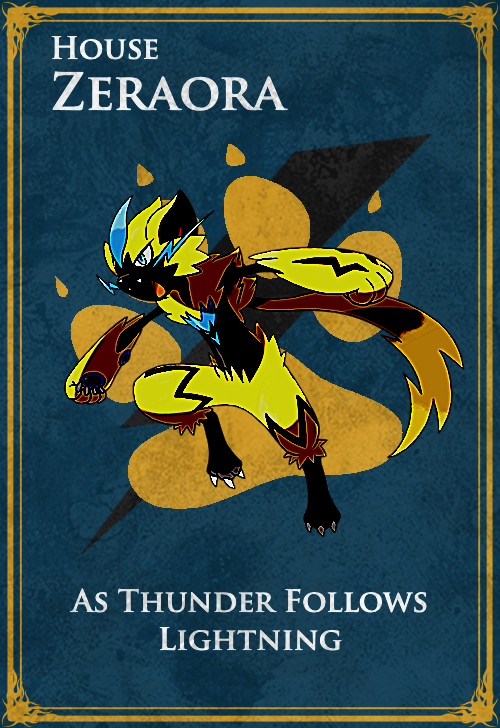
Eighty-four Pokémon down… three to go.  Today we’re looking at the Thunderclap Pokémon, Zeraora, the third of generation VII’s  mythical Pokémon.  As with Magearna and Marshadow, Zeraora doesn’t do anything of note in the games, but unlike them, its TV and movie appearances don’t hint at legendary origins or cosmic powers or forbidden ancient secrets or anything like that.  It’s really just a powerful and extremely rare Pokémon that kinda gets caught up in some $#!t, like Heatran, or (to some extent) Latias and Latios, or even Lucario in its movie debut.  Today we’ll look at how that happens – but first, a few words on Zeraora’s design and inspiration.

Continue reading “Zeraora”

Anonymous asks:

Re-reading your old Genesect review, I noticed “this doesn’t look like a Pokémon” was a complaint you had with it. Which got me wondering; are there any other cases of Pokémon that might have been better suited to being part of other IPs, free from the expectations and restrictions The Pokémon Company imposes on the franchise?

Uggggggggggghhhhhhh I knew I would have to deal with that one someday

even as I was writing it, all the way back in the Year of Our Magic Space-Deer two thousand and eleven, I knew I would eventually have to say something about it

So, just to cover my own butt for a minute, I’m going to point out that I prefaced that complaint with the words “I know this is a cheap shot and even thinking something so blatantly subjective makes me feel dirty inside.”  It’s a fairly drastic thing to say, and it’s not a comment I was willing to make about any other Pokémon in my reviews of generations V, VI or VII.  Anything older than that has had over 10 years to burrow into my conception of what a Pokémon is, so it’s difficult for me to separate them off anymore – even the ones I don’t like.  The only exceptions are some of the Ultra Beasts, and… well, in their case, not looking like Pokémon is kind of the point.

Having said that… well, when you mention being “free from expectations and restrictions,” there are a bunch of Pokémon, particularly in the Ghost-Dark-Psychic sort of area, which, while not exactly un-Pokémon-like, do feel a bit stifled by the kid-friendly ratings that Pokémon has to maintain.  You know what I mean, I suppose – Pokémon like Spiritomb, and Hypno, and Yamask, and Cacturne, and Shedinja, and so on, whose Pokédex entries hint at incredibly sinister abilities and behaviours that can’t be fully explored in official Pokémon media, because Pokémon has so much trouble with serious long-term consequences.  And of course there’s fan-fiction for that, but 98% of fan-fiction is either unfinished or terrible (or both, in the case of my dramatized Nuzlocke of X version). Still, that isn’t even really “these would be better if they were part of something other than Pokémon” as “I would like Pokémon to be something different.”

N asks:

Are bad dads a constant in the Pokémon Universe? Like i can’t remember for the life of me a single good father in the franchise. Hell, the entire plot of the Detective pickachu movie hinges on a son being unable to recognize his own father’s voice.

Well, I can think of… a couple of good dads: Professor Birch, in Ruby and Sapphire, seems to have a very strong relationship with his child, May/Brendan (whichever one isn’t the player character), while Norman, the player character’s father, is away all the time because he works in a different city but seems like a decent enough parent when we actually get to see him.  Bianca’s dad in Black and White… doesn’t really “get it,” but he’s at least trying not to be a $#!tty dad.

There is a standard explanation for this one, and there will always be one person who brings it up, which is: “absent fathers are a theme in Japanese fiction because Japanese fathers work 500 hours a day and are never around.”  That’s… true, and it explains a lot of the $#!ttiness of many Pokémon fathers – like Palmer in Diamond and Pearl being so distant from Barry, or Hau’s unnamed father in Sun and Moon being off in Kanto somewhere doing god knows what.  I think a lot of it really is just Pokémon’s own priorities, though, and a general lack of interest in the families of the player or other major characters (it would be fair to say, I think that the plots of these games are not what you’d call “character-driven”).  Like… fathers who are absent or distant because they work all the time are also a theme of American fiction; American fiction has practically created entire genres out of emotionally stunted men’s obsession with their $#!tty father figures.  But that’s not what the fathers of Pokémon’s main characters are like; they’re just not there, with no explanation and no relevance to anything.  Plenty of other characters have fathers who clearly exist, even if they’re not around very much or aren’t very good parents.  It’s also fairly common for both parents to be equally absent (as in Brock and Misty’s cases; I don’t think we ever meet Hau’s mother either).  I think the presence of the main character’s mother in each game is, in most cases, something of an admission that, at a bare minimum, it would be weird for a child to grow up completely alone.

Patch asks:

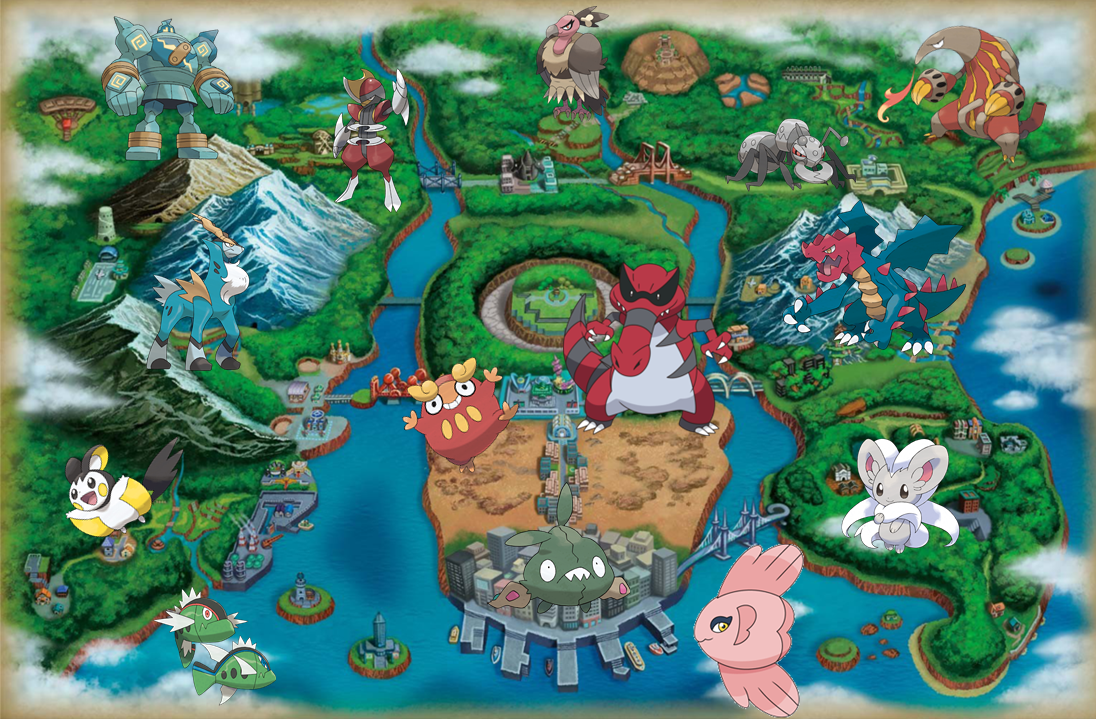
With regional variants no longer restricted to gen I Pokémon, it might be a good time to consider which of the Unovan Pokémon you rejected you would like to give a regional vatiant?

Hmmm… tricky…

There’s probably a fair bit you could do by building on the industrial revolution theme that some of the generation VIII material we’ve seen already seems to be going for.  I could see Heatmor getting some kind of region-specific evolution that builds up to a whole steam engine, maybe changing its type to Fire/Water or Fire/Steel (although the implied comparisons to Volcanion or Heatran would not be flattering).  Or even a Galarian form of… [ahem]… grbdr… that’s based on a sack of coal, making it a Fire/Poison-type that also gets Rock attacks.  Then, on another angle, we could have a Steel/Fairy form of Pawniard and Bisharp based on white pieces from the famous Lewis chess set from Mediaeval Scotland, to contrast the original black Unovan ones.  Possibly some sort of “royal” form for Swanna, but I’m not sure where exactly to take that.

Ashe asks:

You mentioned a while back that if you had your way, Pokémon would have less types, and Water would be one of the types on the chopping block. Can you elaborate more about which types you’d cut and why, and what would remain in your ideal type chart?

It goes through… iterations, depending on how much wild abandon I’m feeling from day to day, and what kind of scope I’m imagining for whatever hypothetical redesign of the Pokémon games that would give me this opportunity.  The common thread of my logic is that (contrary, I think, to a lot of fans) I don’t believe more types actually make the game better. Once you have about seven or eight you’ve probably already exhausted 90% of the strategic depth they add to the battle system (compare the TCG, which originally had just seven, although it was more or less forced to expand to eleven by the introduction of new types in generations II and VI, as well as the proliferation of Dragon-types starting in generation III). Having more just makes it harder to memorise all the relationships, and makes the game harder to get into. Like, I get it because I had the bulk of it seared into my impressionable child brain when I was nine, changes in generations II and VI notwithstanding, but if I picked up my first Pokémon game today, in my late 20s, I’m not sure I’d think that was worth my time (though I admit it helps that recent games in the core series display the type effectiveness of your moves against your opponents).  There’s an argument that more types enable a wider range of creature designs, but I think you can actually achieve the same result with fewer types more broadly defined. But let’s actually take a stab at answering this question.

Continue reading “Ashe asks:”

Spotlight Series: Unova Pokémon Reviews

It’s been a while since we here at Pokémaniacal introduced something new, but with the end of the Gen VII Pokédex in sight, we thought we might try something a little different and begin a spotlight series. This monthly series will take the form of a conversation or interview between Chris and I (Jim the Editor) around the subject of one of Chris’ past projects throughout the eight-year history of this blog. Of course, as good historians, all references to old works will be linked to so if you’re new to the blog, you won’t be left in the dark and can follow on with the loyal few who have followed us from BlogSpot, to Tumblr and finally to our new-ish home on WordPress. 

Now, before you stop reading and accuse us of just lazily pointing at old content in the ever-going quest for more clicks (I mean, yes, I’d be a liar if I said that wasn’t part of it), the real aim of this series is to allow us both – mainly Chris – to revisit some of his older works and address what /he/ liked about some of his older stuff, where his perspective has changed, and whether he might do things differently now. It’s a way of updating and revisiting some of the earlier stuff without having to trawl through each of the 2,237 posts on the site to date individually… Which I don’t think anyone wants. Anyway, without further ado, let’s get to it – please let us know what you think of our topic and this new series in the comments – be sure to include any old posts which you would like to see covered next! 

Continue reading “Spotlight Series: Unova Pokémon Reviews”