Jim the Editor asks:

How does the use of pokeballs by oranguru and their inherent empathy impact the pokemon training as enslavement argument?

So this is something that came up while Jim and I were proofing the Oranguru review, and frankly that was long enough already, so we decided it would be better to publish this separately in question-and-answer format. I haven’t talked directly about the whole Pokémon-and-slavery “thing” in a while, so to summarise my “standard” views on the subject (which are, of course, anything but standard): Continue reading “Jim the Editor asks:”

Anonymous asks:

Thoughts on the Pokemon Tree of Life? (Search on Reddit.) I just spent a good half hour marveling at how much work must have gone into it!

I’ve seen an earlier version, I think in generation V or VI. And, well, I can certainly appreciate the effort, and it is a beautiful thing in its own way. Sort of artistic, really. The trouble I have is that it almost certainly doesn’t work like that. Two kinds of animal that can breed to produce viable offspring (e.g. horse and donkey) almost have to be more closely related to one another than two that can’t (e.g. horse and goat). But here we get Pokémon that can breed with each other despite being from distant parts of the tree, like Tangrowth and Venusaur, and Pokémon that can’t breed with each other despite being adjacent on the tree, like Gardevoir and Medicham. Pokémon clearly don’t follow the real world’s rules of genetics, heredity and speciation; they can breed across species lines and they can inherit at least some acquired characteristics (Lamarckian evolutionists represent!). What that means is that, if it’s even possible to come up with a schema that represents the evolutionary relationships of all Pokémon in a consistent and meaningful way, it probably looks nothing like a real-world “tree of life” or cladogram. It’s… probably more of a Venn diagram situation. Or, like, a spirograph or something.

Oranguru

250px-765Oranguru.png
Oranguru

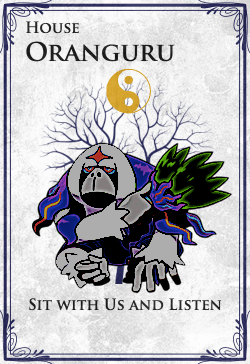
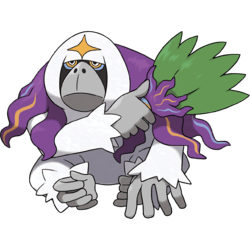
Making strange arguments and dubious assertions about Pokémon lore is an important branch of my schtick. Normally this comes up in questions addressed to this blog, or in whatever mad articles I decide to write in between generational Pokémon reviews, or occasionally in my musings on playthroughs of new games. It’s relatively unusual for a routine Pokémon review to provoke me to a really energetic bit of wild speculation. Luckily(?), however, today we have just the Pokémon to set me off: Oranguru. Continue reading “Oranguru”

Chris the Pokemaniac asks:

http://www.reddit.com/r/pokemonconspiracies/comments/999sk8/claydols_originsthe_first_alolans/

I think you’d like this one

Wait, wait, you- no, no, hang on, no, I’m Chris the Pokémaniac, that’s me! You’re not me!

…unless you’re… me from the future…? In which case you’re enacting the Sarpedon Contingency and you’re here to kill me… or you’ve promised your own soul to an eldritch entity from beyond the Seventh Veil and you’re here to kill me… or you’re from an alternate timeline that doesn’t have my recipe for sour cherry cheesecake and you’re here to kill me.

Well, whichever one it is, I guess I’d better answer the question.

“Hi, this a continuation of my theory Pokemon Cults, Infinite Energy and how it shaped the Pokemon World.

Ohhhhh boy, this again.

Continue reading “Chris the Pokemaniac asks:”

Wimpod and Golisopod

250px-767Wimpod.png
Wimpod

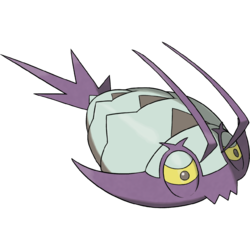
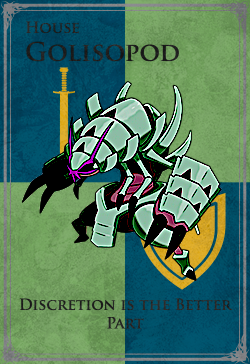
One of Pokémon’s grand traditions is Pokémon who are very difficult to train on account of their weakness, but evolve into very high-statted and powerful beasts. Magikarp is the classic example, practically unable to fight at all, with Feebas following very closely in the same mould. Larvesta and Noibat are better able to fend for themselves but take a very long time to evolve and are pretty pathetic until they do. It’s one of the most powerful expressions of Pokémon’s theme of nurturing leading to growth. Alola’s most traditional contribution to the list is really Cosmog, who is even worse than Magikarp until he suddenly isn’t, but we can also count the Turn Tail Pokémon, Wimpod, and its fearsome evolution Golisopod.

Continue reading “Wimpod and Golisopod”

hugh_donnetono asks:

Have you been watching the Pokémon Sun & Moon anime series? If so, what do you think of it?

Only a little, though I have been thinking about trying to remedy that soon (if only by making time for the episodes that feature whichever Pokémon I’m currently reviewing).  I think the idea of abandoning the “Pokémon journey” premise in favour of Ash attending Professor Kukui’s school is a welcome bit of experimentation.  I’m… not convinced by Ash’s new look, I’m afraid; it somehow feels to me as though his design has changed more than the show’s art style as a whole, and now he’s out of step with everything else.

[prayer circle for no more fire/fighting starters] asks:

i can’t remember (or find) if you’ve covered it before, but how do you think police and the criminal justice system works in the pokemon world works? we know there are police officers, but what do they do/what are they for when most of the populace seems to police themselves?

I’m not sure it necessarily needs to work any differently? Saying that the populace “police themselves” is something I would take with a grain of salt – the games probably give us a distorted view here, because the whole point of an adventure RPG is to let the player be the hero, even when that’s a little bit unrealistic or stretches what are supposed to be the normal rules of the setting. Just because we see preteen trainers stopping crimes and saving the world doesn’t mean that’s how they normally expect criminal justice to work! In the anime the Officers Jenny are pretty numerous and never seem to be hard-pressed to find something to do. I don’t think we ever see lawyers, and criminals tend to just get thrown in prison without a trial, but would an episode of the Pokémon anime really be improved by a five-minute scene where Jenny explains due process to Ash and his friends? Continue reading “[prayer circle for no more fire/fighting starters] asks:”

Comfey

250px-764Comfey.png
Comfey

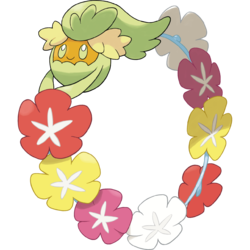
One of the most recognisable symbols of Hawaiian culture is the lei – a garland of flowers, worn around the neck on special occasions. If you’ve ever been to Hawai‘i, you might have been presented with one of these at some point; tourists love receiving lei, and Hawai‘i loves tourists. You can also see them in the stereotypical image of a traditional Hawaiian hula dancer. Lei are so well known as a distinctive element of Hawaiian ceremony and celebration that, really, it would be almost impossible for our Hawai‘i-inspired Pokémon region not to have a Pokémon that referenced them somehow. Enter: Comfey, the Posy Picker Pokémon. Continue reading “Comfey”