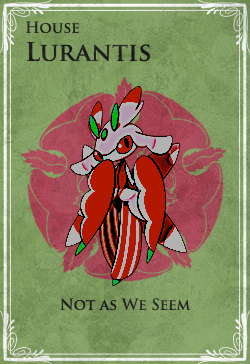
House Lurantis: Not as We Seem

One lunatic's love-hate relationship with the Pokémon franchise, and his addled musings on its rights, wrongs, ins and outs. Come one, come all, and indulge my delusions of grandeur as I inflict my opinions on anyone within shouting distance.
House Lurantis: Not as We Seem
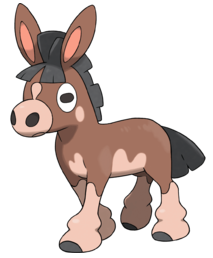
Jim the Editor and I had an American friend once who, while on an archaeological dig in Italy, famously infuriated an old Italian man to the point of explosive outrage by repeatedly addressing a dog “ciao, burro” – burro being (as our friend well knew) the Spanish word for donkey, and therefore already a rather silly thing to say to an Italian dog. Even worse, though, burro is also the Italian word for butter, so an onlooker could forgiven for thinking that someone saying “ciao, burro” to a dog is completely insane. Years later, this event has only two substantial legacies: first, that Jim now feels compelled to address all dogs “ciao, burro,” and second, that my Mudsdale now has the dreadful misfortune of being named “Butter.”
Let’s talk about Mudbray and Mudsdale.
To start with the obvious: Mudbray is a donkey, and Mudsdale is a horse. The two species are actually about as distant from one another as horses are from zebras (which get to be their own Pokémon), but I suppose donkeys are not exactly among the most fascinatingly exotic animals in the world, so it’s understandable that for Pokémon’s purposes they would get lumped in with horses as a “close enough.” Donkeys are proverbially known as stubborn animals, because they have very different fear responses to horses – horses bolt when frightened, but donkeys freeze, and usually give very few external cues to express their discomfort, so someone who only knows horses will often think a startled or cautious donkey is being “stubborn” by refusing to move. You could probably ask, fairly, whether the same might be true of Mudbray, who merits a description by the Pokédex as “stubborn” and “individualistic” (unlike horses, donkeys are not naturally herd animals) – maybe that reputation comes from inexperienced trainers who haven’t been taught how to handle them. Mudbray’s… honestly quite disturbing… blank-looking round eyes are probably meant to reinforce this aspect of her personality, making her look a bit vacant and detached – although the unnerving oblong pupils seem to be based on the appearance of a real equine eye. On account of the rough terrain of their natural habitats, where strength matters more than speed, donkeys are actually stronger for their size than horses. In Mudbray’s case, this translates to a carrying capacity of “50 times its own body weight” – over 5 tonnes. As usual, it’s probably best to think of numbers in the Pokédex as more illustrative than literal – even if a Mudbray might not actually be able to support the weight of a fully grown African elephant, after seeing one in action you might believe it.
Continue reading “Mudbray and Mudsdale”Alternative explanation to why Wishi Washi is allowed to cheat (which is more funny than serious): No one wants to argue with the eldritch horror of the deep. Although I wonder what the rules are in double battles when the trainer’s Wishi Washi joins the rival Wishi Washi’s school. Or maybe there’s a sort of exception for Pokemon like Vespiqueen where it’s just a biological mechanism or something like that. I would say maybe we’re just overthinking it, but overthinking’s where all the fun is.
Maybe there are some Pokémon that are just usually trained by lawyers because they’re the only ones who can keep track of the rules. Continue reading “Anonymous asks:”

Today we come to the newest iteration of mushroom Pokémon: the tall, slim-stalked, luminous Morelull and Shiinotic. Morelull and Shiinotic have an uphill battle to make themselves unique and interesting, as the fourth set mushroom Pokémon after Paras and Parasect (interesting by reason of soulless parasitism), Shroomish and Breloom (interesting by reason of kick-boxing dinosaurs), and Foonguss and Amoonguss (interesting by reason of… um… stealing Voltorb’s schtick in a way that somehow makes even less sense). These latest versions… well, I mean, they give it a go. Continue reading “Morelull and Shiinotic”
They’ll have to make obtaining Alolan forms outside of Alola possible. Although here’s a question I have for you, do you think it’s possible that the Pikachu line is native to Alola? And that Raichu is meant to be a psychic type when it evolves, but without it’s Alolan Diet, ends up being a pure electric type instead?
I’m sure they’ll be obtainable in some way, yeah, same as the regular “Kantonian” morphs are obtainable in Sun and Moon. But that’s not at all the same thing as finding them in the wild with no explanation for how they got there when they’ve previously been specifically described as unique to Alola.
Anyway. Pikachu and Raichu. Unclear. The Pokédex tells us that diet triggers the manifestation of Raichu’s psychic abilities, but doesn’t really give us anything either way on which evolutionary path is the “original” one. Thinking in terms of Alola being an analogue to Hawai’i I’m inclined to see rodent-like Pokémon like Pikachu as introduced by humans, but potentially quite a long time ago – long enough to have adapted in surprising ways to their new environment. On the other hand, we know from direct empirical evidence that all Pikachu, regardless of their origin – Kantonian, Kalosian, everything in between – become psychic Raichu if they evolve in Alola (the only other Alolan form that works this way is Marowak, and that might literally be magic [EDIT: Also Exeggutor]). If we assume something resembling a real-world understanding of genetics and evolution, then that suggests that the psychic abilities are a dormant ancestral trait, present in all Pikachu but requiring some environmental stimulus to activate. Buuut it could also be that components of Pikachu’s Alolan diet – or even something else about Alola – are somehow mutagenic (or some mystical equivalent), and alter their genetics and powers in predictable ways. Or it could be that, as I’m inclined to think for Marowak, there’s no genetic component at all and instead there are Alolan traditions that allow them, basically, to learn magic (because, like Marowak, the Alolan Raichu form is associated closely with a particular cultural practice – namely, surfing). I actually had a massive argument with Jim the Editor over this one. He thinks that the Pokédex must be wrong about diet being a factor, since Pikachu can evolve into Alolan Raichu after spending literally minutes in Alola and without eating anything; I think that this is an edge case that doesn’t reflect the designers’ intent, and is a result of Pokémon’s mechanics for time and eating being extremely unrealistic. Also his interpretation doesn’t really suggest any other answer for why it happens other than Alola being surrounded by a magic field that gives Pikachu psychic powers for some reason. Basically he thinks that if the designers had meant for Pikachu’s diet to be a factor, they should have represented that with a change in the evolution method (he suggests an item called a Thunderstone Cake, or something similar).
So I’m a solid “maybe” on this one.
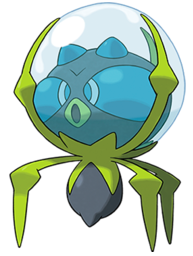
Sometimes, we all need more spiders in our lives. Spiders kill flies and mosquitos, keep the streets of New York safe from techno-goblins and octopus-physicists, rescue intelligent piglets from the slaughterhouse with their whimsical web messages, and keep you from getting hungry at night by crawling into your mouth while you sleep. Game Freak, bless their hearts, recognise the importance of spiders, and periodically give us more. Thus, today, we come to Dewpider and Araquanid, the alien bubble spiders of doom… Continue reading “Dewpider and Araquanid”
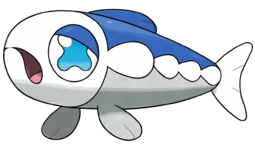
One of my favourite sequences in the whole of the original Sun and Moon was Lana’s Water trial on Akala Island, which introduces Wishiwashi: a small, very weak and actually rather pathetic-looking fish Pokémon with apparently no special powers. Before you actually enter the trial grounds, Lana leads you through Brooklet Hill to investigate several commotions taking place in the area’s many pools. Each is apparently caused by a group of Wishiwashi, most of which flee at your approach, leaving one behind to take the rap, but if you catch one, you’ll get some hint of what’s going on by reading the text of its Schooling ability. The further you go, the larger the splashes in the pools become, slowly building a sense of menace around whatever it is you’re following, and Lana starts dropping hints about a powerful Pokémon that must be causing everything, even telling you at one point that Kyogre is said to live in Brooklet Hill. Continue reading “Wishiwashi”
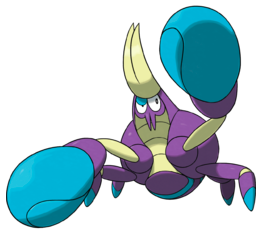
Today I would like to talk to you about crabs: specifically, Crabrawler and the delightfully named Crabominable (seriously, can we just take a minute to appreciate the wonderful tumbling rhythm of that name?). In the process of writing this piece, I have learned (because learning obscure and not particularly useful zoological trivia is just part of what I do here) that evolution just really likes crabs for some reason, and consequently keeps trying to turn other random animals into crabs with mixed results, a process known as carcinisation. Crabs have apparently evolved at least five separate times, from a variety of starting points (giving rise, surprisingly, to only two Pokémon before now: Kingler and Crustle, Crawdaunt being a lobster). On the basis of this vague half-substantiated piece of pseudo-knowledge, I have decided that crabs are the ultimate form of life, to which all other species aspire. Of course, Crabrawler and Crabominable have the advantage of already being there – so let’s see what the apex of all biological life has to offer the Alola region. Continue reading “Crabrawler and Crabominable”
Today’s Pokémon are… not bees. We think.

As their species designation – the Bee Fly Pokémon – attests, Cutiefly and Ribombee are based (in Ribombee’s case, somewhat loosely and with the addition of fairy-like traits) on bee flies. Bee flies, as their remarkably inventive name suggests, are a family of insects within the fly order, Diptera, that pollinate flowers and look like bees, though they are usually smaller. They are related to predatory robber flies, and despite their fuzzy appearance, most bee flies are parasites that will lay their eggs on the larvae of other insects, typically beetles or solitary bees, resulting in the slow and gruesome death of the larvae. There are over 5000 species of bee fly around the world (because clearly the world needed that many), but the particular one referenced by Cutiefly is the adorable internet celebrity Anastoechus nitidulus, a rare species that lives only in southwest Japan, in the area around the city of Okayama. As far as I can tell, this species is so rare, and bee flies in general are so poorly studied by entomologists, that it doesn’t even have an English name – I’ve seen them called “tiger bee flies,” which I think is an attempt to translate the Japanese name toratsuri-abu, but in English the name “tiger bee fly” ought to refer to a different species of bee fly, the larger, blacker and more sinister-looking Xenox tigrinus, which can be found throughout North America. Thankfully, Cutiefly already represents a fully adult bee fly, so we don’t have to observe first hand the family’s parasitic tendencies; instead we see only the adults’ more palatable diet of nectar, which they harvest with their mosquito-like proboscises. Cutiefly and Ribombee express this through their flavour text, through the Honey Gather ability they share with Combee, and through their in-game distribution in the areas in and around Alola’s Oricorio meadows.
Continue reading “Cutiefly and Ribombee”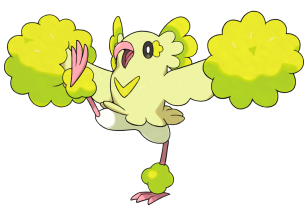
I do not have a good record with anything capable of earning the title of “gimmick” Pokémon – Pokémon whose schtick is some unique move, ability or game mechanic that was so clever Game Freak felt they could stop there, and didn’t need to have the Pokémon be any good or the design make any sense. Today we decide whether Oricorio, the dancing honeycreeper Pokémon, fits that description. Four interchangeable and mostly cosmetic forms, a weird signature move, a weirder ability… the phrase “walks like a duck, quacks like a duck” comes to mind, but let’s take a closer look. Continue reading “Oricorio”
 Pokémaniacal