
Today on Pokémaniacal I’m looking at Tony Stark, better known as Iron Man, a Marvel Comics superhero who made his debut appearance in 1963 and has since-
…I’m sorry, I seem to have wandered into the wrong blog. Normally I do Pokémon stuff.
Oh, really? Huh.
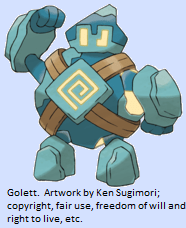 *Ahem* Today on Pokémaniacal I’m looking at Golett and Golurk, the automaton Pokémon. These two are based on golems (as distinct from Golem, the evolved form of Graveler), humanoid guardian creatures from Jewish folklore originally associated with the city of Prague, which have since worked their way into a number of high fantasy settings as the magical equivalent to robots. Nowadays golems can be constructed from just about any material you care to name, the more outlandish the better, but as Ground-types Golett and Golurk seem to follow the original in being made primarily out of clay. They are likewise believed to have been created by ancient people to act as protectors (goodness knows how the things are still around after all this time). So far, so good. Continue reading “Golett and Golurk”

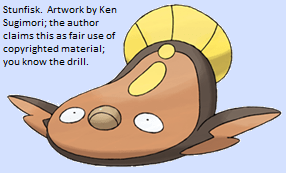 This one is tricky; I’m not sure whether to love it or hate it… Today I’m looking at Stunfisk, the trap Pokémon, a flat-bodied bottom-dweller with a penchant for frying anything unlucky enough to step on him. My first thought was that Stunfisk is pretty clearly based on a perfectly ordinary flatfish like a flounder or plaice, but with added lightning because everything is better with lightning (kind of arbitrary, but also fun). I have since learned, however, that there are actually fish, called stargazers (so named because their eyes, like a flounder’s, are on the tops of their heads), which behave in more or less the same way as flounders – they spend most of their time half-buried on the seafloor, waiting for prey to stumble across them – but can also produce electrical current in much the same way as an electric eel.
 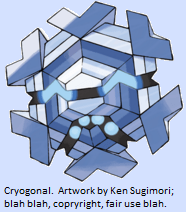 Ice is one of the more underrepresented elements in Pokémon: the original games had only five Ice-types (Articuno, Jynx, Dewgong, Lapras and Cloyster), single-typed Ice Pokémon didn’t exist until Snorunt, Glalie and Regice in Ruby and Sapphire, and even now, with more than six hundred Pokémon in the game, fewer than thirty of them are Ice-types. Black and White have made two valiant efforts already to expand the number of pure Ice-types but have failed to impress me, producing Beartic and Vanilluxe. Well, third time’s the charm, so they say, so let’s have a look at Cryogonal, the crystallising Pokémon.
 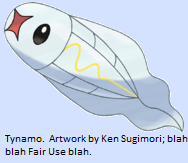 Today’s Pokémon are the latest addition to the stable of Electric Pokémon: Tynamo, Eelektrik and Eelektross. These ugly-looking things are the misbegotten spawn of two similar-looking but very distinct creatures: the electric eel (which isn’t really an eel at all, phylogenetically speaking) and the lamprey (which isn’t an eel either but looks like it should be). Tynamo are about as close as you get to Magikarp in Black and White: they’re distinctly based on larval eels and they’re extremely weak on their own (but can co-operate to produce more powerful attacks). This is aptly reflected in their total inability to learn any attacks aside from the ones they start with: Tackle, Thunder Wave, Charge Beam and Spark.
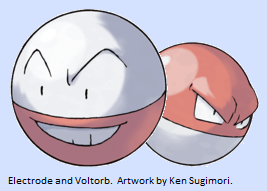
 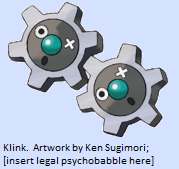 Pokémon, it is known, may not all be completely natural; many owe their existence to human activity in the last few centuries. Voltorb and Electrode, whose bodies are modelled on Pokéballs, are almost certainly artificial in some way. Grimer and Muk were born from the toxic waste of human industrialisation. Magnemite and Magneton certainly seem artificial but their true nature is extremely mysterious. Today’s Pokémon, Klink, Klang and Klinklang, continue the theme. These bizarre Steel-type Pokémon seem to be entirely mechanical and evolve by adding on extra components. The resident Professor Tree of the Unova region, Professor Juniper, investigates Klink during the course of the game and determines that they did not exist in Unova more than one hundred years ago, when they appeared suddenly in an area called the Chargestone Cave. How she can possibly have figured this out is beyond me, but (in fairness to Aurea Juniper) she’s probably the least incompetent of the regional professors to date, so I’m inclined to take her word for it.
  Oh, hey, a Pokéball.
 Today’s Pokémon are Foongus and Amoonguss (and yes, I knew what the adult form was going to be called as soon as I met the juvenile).
 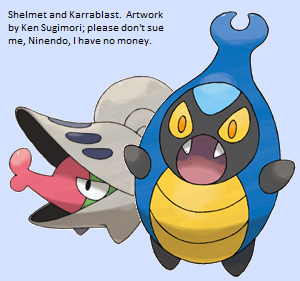 I mentioned recently that it’s been a good year for Bug Pokémon, and it continues to be… well, interesting at least… with these curious specimens: Karrablast, Escavalier, Shelmet and Accelgor. Shelmet is a fairly unexciting pink snail-like Pokémon that lives inside a helmet and sprays acid when people bother it, and Karrablast is an utterly unremarkable horned beetle that… sprays acid when people bother it. Things get interesting when we put them together. When Karrablast and Shelmet are “bathed in an electric-like energy together” (obfuscating Pokédex-speak for “when you trade a Karrablast for a Shelmet”) both of them evolve in a rather unusual way: Karrablast swipes Shelmet’s armour.
 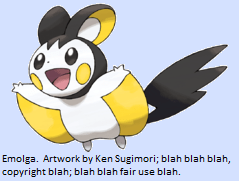 My next Pokémon is Emolga, the cute electrical rodent Pokémon. Yes, you’re experiencing déjà vu for a reason. It’s a glitch in Game Freak’s design process; it happens when they change nothing. Because, yes, this is exactly what you think it is: a flying Pikachu.
 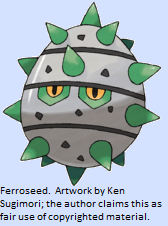 Today’s Pokémon are Ferroseed and Ferrothorn, the… uh… the… spiky… metal… plant-things…
 Pokémaniacal