
This must be the weirdest concept for a Pokémon ever.
Well, okay, Deoxys is a shapeshifting psychic virus from space, that’s pretty weird. And Mawile is some kind of metallic rabbit-thing with a huge pair of jaws growing out of the back of its head. And Breloom is an overgrown mushroom that punches things. And Garchomp is a shark with arms, legs, claws and armour spikes. That flies.
…what the hell kind of game am I playing here anyway?

Even so, Solosis is an odd idea. He’s… well, a cell. Some kind of nucleus-type structure, suspended in a mysterious green fluid that shields his delicate body from the elements, with almost no discernable anatomical features. Continue reading “Solosis, Duosion and Reuniclus”
 This has been a good year for Bug Pokémon. Black and White introduced Leavanny and Scolipede, who, despite not being remarkably powerful, finally banished the unfortunate cliché of Bug-types that appear early in the game, evolve quickly, peak early, and ultimately prove useless. So far, I’ve also looked at the bizarre but surprisingly intriguing Crustle and the awe-inspiring solar moth, Volcarona, both fun and powerful additions to the Bug-type hive. Like Volcarona, the Pokémon I’m looking at today – Joltik and Galvantula – draw much of their uniqueness from something very simple, a new type combination: Bug/Electric.
  Time to bring out the big guns. Dragon Pokémon have always had a reputation for being among the roughest, toughest, most ornery Pokémon around, and my subjects today are no exception. Axew, Fraxure and Haxorus are territorial Pokémon that fight with pairs of massive tusks shaped like the blades of a double-axe, which grow harder, sharper and more powerful as they evolve, chopping through first wood, then rock, then steel. Oddly enough, Axew’s tusks quickly regenerate when broken, but Fraxure’s will not (presumably Haxorus’ won’t either, but since the Pokédex is silent on that question it’s entirely possible that there’s never been a recorded instance of a Haxorus’ tusk breaking in the first place). I doubt that’s a mistake; even I give Game Freak more credit than that, but I’m not sure what, if anything, it’s supposed to imply; maybe Axew have greater vitality because of their youth?
 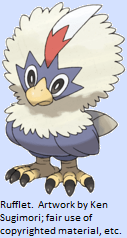 Oh look. Another bird Pokémon. Whoo. I am ecstatic. Can you tell?
 Two more bird Pokémon enter the fray, these ones based on the humble duck and regal swan. Are they interesting? Probably not? Are they powerful? I doubt it. Do I like them? Heck no, but let’s look at them anyway.
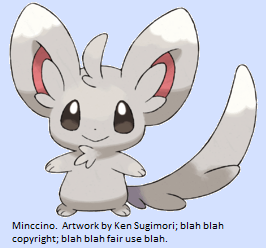 Today’s Pokémon are Game Freak’s most recent addition to the “cute fuzzy Normal-type” pool: Minccino and Cinccino, the chinchilla Pokémon. Now, I’ve expressed irritation in the past that there were already quite enough of these, and summarily executed Audino on those grounds since, let’s face it, she’s Chansey 2.0. Minccino’s odds are, to put it mildly, not looking good.
 …okay, fine. Today’s Pokémon is Alomomola, who, to practically everyone’s disappointment and against all logic, is not the evolved form of Luvdisc.
  Today’s Pokémon comes straight from Roswell, New Mexico, where they don’t know what to do with him either. Meet Elgyem, the… well, the LGM (Little Green Man) Pokémon.
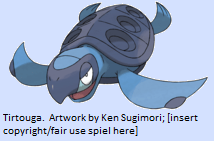 I need to be up-front with you about this one. I really like Tirtouga and Carracosta. These turtle Pokémon are two of the fossil species of Black and White (the other two are Archen and Archeops, whom I talked about ages ago and allowed to live – perhaps a little generously) and the latest in a long line of prehistoric Pokémon resurrected by the miracle of SCIENCE. I think the artistic designs for Tirtouga and Carracosta are superb; Tirtouga is cute but also clearly strong enough to take care of himself, and Carracosta practically dares you to try attacking him. Both channel the “ancient” quality fossil Pokémon are supposed to possess exceptionally well. As well as having typical sea turtle qualities, like being able to safely dive to tremendous depths, they seem to be part-way through evolution into terrestrial turtles and can hunt prey on land as well.
  Pokémaniacal