Moves, Movepools and Flavour

Pokémon are, almost by definition, creatures with incredible abilities, often ones which exceed the boundaries of what we believe to be possible.  Normally I like to make a fuss of the aspects of the Pokémon world that have nothing to do with the powers, like history and ethics and society and culture and all the rest, but let’s face it, I’m at least partly in it for the thrill of having a flying murder-dragon with four different kinds of exploding death lasers.  What you can do and what you can’t is fundamentally a part of who you are, and what Pokémon can and can’t do is expressed in the games through their stats, their abilities, and in perhaps the greatest variety through their moves.  I like to say that Pokémon “should be good at the things they’re good at” – that is, they should possess the skills we would expect them to, based on their designs, and those skills should in turn contribute to the way we see them and use them.  Mechanics and flavour should work together – well, at least that’s what I think.  Let’s talk about how that works (or fails to).

As of the release of X and Y, there are 609 moves in the Pokémon games: 609 effects which are available in various combinations to different species.  Some are basic, and others are complicated.  Some are effective in a wide variety of situations, others require a great deal of forethought to be useful at all (with varying degrees of payoff).  Some are powerful, others are weak.  Some are available to many Pokémon, or to almost all of them, others to only one or two.  All of them say something about the Pokémon capable of using them – and that includes the ones that would never see any use competitively, or even in a normal playthrough!  Let’s take as our first example the unanimously agreed worst move of all: Splash, which has no effect whatsoever, and is useful only in the most contrived of situations (say, if your opponent is trying to stall you down to Struggle, and Splash’s 40 PP allow you to sit on your butt for longer without running out of moves, or something).  For all that, only a handful of Pokémon are actually able to learn this non-technique; indeed in Red and Blue it was unique to Magikarp, hailed in-universe as the weakest Pokémon of all – the only one so pathetic it had a move that allowed it to flop around doing absolutely nothing.  Since then the move has been bestowed (either as a level-up move or a hereditary one) upon Poliwag, Horsea, Hoppip, Cleffa, Delibird, Azurill, Wailmer, Spoink, Feebas, Wynaut, Luvdisc, Buneary, Finneon, Mantyke and Clauncher.  What is the common thread with these Pokémon?  Like Magikarp, some of them are portrayed as being particularly helpless, like Poliwag, who can barely walk on land, Hoppip, at the mercy of the breeze, Wynaut, whose evolved form is unable to take spontaneous action, or Spoink, whose heart actually stops if he doesn’t continually keep bouncing around uselessly.  Most of them are on the cute end of the spectrum as well, adding to the impression of vulnerability.  The enduring message is that these are Pokémon who require particular nurturing and attention in order to grow and succeed (although they won’t necessarily be helpless forever – Gyarados certainly proves that, as does Kingdra).  One of these things is not like the others, though – what’s Clauncher doing on this list?  To me, the fact that Clauncher starts with Splash conveys a certain weakness that would not otherwise be immediately apparent from his design – and it’s not entirely inappropriate, since he isn’t exactly a physically imposing Pokémon.  I would also suggest a link with the fact that Clauncher is incapable of learning many of Clawitzer’s most powerful attacks, like Dark Pulse and Aura Sphere; more than most Pokémon, he has a lot of growing to do, and is especially vulnerable in his infancy.

X and Y added a lot of moves with very specific uses; in particular, there are a number of support moves which seem like they would only be useful in a triple battle, and only then with a fair amount of planning.  Take Rototiller, for instance, which raises the attack and special attack of all Grass Pokémon in battle.  To begin with, only two Grass Pokémon – Paras and Cacnea – are capable of learning this move (and even them by chain-breeding via Buneary), so for most Pokémon it can only be useful in a double battle.  Even then, a Rototiller boost is functionally equivalent to the boost provided by Growth… which, y’know, most Grass Pokémon can learn… so really in order to get the proper bang for your buck you want to set things up in a triple battle so that two Grass Pokémon at once are getting the bonus.  As contrived a situation as it takes to make Rototiller useful (and believe me, as a card-carrying Grass Pokémon Master, my next project is to contrive the heck out of it for a Battle Maison triples team), as a move that expands what we know about the Pokémon who learn it, it’s solid gold, because it conveys the ecological function that the Pokémon who possess it – Sandshrew, Dugtrio, Onix, Rhyhorn, Linoone, Bibarel, Lopunny, Watchog, Excadrill, Dwebble and Diggersby – have in aerating soil and helping plants grow.  In the case of Dugtrio and Excadrill, we knew that already, but for the others it’s neat new information (although one does wonder how important a desert Pokémon like Sandshrew would be in that capacity).  For a Pokémon like Rhyhorn, who doesn’t really dig tunnels habitually, it even prompts me to imagine early human farmers hitching up their first rudimentary ploughs to domesticated Rhyhorn.  Another bizarre little trick is Vivillon’s signature move, Powder, a priority attack that causes a Pokémon to explode and take damage if it tries to use a Fire attack during that turn.  There are numerous disadvantages here – 1) you have to predict an incoming Fire attack, 2) it’s unlikely to work more than once in a battle, especially given that Vivillon’s defences are so bad it doesn’t really take a super-effective attack to bring her down, and 3) it requires you to actually use Vivillon in the first place.  On the other hand, I feel like all that is totally worth it to see an attack backfire in such a spectacular fashion, and it does establish Vivillon as a clever, tricky Pokémon who will take no $#!t from anyone.  Probably my single favourite ‘WTF’ attack in X and Y is Ion Deluge, another priority technique which turns all Normal attacks used that turn into Electric attacks.  Again, it seems like this could only be useful in double or triple battles, because although most of the Pokémon that learn it do have some kind of ability that lets them absorb Electric attacks, you still have to predict an incoming Normal attack, and even then the benefit you get is not huge.  Even in doubles or triples, I have difficulty imagining a situation (let alone thinking of a reliable way to set one up) where it would not be equally useful just to… y’know… use an Electric attack, something all Pokémon with Ion Deluge can do.  I’m not sure what kind of ‘characterisation’ Ion Deluge is supposed to create either, which is a shame.

Other times, we get Pokémon whose techniques conspicuously fail to express what they’re supposedly all about.  My favourite example is probably Gigalith, whose ‘thing’ is his ability to store, magnify and direct solar energy using the crystals on his body, creating devastating blast attacks that can destroy mountains.  Great, except that Gigalith needs a TM to learn Solar Beam, and has a very discouraging special attack stat to back it up.  Drowzee and Hypno, famously, still require human intervention to learn Dream Eater after all these years, despite the fact that eating dreams is literally how they survive.  In Red and Blue this almost made sense because the Dream Eater TM could only be used by Hypno, Gengar and Mew anyway, so it was sort of an unlockable signature move like Softboiled (which no Pokémon learned on its own, but could be taught to Chansey with TM 41).  Now, though, there are literally hundreds of Pokémon, including some who can’t even induce sleep like Ambipom, Lickilicky and Aurorus, who are just as good at eating dreams as the dream-eater Pokémon themselves.  Just as strange is Sceptile, introduced in the last generation before moves started to be assigned “physical” or “special” individually rather than by type.  By now, Game Freak had gotten the hang of the way their own system worked.  Sceptile seems like a physical Pokémon but, like poor Feraligatr, all his best flavour-appropriate attacks – Leaf Blade, Dragon Claw and Crunch – were special, so they made Sceptile a special attacker.  Things became very weird when Diamond and Pearl rolled around, though; all Sceptile’s favourite moves were suddenly keyed to the wrong stat.  As a result, he now favours Dragon Pulse, Focus Blast and Leaf Storm, and is actually quite bad at using his own signature move.  Would it not have made more sense if, when Sceptile’s entire movepool flipped from special to physical, he had flipped with it?  A happier example is Lickitung, whose key characteristic is his enormous tongue.  The obvious problem with Lickitung, in the mad old days of Red and Blue, was that he couldn’t actually learn Lick.  The interesting problem was that although he got Lick in Gold and Silver, it was much longer before he gained effective attacks that could be visualised as using his tongue.  Slam was his mainstay from the beginning, but Slam is terrible.  Wrap, which he got in Gold and Silver, is scarcely worth mentioning.  Knock Off in Ruby and Sapphire was an improvement, but it was really Diamond and Pearl that gave Lickitung and Lickilicky properly useful attacks that fit the way we’re supposed to imagine them fighting: Power Whip and Wring Out, which relatively few other Pokémon learn.  They’re not the best attacks around, but both can argue for a place on a serious moveset, and they provide a good example of updating an old Pokémon in an appropriate and interesting way.

Then there are attacks that everything learns, or almost everything, at any rate: Hyper Beam, the ultimate expression of a fully-evolved Pokémon’s might, Protect, the standard “no” technique, and Hidden Power, whose universal availability hints at a kind of soul energy that can be drawn upon by all living things.  There are also things which are… harder to explain or justify.  All Pokémon can learn Toxic.  What?  I’ve actually been asked to explain this before, and settled on the idea that since Toxic is supposed to be a ninja technique – that is, a human technique – it probably uses principles that are accessible to humans, and to all Pokémon.  Pokémon who’ve been taught Toxic can recognise, collect, store, and use poisonous substances that they might not actually be able to secrete on their own.  A bit unfortunate, perhaps, for the poor Poison-types, who have to live down the fact that their most powerful ability is available to nearly every Pokémon in existence, but at least X and Y threw them a bone by giving Toxic perfect accuracy when used by a Poison Pokémon.  It gets worse, though; most Pokémon can create illusionary duplicates of themselves, with varying degrees of substance – almost all can learn Double Team and Substitute.  Weather manipulation, too, is shockingly common; Sunny Day and Rain Dance are normally denied only to Pokémon who would specifically be disadvantaged by them in some way.  I have to imagine that, in all but a few cases, these techniques are more like prayers (to Groudon or Kyogre?) than actual exercises of a Pokémon’s own powers – think of the connotations that the phrase “rain dance” has in English, and the fact that Rain Dance’s Japanese name, Amagoi, refers to a prayer for rain – while the rarer and seemingly effortless Drought and Drizzle abilities imply a real connection with the weather on some level.

Other moves available by TM are not quite so universal, but in general they are still far more often seen than most Pokémon techniques.  Many of these are go-to attacks for competitive movesets – staples like Thunderbolt, Ice Beam, and Surf.  Being so widely available means that these moves don’t tell us all that much about the specific Pokémon who learn them, but their prominence in strategy means that they contribute something to how the types themselves are portrayed.  When we think of the Ground type, for instance, we don’t just think of Ground-type Pokémon – we think of the ubiquitous Earthquake, one of the best physical attacks in the game.  When we think of Fire, we think of Flamethrower, but also of Fire Blast, which, being more accurate than Thunder or Blizzard and often a better choice than Flamethrower, is much more likely to come to mind than its Ice or Electric equivalents, so that Fire becomes a type associated with overwhelming power (Overheat only adds to the effect – Grass has an equivalent attack, Leaf Storm, but very few Pokémon can learn it, while Overheat is widely available).  The closest thing Psychic has to a go-to physical attack isn’t a physical attack at all, but a special attack which hits the target’s physical defence, Psyshock, thus reinforcing the typical view that Psychic types do not rely on their bodily strength.  Conversely, Rock has no common special attack at all.  The popularity of U-Turn and Volt Switch, accessible to many Pokémon through TMs, links Bug and Electric with speed, cleverness and changeability.  Sometimes I am concerned that the steady proliferation of techniques with every generation will eventually erode the differences between the types completely; we’re moving steadily closer to a situation where every type has both a physical and a special attack with a power rating of 80-90 and 100% accuracy, which would rather be throwing the baby out with the bathwater as far as establishing balance.  On the other hand, if only a few Pokémon get to flout the stereotypes of their elements – like Lucario and Beartic do, like Gigalith could have – then what we’re really getting is opportunities for specific Pokémon to be awesome in specific ways, which is the primary virtue that should be kept in mind here.

Finally, since we’re talking about TMs, we inevitably come to my pet hate, a move that not everything can learn, by any stretch of the imagination, but available to a truly bizarre selection of Pokémon who seem as though they should have no business learning it: Aerial Ace.  I offer first the usual disclaimer: I know Aerial Ace in Japanese is called “Turning Swallow Cut” and is named after an old katana technique.  Fine.  I have no problem with this move being available to Pokémon who can’t fly.  However.  The move’s description implies that it involves great speed and agility, which is why it never misses.  Also, it’s a Flying-type move and the Pokémon who learn it on their own are mostly birds, continuing that theme (the exceptions being Heracross, who can fly, Honedge, who is a living sword, and Gogoat, who… um… yeah, I got nothing).  And indeed, many of the Pokémon who learn it out of TM 40, as well as favouring cutting or slashing attacks, possess either great speed or flight… but then there’s Slaking.  Bouffalant.  Tyranitar.  Shelgon.  Ferrothorn.  Mr. Mime.  Crustle.  Aggron.  Regigigas, of all things.

And, of course, my favourite: Slowbro, but not Slowking.

Mechanically, very little separates Slowbro and Slowking.  Slowking’s special defence is higher, and he can learn Nasty Plot, Swagger, Power Gem, Quash, and Dragon Tail.  Slowbro’s defence is higher, and he can learn (in addition to a few moves that Slowking could get as a Slowpoke by delaying his evolution) Aerial Ace.  That’s the one move Slowbro has that Slowking can’t mimic.  Think about this in the context of everything else I’ve talked about in this over-long entry, and it all adds up to one thing.

Someone over there has a very strange sense of humour.

Fairy Pokémon

So.  How ‘bout that new element, huh?

When Nintendo announced that there would be an eighteenth type in Generation VI, I was one of the Pokémon fans who were neither excited and joyful about it nor annoyed and upset (there are, at the last count, seventeen of us in the world, one of whom is quite old and could die any minute).  Before X and Y were announced people used to ask me sometimes what new type I would add if I could, expecting that of course I would add one or more if I had the chance, and naturally I was difficult with them because I enjoy being difficult, and I was minimalist because I enjoy being minimalist, and I would say “well, actually, there’s one or two that could stand to be taken out…” and if pressed I would babble a bit about having a ‘Holy’ type or some such, although my heart wasn’t exactly in it.  It’s not that I disliked the idea; I just had a different view of how to do the things that a new type would do.  A new type means rebalancing the type chart – well, you can fiddle with the relationships of the existing types without adding new ones (though people might feel cheated by that).  A new type means new design opportunities – but really, what gaps were there in the existing set?  A new type means a new class of Pokémon, linking species that were previously disparate – is that good or bad?  In short, having a Fairy-type does all sorts of things that I probably would have chosen to do without it, but they’re done now, and Dragon and Steel no longer rule the universe, and there are probably lots of different new Pokémon that will happen now who wouldn’t have happened before, so let’s see what we can come up with to say about these critters.

Game Freak have rebalanced the type chart before, of course; they added Dark and Steel, way back when, because they wanted to break the stranglehold of the Psychic-types over the world of Red and Blue (apologies if this next part bores you; some of us old f%$#wits, of course, remember what Psychic-types were like in Red and Blue, but not everyone was there, so shut up and let them listen).  With their attacks resisted only by other Psychic Pokémon, vulnerable only to the pathetic Leech Life, Pin Missile and Twineedle, immune to Ghost attacks (i.e. Lick – Night Shade worked, but dealt static damage anyway) because of a mistake in the type chart, and thereby dominating over the poor Ghost/Poison Pokémon who were somehow supposed to counter them, Psychic was hands-down the best element in the game.  The addition of Pokémon who actually resisted their attacks changed all of that, and Psychic-types are now better known for supporting roles than for the devastating special attacker positions they tended to occupy in the first generation.  The fourth and fifth generations had a somewhat different situation going on: there were two types ruling the roost the way Psychic Pokémon once had – Dragon, because they had some of the most powerful attacks that could be relied upon (notably Outrage and Draco Meteor) and could only be resisted by one other element, and Steel, because they were that element (and also because they resisted literally two thirds of the type chart).  Thus we have Fairy Pokémon.  Fairy Pokémon, as I’m sure you’re all aware by now, are completely immune to Dragon attacks.  This spells disaster for Outrage, because it locks the user into using the same move again for two or three turns, it spells disaster for Dragons with Choice items, which have a similar effect and remain among the most popular ways of getting the biggest bang for your buck, and even Dragons who use neither are none too happy.  They now find themselves in a similar position to that Psychic Pokémon did in Gold and Silver, though admittedly not quite as serious: their near-perfect neutral coverage is now blemished, forcing them to confront the fact that, actually, their attacks hit for super-effective damage against very little (only other Dragon types, in fact).  Lesser Dragon-types like Druddigon and Altaria are going to be feeling that one for a while, but Pokémon like Dragonite and Hydreigon still enjoy the advantage of… y’know, being Dragonite and Hydreigon, with the attendant versatility, power and all-around magnificence, so they can come through just about anything smelling of roses, but now that the most terrifying thing about them can be wished away with the wave of a magic wand, their lives are going to get a lot more… interesting.

An aside on how the other types feel about all this, purely because it’s the only chance I’ll have to talk about that (and throughout all this, it’s also good to remember that the availability of Dazzling Gleam via TM adds a completely new trick to the repertoires of a lot of Pokémon who can now stand up to Dragon-types).  Steel-types didn’t come through the changes entirely unscathed – they lost two of their resistances, to Dark and Ghost, which is important because there were so few types that did even neutral damage to Steel before, much less super-effective, that many Pokémon found they were utterly incapable even of learning anything Steel-types didn’t resist, through no fault of their own.  Steel also got a huge bonus, though – they’re one of the two elements that can hit hard against Fairy Pokémon (the other being Poison, which desperately needed the boost), a benefit which also comes with another bloody resistance, so honestly I think they probably win as much as they lose here.  I just want to point out, at this juncture, that no other type in the game has more than six resistances (the runner up, surprisingly, is Fire; Poison has five, and none of the others exceeds four).  Steel has ten, plus Poison immunity.  Just saying.  Meanwhile, Fighting loses out by being one of the elements resisted by Fairy-types, but I’m pretty sure they can take it; a lot of things resist Fighting attacks, but almost as many are weak against them.  For some reason, Game Freak also felt that Bug needed to suffer in the same way, which seems kind of unfair, given how awful an element Bug was already, but maybe they thought that Grass was feeling lonely being the only type resisted by seven others.  What I seem to be getting at is that I don’t think the type chart is now ‘fixed’ by any stretch of the imagination and that more aggressive changes would not have hurt, but this isn’t really what I’m supposed to be talking about.  Back to Fairies.

Most of the ways Fairy Pokémon interact with the other types make some sort of thematic sense.  The overpowering advantage against Dragon-types is controversial, but, well, what do dragons do in fairytales?  “Get slain,” seems to be the pattern.  Rarely does one find a terrible fire-breathing damsel who must be slain in order to rescue the pure and virtuous dragon, though I’m sure it would make a good story.  The posture of abject surrender which they adopt when facing Steel-types, likewise, makes sense – it is well-attested in European folklore that creatures of the Fey are repelled by cold iron (often any metal will do, but cold iron – iron forged by pure bludgeoning force, without the application of heat – seems to get the most consistent results).  Fire, similarly, is universally known for its ability to repel magical threats, while Fighting-types stand little chance against Fairies for much the same reason as they are defeated by Ghost- and Psychic-types; all the martial skill in the world just doesn’t help much against magic.  The remainder are trickier.  Fairies beat Dark-types, I suspect, by virtue of being associated with goodness and purity, where Dark Pokémon are connected with treachery and outright evil.  Weakness to Poison was obviously necessary for balance reasons but thematically, as far as I can tell, it’s probably something about purity and corruption, perhaps mixed with the idea that Fairies, being otherworldly and having their origins in a place without sickness or disease, are particularly vulnerable to these earthly difficulties.  I’m afraid on Bug they’ve lost me, which is doubly infuriating because resistance to Bug is probably the one thing about the Fairy-type that makes me wonder, from a purely mechanical perspective, just what on earth they were thinking.  Maybe because traditional fairies often have the ability to control insects, as mounts and the like…?  I’m not sure I buy it.  Honestly, the reverse, much more kindly to the poor Bug-types, could have been easily justified: fairies react to bugs with a girlish shriek in the tradition of Misty.  While I’m on the subject of unfairness, I also think this would have been a wonderful opportunity to give the downtrodden Normal-types some love by making them strong against Fairy Pokémon, on the grounds that they are normal, firmly rooted in the real world, and don’t care so much about magic (which I think is the same reason they’re immune to Ghost attacks) – but no; no-one cares about Normal-types.  Anyway, the sense we get here, overall, is that the type relationships of Fairy Pokémon mark them out as being representative of fairytale goodness in general, and all things bright and beautiful – although their relationships with Steel- and Fire-types might hint at a connection to older folklore in which fairies, elves and the like, while enchanting and beautiful, are also dangerous.

Before the Victorian authors (and to a lesser extent Shakespeare, most notably in A Midsummer Night’s Dream) got to them, fairies in European folklore were a curious mix of old Celtic nature gods and Christian ideas about demons.  Even more recent characters like J.M. Barrie’s Tinkerbell, who can be jealous, spiteful and possessive, don’t entirely leave this behind.  They’re not necessarily malevolent, but they come from a place where humans really don’t belong and can easily get lost.  They play tricks, they lie, cheat and steal, they dispense good luck and bad on a whim.  They steal children and raise them as fey, leaving stunted, dumb Changelings in their place.  They’re known to kidnap adults too at times, which can be great until they quite innocently forget that humans need to eat, or just don’t realize that we age.  Terry Pratchett said it best:

“Elves are wonderful.  They provoke wonder.  Elves are marvellous. They cause marvels.  Elves are fantastic.  They create fantasies.  Elves are glamorous.  They project glamour.  Elves are enchanting.  They weave enchantment.  Elves are terrific.  They beget terror.  The thing about words is that meanings can twist just like a snake, and if you want to find snakes look for them behind words that have changed their meaning.  No one ever said elves are nice.  Elves are bad.”

The kinds of Pokémon who have been awarded the Fairy-type so far seem to bear out a more standard ‘fairytale’ interpretation – I mean, really, how much more saccharine can you get than a literal sentient ball of candyfloss?  Like Puck or Tinkerbell, there are some mischievous ones in the bunch, like the famously unpredictable Clefairy or the cheeky Whimsicott, but mixed in with sweetness-and-light Togekiss, and loyal, pure Gardevoir.  Perhaps the only one who hints at the really dark side of the fey is Mawile, based on a treacherous Japanese monster.  In fairness, though, when we start getting further into that style of fairy, there’d be a lot of overlap with Dark in terms of what the type means… which brings me to the next question: does the Fairy type blaze such new ground that we needed it to accommodate new designs?

Jim the Editor is adamant that there are no Pokémon in X and Y or anywhere else that actually need a new type in order to express what they can do, and that there is no reason any hypothetical Fairy Pokémon you care to come up with would not be equally well served by some combination of Normal, Psychic, Dark and possibly Grass.  Ultimately there aren’t that many to account for because, of course, most of the Fairy-types that exist now are Pokémon who already had types or type combinations that served them well enough.  All we’re left to deal with are Flabébé and co. (Grass or Grass/Psychic), Aromatisse, Slurpuff and their associated spawn (and honestly, Normal has so much in it already that stuffing in perfume and candyfloss as well would hardly hurt it), Dedenne (who is just Pikachu again for the fifth time; face it), Carbink and Diancie, whatever their relationship is (pure Rock would work, actually, since Power Gem has established that gems and crystals fall under Rock, but Rock/Psychic would surely be fine too), Klefki (Steel/Psychic), Xerneas (why not Psychic, really?), and Sylveon, who was the first hint anyone got that there would be a new type – but be honest, if not for the fact that a Normal-type Eevee evolution would have been weird, is there anything about Sylveon that would have said to you “no; can’t be a Normal Pokémon”?  If all those other Pokémon had been part of the pre-release hype and Sylveon had been kept hidden, would you really have thought to yourself “gotta be a new type there”?  Perhaps the existence of the Fairy-type will stimulate the creation of more folklore-based Pokémon, who are often among my favourites.  On the other, perhaps it will only give us more pink fuzzballs.  I am uncertain.

The other question I’m left with is why certain other Pokémon are not Fairy-types, because I’ve always found that an equally useful way of thinking about what a type means and where its unity comes from.  Why isn’t Chansey a Fairy-type (aside from the fact that no-one wants Blissey running around with Dragon immunity)?  What do Wigglytuff and Azumarill have that she doesn’t?  Why should Gallade have remained Psychic/Fighting rather than switching to Fairy/Fighting?  Doesn’t his ‘chivalry’ thing fit right in with the fairytale theme, and isn’t it arguably more important than “I have MIND SWORDS”?  Personally, I also would have loved to see Snorunt and Glalie become Ice/Fairy, because they’re straight out of Japanese folklore just like Mawile, and because I’m fond of malevolent fairies.  Jim the Editor wants Tangela to be Grass/Fairy, because of its deceptive and tricky nature, Milotic to be Water/Fairy, because of her aura of serenity (and what’s more ‘fairytale’ than a magical lake with a beautiful fairy guardian?), and Rapidash to be Fire/Fairy, because… y’know, unicorn (although admittedly Rapidash lacks the purity-and-magic ideas associated with the unicorns of folklore and is more about fire and horsiness).  This might be a good place to return to Dragon-types, because Dragon is an element that is similarly difficult to pin down, for similar reasons – both are subsets of “Pokémon inspired by folklore,” and both represent a particular kind of creature with representatives of one sort or another in multiple cultures, ensuring that the names evoke a wide range of different ideas in the real world, and as a result, both have lines that are very difficult to draw.  I’m not sure anyone knows what a Dragon-type is anymore, living as we are in a world where Altaria and Dragalge are Dragons while Gyarados and Charizard are not.  The fact that there are Dragon and Fairy breeding groups, which overlap with their namesake types, but not exactly, makes life even more confusing.  Probably the best we can hope for is some vague thematic statement: both are magical creatures (more magical than most Pokémon, that is) with powers that place them above mere mortal concerns, Dragons being generally monstrous in nature, Fairies generally sweet and kind (or at least appearing to be), and superficially more human-like.

Fairy is hardly the only type with blurred edges – I’ve long contended that Ground melts into Normal on one side and Rock on the other, and I think everyone has one or two retypes they want to see happen.  It also isn’t going to create a neat balance between the types, though it’s certainly a valiant effort.  It mostly makes sense, but in some ways is very weird.  I don’t think it really needed to exist, but since ‘fairy’ Pokémon have been a legitimate classification for a long time now, it sort of makes sense, in a way, that we now finally have Fairy-with-a-capital-F Pokémon.  I guess ultimately that puts me right back where I started: it’s not good or bad; it’s just new.  One way or another, the game will never be the same again – which is exactly what we really want out of a new generation, isn’t it?

Team Flare

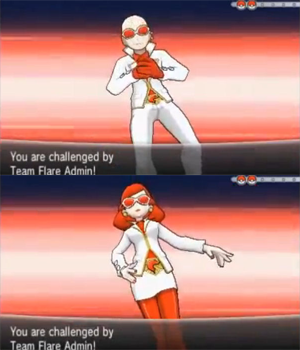
Team Flare grunts showing off their trademark poses and 'stylish' uniforms.

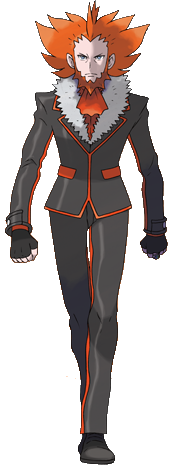
Just like I had to talk about Iris and Diantha because I’ve done all the other Champions before, I have to talk about Team Flare and Lysandre because I’ve done all the other bad guys before.  If you followed my playthrough journal of X version, you may have picked up that I have some rather strong opinions about Lysandre and his underlings, and the way the games portray them, so I think it makes sense now to take a deeper retrospective look at their involvement in the whole of the plot.  What do Team Flare really want, what makes them tick, and does Lysandre deserve our forgiveness?

Our first encounters with Lysandre are in Lumiose City, first in Professor Sycamore’s lab and then with Diantha in the Café Soleil.  Here we see the face Lysandre presents to the world: utterly dedicated to the preservation of beauty and the betterment of the world.  He speaks admiringly of Professor Sycamore’s brilliance as a scientist and Diantha’s ability as an actress to bring joy to millions, associating them and their careers with his own quest to build a beautiful world.  Even here, though, there are strong hints that he’s up to more than he lets on – on X, he declares that he wishes to “make this world unchanging and eternal so all beauty will last forever.”  In another game, I would not take such a clearly poetic sentiment seriously, but this is Pokémon, and Pokémon is not especially known for its subtlety.  On Y, he is far less circumspect about it: “I would end the world in an instant so that beauty never fades.”  Again, it’s probably meant to sound hyperbolic, but since ending the world is something that people have tried to do before in this series, that probably escaped many players; I played X, of course, but I find myself wondering how anyone could doubt that Lysandre was an enemy after hearing a line like the one he delivers on Y.  Ultimately, what he’s actually trying to do (on both versions) falls somewhere between the two – end the world of human civilisation in order to preserve what remains of the beauty of nature.  In addition to his potentially apocalyptic foreshadowing, I also noted in my entry on Diantha that this scene hints at some degree of superficiality (even sexism?) in Lysandre’s character – he focuses on Diantha’s physical beauty as the thing that makes her a good person and contributes to building a better world, considering that the loss of her own beauty with age would diminish her ability to make the world more beautiful too.  Much as he admires her devotion to making people happy, he downplays her ability to take action towards that goal and looks to her passive qualities – this represents an important flaw in his character that is going to recur later in the story.

 Xerosic, mastermind of the Expansion Suit and chief scientist of Team Flare.

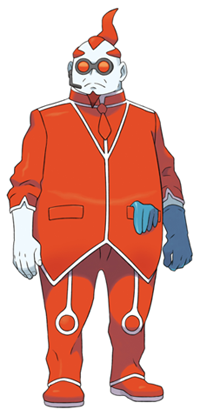
Lysandre’s minions, in their first appearances in the Glittering Cave and outside Geosenge Town, display none of his semblance of nobility.  Their stated aim is to help and advance members of their own organisation, regardless of the cost to others (and to pursue the heights of fashion…).  The idea of “a more beautiful world” never comes up, even in the later dialogue of the five scientists who run the group’s more pedestrian activities while Lysandre is busy: Aliana, Bryony, Celosia, Mable and Xerosic.  It annoys me a little that there are so many of them, because it means that each of the four girls doesn’t get to do much, but they do have distinct personalities, which is nice.  Aliana, who supervises the attack on the Kalos Power Plant to gather electricity to power the Ultimate Weapon, seems to enjoy battling the most, and may be slightly unhinged.  Celosia and Bryony (who are together in both of their appearances – I unashamedly ship these two) are responsible for raiding the Pokéball factory in Laverre City to gain the Pokéballs necessary to catch many powerful Pokémon whose life energy will fuel the weapon; they seem detached, nerdy, and a little philosophical.  Finally, Mable, who goes after one such Pokémon, the Abomasnow in the Frost Cavern… well, frankly, Mable is a callous b!tch.  “Allow me to spell it out for you! It’s so Team Flare – and only Team Flare – can survive!” she declares as she torments the gentle Ice Pokémon.  “After all, why should we care about saving people who aren’t on our side?”  Xerosic’s appearance in the story’s climax in Geosenge Town establishes him as a man utterly without conscience or remorse, willing to activate the Ultimate Weapon and slaughter billions even against Lysandre’s orders (if the player wins Lysandre’s bet about the two buttons in Xerosic’s lab) simply for the joy of what he considers scientific achievement.  He also features, of course, in the little post-Elite Four Looker vignette as Emma’s employer and tutor, a position which he exploits heinously.  The message of his involvement in that story seems to be that even thoroughly evil people are capable of love and affection and that, even though those things cannot and should not absolve Xerosic of his actions as part of Team Flare, they still deserve recognition.  Also appearing in the Looker sequence is Malva of the Elite Four, apparently a member of Team Flare, who makes no secret of the fact that she despises you, but seems to hate Xerosic more for abandoning Team Flare’s grand mission in favour of petty crime.  Her dialogue in Elite Four rematches thereafter suggests that Malva has developed something of a grudging respect for the player’s strength, despite her intense hatred, and believes that the strength to force one’s beliefs upon the world is all that really matters in life.

 Whatever else may be said about them, I love the Team Flare Admins' ridiculous pimp outfits.

Interspersed with your actual encounters with Team Flare, a few more interviews with Lysandre himself take place, one in person with Professor Sycamore and a couple by Holo-Caster.  His speech and ideas remain grandiose throughout, and he encourages us to give thought to how we will use our power, but only when you see him in Lysandre Café do we receive more ominous hints about his plans – as with many Pokémon villains, the problem is in his absolutism, his willingness to divide all people in the world into “those who give and those who take” and declare all of the latter, most emphatically, “filth.”  This is the conversation that first suggests the existence of the Ultimate Weapon, and hints at Lysandre’s willingness to use it.  When he finally reveals his Team Flare allegiance to the world and explains his plans to wipe out the rest of humanity… well, it surprised me that he was willing to go so far for his “beautiful world,” but it’s not a total shock, put it that way.  His criteria for who gets to survive the imminent devastation are disheartening – “anyone who is a member of Team Flare, and no-one else,” which makes me question how well he really knows his members.  Would all of them really satisfy his idea of a person who will give and sacrifice to create a beautiful world?  Most are selfish, short-sighted and callous – exactly the kind of person you’d think Lysandre would normally deride as ‘filth’ – and they are able to enter his select group of followers not by proving that they will help to build and preserve a beautiful world, but by paying a truly mind-boggling membership fee.  The interesting thing is that, when we battle him for the first time in his lab beneath Lumiose City, Lysandre seems open to the possibility of letting the player join him and live in the new world.  More so than any other Pokémon villain, Lysandre is interested in our passion and the way we express our beliefs through battle – he’s a little like N that way.  Like N, he also seems almost like he might want a way out, like he might want to be stopped, on some level; he encourages us to fight him and his underlings, and is even willing to let us decide (after a fashion) whether the Ultimate Weapon will be activated.  In the end, though, Xerosic intervenes and we are forced to pursue Lysandre to Geosenge Town to confront him once more.

This is when we learn the dirty little secret, the part of his plan that disturbs even Lysandre: that there will be no place for Pokémon in his new world, not even those who belong to Team Flare.  Lysandre loves his Pokémon; his ability to harness Mega Evolution proves that, as Shauna observes.  In some ways his willingness to sacrifice them speaks to the strength of his convictions, but his reasoning is concerning.  As long as Pokémon exist, Lysandre believes, and as long as some people have Pokémon while others do not, people will use them to take more than their share and seize more power than they deserve.  Some of his research notes back in Lysandre Labs take the form of a broad sketch in anthropological terms of the genesis of inequality in civilisation (a problem that, in the real world, is one of the major areas of study in prehistoric archaeology), and place the impetus squarely with Pokémon – people who commanded Pokémon were able to amass wealth and influence, becoming great leaders.  He makes essentially the same point to us, far more briefly, in person.  The problem is that, despite all his love for his own Pokémon, he never considers that they might have a choice, or that their decisions might impact the way things turned out.  He thinks about the way their powers can be used, for good or ill, but not about how they will allow people to use them.  Remember what I said about the way Lysandre views Diantha as essentially passive?  He’s doing the same thing here.  He’s denying agency to Pokémon, who are clearly intelligent beings, and thinking about them as though they were little more than the extensions of their trainers’ will.  In short, by taking such a deterministic view of the effect Pokémon have on human society, he is committing one of the franchise’s cardinal sins: viewing Pokémon as tools.

 This man.  What a dick.  Seriously.

Lysandre reminds me – and many other people, I’m sure – very strongly of Cyrus (even sharing two Pokémon, Gyarados and Honchkrow, with his predecessor).  Both are acknowledged as intellectually brilliant, and their goals and beliefs are quite similar.  Both felt driven to crime by despair at the human condition and a belief that an ideal world could only be brought about by drastic and destructive means; Cyrus’s goal was to create a world without suffering – the problem was that he believed the ‘incomplete’ nature of the soul made suffering inevitable – while Lysandre wanted to create a utopia where the world’s resources were shared fairly and sustainably, but came to believe that the greed and laziness inherent in human nature made his vision impossible.  Both are charismatic leaders who command blind obedience, both have keen engineering skills, and both meet mysterious ends.  My trouble with Team Flare and Lysandre though, is that I think we’re supposed to have much more sympathy for them than I can muster.  No one ever asked us to like Cyrus.  The more generous amongst us might have appreciated a certain nobility in his desire to end all suffering, but there was never any question that he was Evil with a capital E.  People regularly ask us to like Lysandre, from Professors to rivals to random townspeople – largely because, unlike the cold and emotionless Cyrus, Lysandre actually cares, and seems to feel genuine remorse even as he continues to work towards his goals.  He seems like he’s meant to be a tragic figure, but having seen so little of his famed philanthropy, I find it difficult to empathise.  In some ways, I think, Lysandre is even worse than Cyrus, because Cyrus’ decisions and actions were very impersonal.  Cyrus felt that life itself was fundamentally broken; killing everyone wasn’t exactly part of his goals, but he felt it was a reasonable sacrifice to make for the chance to create a perfect universe.  Lysandre, on the other hand, just unilaterally decided that most of the people in the world deserved to die for wasting the planet’s limited resources.  As for Team Flare – well, they may not have been pleasant people, but at least Team Galactic and Team Plasma were genuinely in the dark about the true extent of their leaders’ motives (even one of the Galactic admins, Saturn, had no idea Cyrus was trying to destroy the universe and become a god).  Team Flare seem to have known all along what havoc their master was planning – they regularly speak of their desire to create a beautiful word, just for them, and as far as we see no-one abandons Lysandre in shock when he announces his plan to all of Kalos – yet even at the end, Malva is able to claim with a straight face that she did what she thought was right.

I keep coming back to Serena’s words in the battle with her on Victory Road, because I think they encapsulate what the writers intended us to take from this story, and how far that is from what I actually took from it: “Lysandre chose only Team Flare.  You and I chose everyone but Team Flare.  But since our positions forced our hands, you can’t really say any of us were right.  So maybe if both sides have something to say, it’s best to meet halfway.”  Well, okay; that would have been fair enough if we had met Lysandre ten years ago and he had been saying “we need to move Kalos in a more socialist direction and commit ourselves to sustainability.”  Unfortunately, it seems pretty clear that even by the time we first meet him he has already gone off the deep end and is merely hiding it, so that his position is actually “I have no choice but to kill all of you, and your pets.”  How exactly does one “meet halfway” with that?  As far as I can make out, the writers were trying really hard to make Lysandre a tragic and morally ambiguous villain, and even thought they had succeeded, but we get little opportunity to see his positive traits for ourselves, are given the chance to understand his descent into evil only in retrospect, and are eventually asked to sympathise with a man who tried to destroy everyone we have ever loved for the ‘greater good’… of himself and his band of thugs.

Honestly, I think there’s only one way now to achieve the aims the writers actually had in mind for Team Flare and Lysandre: the next sixth generation game has to be a prequel.

Champions of the Pokémon League, Part 8: Diantha

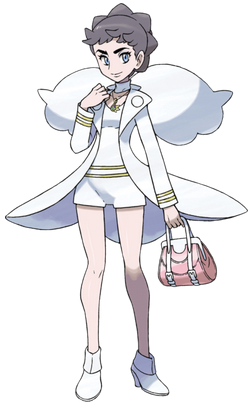
Diantha in her angel-winged white coat.  Note the jewelled necklace - that's her Digivice.

Glamorous but relatable, ethereal but down-to-earth, the Kalosian Champion, Diantha, is everything you want in an actress – but how does she stack up as a Pokémon League Champion?  She certainly has the look down, with an extravagant costume reminiscent of angel wings, and more importantly she also has the right kind of attitude to Pokémon and training.  Sadly – and I may as well be up front about this – the story of X and Y doesn’t give Diantha very much of an opportunity to do anything, something that was rather a disappointment to me.  Still, she gets a few good lines, and when you get her into a battle she’s the equal of any of her predecessors, so let’s take a look at her and see what makes this Champion tick.

We first meet Diantha in Lumiose City at the Café Soleil, and this scene is probably her most interesting because she has the opportunity to speak directly to Lysandre and set up a compelling argument against his beliefs – even here, the game doesn’t let her have many lines, but she makes them count.  Lysandre puts to Diantha the question of whether, as an actress, she would prefer to stay young forever, since it is her duty to inspire people with her beauty.  He clearly expects the answer ‘yes,’ but Diantha finds the question bizarre – being forever young would mean playing the same kinds of roles forever, but she views change and age as essential parts of the experience of human life, and eagerly anticipates the variety of more mature characters she will play as she grows older.  Their conversation betrays a certain narrowness and superficiality on Lysandre’s part; despite his comment that Diantha’s great contribution consists in “[moving] the multitudes with her excellent acting,” it seems clear that he regards her physical beauty as the most important aspect of her craft – to him, Diantha really is just a pretty face.  Her second appearance makes it clear that Diantha herself has a very different understanding of what she does.  We meet her again in Coumarine City, where she is talking with Professor Sycamore at the monorail station.  Diantha offers some comments on Mega Evolution, suggesting that perhaps the reason it seems to be limited to Kalos is because it has something to do with the legendary Pokémon of the region (if Professor Sycamore is correct in his eventual conclusion that Mega Stones were evolutionary stones irradiated with the energy of the Ultimate Weapon three thousand years ago, she’s not far off – although Xerneas and Yveltal don’t seem to have been directly involved with the weapon’s first use, they command similar powers).  More interesting from a characterisation perspective, though, is what she talks about after he leaves.  Sycamore had mentioned the bonds between trainer and Pokémon as a critical component of Mega Evolution, and Diantha makes an interesting comparison with the way she approaches acting: she sees it as an exercise in empathy.  In order to enjoy a role and play it effectively, Diantha says, she needs to put herself in her character’s shoes and understand what they have in common.  She also believes in taking the same approach to interacting with both people and Pokémon.  Essentially, the reason she’s both a successful actress and a great Pokémon trainer is because she’s figured out that the two professions share a key skill – empathy – and made it a part of her general approach to life.

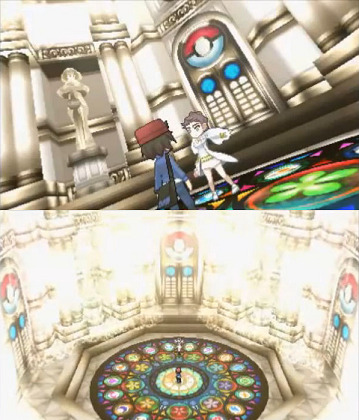
 Diantha's Radiant Chamber, in all its stained-glass glory, seems intended to be 'heavenly' in its appearance, like her costume.

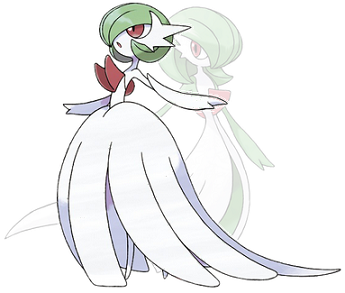
And that… is the last we see of her.  Diantha doesn’t take any further part in the storyline of X and Y until your troubles with Team Flare are all over and you reach the cathedral of the Elite Four.  Realistically enough, she seems to have almost forgotten you herself by this point, but quickly realises that she does know who you are and what you’ve done for Kalos after all – which brings us to the battle.  Like Blue and Cynthia, Diantha is very hard to pin down to a preferred Pokémon type or battling style.  She appears to favour Rock- and Dragon-types, with two of each on her team, but her signature Pokémon, the strongest in her line-up, whose physical appearance is recalled in the flaring white skirts of her coat, is a Fairy/Psychic dual-type, Gardevoir.  In Hawlucha, her opener, Diantha has a strong and fast physical attacker with excellent type coverage thanks to Flying Press, Hawlucha’s idiosyncratic signature move, while Tyrantrum adds a sledgehammer to her tool kit.  Aurorus provides Reflect and Light Screen support, though with two double-weaknesses it may not last long enough to set up more than one.  Goodra is a resilient special tank with a wide variety of powerful attacks.  Gourgeist is surprisingly tough and can hit almost anything for super-effective damage by adding the Ghost type to Pokémon with Trick-or-Treat.  Last, but most definitely not least, is Gardevoir, who proves that Diantha can put her money where her mouth is when it comes to empathy and bonding with her Pokémon – by using her Mega Charm to Digivolve Gardevoir, Diantha can turn her partner into as great a threat as the whole of the rest of her team put together (as I learned to my cost when I first challenged her and won with my Venusaur’s last three hit points).  Mega Gardevoir’s Moonblast and Psychic attacks are phenomenal, more powerful than anything a Champion has brought to bear against us before, and without a Steel-type to resist her primary attacks she is one of the most dangerous single opponents the games have ever produced.  Ironically, Diantha’s greatest vulnerability is probably to Fairy Pokémon, since she has three Pokémon that are weak to their attacks, none that resist them, and only one super-effective attack to hit back with (Hawlucha’s Poison Jab); she also has great difficulty with Ice- and Steel-types.  Still, her weak points are certainly less easy to exploit than those of predecessors like Water-type master Wallace and the closeted Flying-type specialist Lance, making her a solid end-game challenge.

 Diantha's partner, Mega Gardevoir.

(Of course, if you’ve been using the Exp. Share consistently throughout the game Diantha is probably a walk in the park, but hey, who’s counting?)

The variety of Pokémon we see on Diantha’s team – in terms of not only their types and skills but their personalities and dispositions – may be intended to recall her desire for variety in her career and her life.  Partly I’m just saying this because I can’t find any other sort of theme to link her team together, but it seems to me that a wide variety of popular film genres have Pokémon representatives on her team; she has action (Hawlucha), horror (Gourgeist), family/comedy (Goodra and Aurorus), disaster (Tyrantrum) and, of course, romance (Gardevoir) all covered.  Perhaps that’s entirely in my head and the designers just wanted to give her a diverse bag of the new Pokémon the sixth generation has to offer, but it makes sense, given Diantha’s stated interest in playing a variety of roles, that she might have acted in many different genres, possibly meeting many different Pokémon in the process.

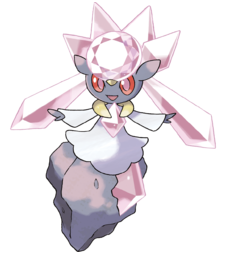
 The recently-revealed legendary Pokémon, Diancie, whom I'm bringing up because I know someone else will if I don't.  A lot of people speculate about a connection between Diantha and Diancie, but I don't believe there is any, because the similarity between their names doesn't exist in Japanese, where Diantha's name is Carnet, and because it makes as much sense for the design of her coat to be based on Gardevoir as on Diancie.

One last thing that’s worth mentioning about Diantha is her reappearance in the Café Soleil after the end of the game.  Diantha here offers you the opportunity to trade for a Ralts holding the Gardevoirite Mega Stone, so that you can raise a Mega Gardevoir of your very own.  This is not in itself particularly interesting; what is noteworthy is that she actually takes the time to think about how the Pokémon involved in this trade feel about it – something I can’t recall any other character in the games ever doing (although, granted, most in-game trades are with random NPCs who have no other discernable purpose in life).  “We Trainers all feel a bit nervous when trading Pokémon,” she comments as the trade begins, “but I’m sure it’s nothing compared to how the Pokémon must feel!”  When the switch has been completed, she even takes a moment to address the Pokémon you’ve given her directly, asking “was it a bit shocking to be traded?” and promising to care for it to the best of her ability.  A tiny detail at the very end of the game, but one that once again demonstrates that Diantha really does know what she’s talking about when it comes to empathy and consistently makes an honest effort to understand the perspectives of her Pokémon on their lives together.

On some level Diantha’s non-existent involvement in the Team Flare crisis makes sense, since she’s very clear that she’s only a Pokémon trainer “in [her] off time” – acting is her real career, and for all her power, she’s not really a ‘saving the world’ kind of girl.  Still, I find her remoteness from the actual plot as disappointing as I did Iris’s, and I don’t think Diantha even gets as much screen time (ironically) as Iris did in Black and White.  Having said that, she makes a good effort to stay relevant in the time she does get – and I can always hope for more in any future games.  Though she never gets the chance to be a hero, through her dialogue she does manage to establish herself as a role model for Kalos’ trainers and a champion of a worldview opposite to Team Flare’s.  Lysandre wants to put the beauty of the world on a pedestal and keep it from changing for all time, but Diantha wants to engage with and understand beauty, and prefers to embrace change, for better or worse, which, ultimately, is what the central conflict of X and Y is about.

Champions of the Pokémon League, (Belated) Part 7: Iris

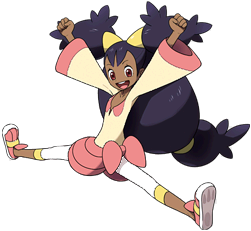
Original recipe Iris, in the relatively simple clothes she wears in Black and White.

As odd a time as this is to be talking about Iris, my next post is going to be on Diantha, which would otherwise make Iris the only Champion I haven’t written about, having discussed all the previous ones about two years ago now, a possibility that makes me feel a little twinge of unfairness in my normally blackened iron heart.  For the sake of completeness, then, let’s give some thought to the fifth generation games’ portrayal of the dragon master Iris, our second female and first dark-skinned Champion (yay diversity!).

Iris first shows up when the player reaches Castelia City in Black and White, where she enthusiastically volunteers to be Bianca’s bodyguard after the latter’s Munna is abducted, and takes part in the standoff with Team Plasma.  She is here portrayed as passionate and firm in her convictions, reacting with anger and dismay when she learns of Team Plasma’s theft and bewilderment when the rest of the group agrees to let Ghetsis and his minions leave without a fight, but is also extremely ready to help people in need, and perhaps a little naïve (Burgh suggests that Iris will need Bianca’s help finding her way around the huge city as much as Bianca will need Iris’s protection).  On White, Iris is subsequently revealed to be the Gym Leader of the ancient, traditionalist version of Opelucid City; on Black (and I say this as a player of Black version) one is rather left wondering what the point of her is supposed to be.  In both games, she also helps Drayden narrate of the story of Reshiram and Zekrom.  Since they’re both Gym Leaders of Opelucid City, it makes sense to look at Drayden in Black and White as something of a foil to Iris.  Compared to her older mentor, Iris stands out for her excitable speech patterns, liberally peppered with exclamation marks, and her emotional, evocative language.  Both are idealistic, but Iris is much more liberal in showing it.  On Black, the Opelucid Gym gives Drayden, as its leader, the epithet “the Spartan Mayor,” announcing him to be hardworking, physically strong and austere, as well as reminding challengers of the respect he commands as Mayor of Opelucid City (also, almost uniquely for these titles, it makes no reference to his elemental specialisation).  On White, where Iris is the Gym Leader, she is referred to as “the Girl Who Knows the Hearts of Dragons,” a description that focuses instead on her capacity for empathy and intuition, her deep connection with one of the most mysterious Pokémon types, and possibly her raw talent as a Pokémon trainer.  It may also be worth comment, in connection with Iris’ characterisation as energetic and youthful, that the only difference between the teams they deploy as Gym Leaders (aside from the gender of their Pokémon – Drayden’s are male; Iris’s are female) is which abilities their Druddigon possess; Drayden’s has Rough Skin, reflecting endurance and severity, while Iris’s has Sheer Force, suggestive of potency and vitality.  A minor difference, but when everything else about their Pokémon is kept the same, one little change feels that much more purposeful.  Even the city itself may contribute.  Drayden is the Gym Leader of a futuristic, technologically advanced Opelucid City, the result of industrious dedication to progress, while Iris’ Opelucid City is peaceful, quiet and very traditional, in keeping with her emphasis on closeness to Pokémon and nature (though her ‘nature girl’ traits, it must be said, are much less noticeable than in her anime incarnation).

Iris in the extravagant, flowing dress she wears as Champion of the Unova League.

At some point before the events of Black and White 2, Iris replaces Alder as Unova’s Champion.  As it did for Wallace in Hoenn, this apparently occasions a change of costume, with Iris’ relatively plain beige sweater being replaced by a frilled pink dress like something out of a fairy tale (appropriately enough, given her specialisation), complete with a golden, emerald-studded tiara.  We first encounter her, again, in Castelia City.  She retains her desire to help people in need, immediately volunteering to assist in your search for Team Plasma despite her belief that they are no longer a threat – but in a pointed contrast to her last appearance suggestive of her greater experience and maturity, she now appears to know the city very well, and is immediately able to direct the player to the most likely site of any suspicious activity, namely the Castelia Sewers.  She does very little else in that game, however, appearing again only in Opelucid City for a brief and not especially revealing conversation about Drayden (if nothing else, we learn here that although she calls Drayden ‘grandpa,’ they aren’t actually related).  At the time of Black and White 2, Iris was the only Champion since Blue not to take an active role in fighting the primary villains (she is now joined by Diantha), which, given her keen interest in the legends of Reshiram and Zekrom, is baffling.  Her initial scepticism at the possibility of a Team Plasma comeback goes some way towards explaining this, but the flying battleship shelling Opelucid City with ice cannons must have been one hell of a wakeup call.  Having said that, I’m not sure what her presence would have added other than opportunities for characterisation – unlike Alder, whose own personal flaws and troubled past complicate his opposition to Team Plasma, Iris’s involvement in that plot would have been fairly straightforward, so in some ways it’s perhaps better that she wasn’t there to take the spotlight from Hugh.

Probably the most interesting bit of characterisation Iris gets in Black and White 2 is not actually in the events of the games themselves but through a Memory Link scene (if you’re not familiar with these, they’re scenes which take place between the original Black and White and the sequels, which you can only view if your Black 2 or White 2 game is associated with the same Global Link account as a Black or White game which has completed certain parts of the storyline).  In Opelucid City, you can hear from Drayden about how Iris became his student and eventually the Champion – a position she has apparently been groomed for by Drayden since she first came to Unova as his successor.  In fact, having the opportunity to challenge Alder and become Champion was apparently her condition for leaving her home in the distant Village of Dragons, hinting at ambition, vigour, and possibly (as we’ve already seen from her) a touch of naïveté about the magnitude of this goal, though it appears she was an exceptionally talented trainer even before she met Drayden.  The fact that Alder, in consultation with Drayden, apparently chose his successor is interesting, although it appears that actually defeating him was still a requirement for Iris to take up the position and, far from considering it a formality, Alder actually put himself through a special training regimen (“ghastly,” according to Drayden) to prepare himself for this final duty, intent on pushing Iris to her limit.  Now that she’s there, Iris declares that her mission as Champion will be to help people and Pokémon continue to grow ever closer (a pledge that is not without resonance in the overarching themes of the fifth generation).  We also see in this flashback that the enormous pink dress Iris wears as the Champion was actually Drayden’s idea, a gift from him upon the completion of her training; now that she’s the Champion, he tells her, it’s okay to dress up – her hard work has earned her the right to a little frivolity now and then.

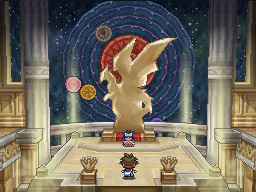
Iris' astronomically-inspired throne room.

When we finally meet Iris again in the palace of the Elite Four and battle her for the championship, the game pulls out all the stops.  Not only is Iris’ chamber particularly spectacular in comparison to those of past champions, with a huge throne in the shape of a dragon silhouette and a rotating circular backdrop apparently meant to represent the planets in orbit around the sun, the battle scene itself is marked by eye-catching streaks of rainbow light flashing across a twilight background.  The battle scenery of X and Y, of course, put it all to shame, but it was quite spectacular compared to everything that had preceded it, making the battle with Iris a unique and memorable one.  Nor does Iris herself let us down.  The game designers, apparently ashamed at their decision to neuter Ghetsis’ Hydreigon with a bizarre physical attacker moveset, have Iris open with a proper special attacker Hydreigon, as deadly a foe as any you’re likely to face in this game.  The rest of her team illustrates nicely that it’s quite easy to design a varied and balanced line-up for a Dragon master, simply because there are so many ‘dragon’ Pokémon who aren’t actually Dragon-with-a-capital-D Pokémon.  Iris uses three of them: Aggron, Lapras and Archeops.  Lapras ensures that she has an answer to Water- and Ice-type Pokémon who think they can sweep her team with Ice attacks, while Aggron covers up her defensive weakness to opposing Dragon Pokémon, and Archeops is simply vicious, and even carries Endeavour to help compensate for the Defeatist ability that normally renders him harmless when his health is low.  Druddigon would be the weakest member of her team, but the designers apparently realised this and gave him a Life Orb (making him the only member of her team aside from her partner to use a held item) so as to abuse the way Life Orb and Sheer Force work together – Sheer Force negates Life Orb recoil damage, but only on attacks that Sheer Force applies to normally.  Finally her partner, a Pokémon that needs no introduction, is a Dragon Dance Haxorus, complete with an Earthquake that can bring down even Levitating Pokémon thanks to Mold Breaker.  With the possible exception of Lapras, all of Iris’ Pokémon and their movesets are ones which emphasise overwhelming force; no stalling Spiritomb, Recover-spamming Milotic or defence-buffing Vanilluxe for her (even her Lapras exploits its powerful special movepool in preference to, say, a more sedate and arguably more effective Rest/Sleep Talk strategy).  Iris is all about enthusiasm and passion, and her first priority is to jump right in and blast away from start to finish.

Iris may still be an AI trainer, but as AI trainers go, she’s very much at the top of her game.  As a character, she has an odd relationship with the story, spending as little time directly interacting with it as possible but managing to snatch a fair bit of characterisation anyway, courtesy of the greater screen time Black and White gave to most of their Gym Leaders.  Her beliefs and goals as Champion also make a very clear statement about the central theme of the games – whether humans should become closer with Pokémon or move further apart.  While I remain a bigger fan of Alder and Cynthia, she’s a neat character, and has little trouble stepping into the larger-than-life boots of her predecessors.  Will her successor, Diantha, measure up?  Only one way to find out…

Pokémon: Twitch Version

In memory of the recent astonishing victories of Twitch Plays Pokémon, now you too can experience the frustration and insanity of the hit stream on your very own Nintendo 3DS! (If someone with more programming skills than me actually wants to make this into a hacked rom, I will love you forever)

Features:
–          Choose your starter Pokémon: Pidgey, Rattata or Nidoran!
–          Start the game with a powerful item to provide guidance in times of need: the Helix Fossil!  Consult the Helix Fossil to learn whether this is the right time to use an item, or which move to use against your opponents!
–          No more Pokéballs – instead, wild Pokémon will join your party at random!  Be careful – if your party is full, you might need to brave the PC to retrieve them!
–          A surprise around every corner when learning new moves – you never know what your Pokémon are going to forget!
–          Bill’s PC – the classic villain of Twitch Plays Pokémon is back, with some all new tricks!  Deposit one Pokémon, get one back – but if you want to choose which ones those are, you’d better be prepared to make a sacrifice!  What’s more, the longer you spend using the PC, the more likely it is to demand blood – make sure you release Pokémon regularly, or Bill may take matters into his own hands!
–          Classic RBY mechanics – the Special stat!  15 types!  No held items, abilities or breeding!  No decent attacks for Bug, Grass, Flying, Ghost or Dragon Pokémon!  TMs of powerful moves like Teleport, Dragon Rage and Razor Wind!
–          Meet all your favourite characters from the original Twitch Plays Pokémon, like ABBBBBBK( and JLVWNNOOOO!
–          Powerful new skills for certain Pokémon: Pidgeot gains a boost to all base stats; Venomoth can learn all HM moves; Rattata’s level-up move pool is expanded with attacks like Thunderbolt and Bubblebeam; Gastly starts with Sing and Rollout – explore the game and find out what all your Pokémon can do!
–          Pokémon with field moves like Dig and Teleport will use them on their own initiative to get you out of tight spots, back to the safety of the Pokémon Centre – but be careful, or you might end up leaving a dungeon before you’re done!
–          Hours of play time in every area with engaging ledge-jumping puzzles!
–          Listen for Bulbasaur’s cry to help find hidden items and areas!  Make sure to play it from your Pokédex regularly so you remember what it sounds like!
–          Beat Misty, the Cerulean City Gym Leader!
–          And much, much more (or less, depending on your perspective)!

With seven exciting game modes to unlock!  Switch between modes at a Pokémon Centre, or when the Helix is pleased with your progress!

–          Anarchy – The default setting.  All Pokémon disobey orders, regardless of the number of their trainer’s badges, and movement commands in the overworld are scrambled.  When you try to use an item, there is a 50% chance of tossing it instead.
–          Democracy – All Pokémon disobey orders, regardless of the number of their trainer’s badges, and gameplay speed is reduced by 80%.  When you try to use an item, there is a 33% chance of tossing it instead.  Unlock Democracy mode by finding the mysterious Dome Fossil!
–          Dictatorship – For online play only.  Connect your game to the controls of a random player on the internet and let the blind lead the insane!  Unlock Dictatorship mode by resurrecting Kabuto!
–          Capitalism – Every step costs money, and Pokémon centres charge for healing.  Pokémon will charge for using their attacks, and become more expensive at higher levels – hey, you can’t expect them to put in all that effort for no reward, right?  Unlock Capitalism mode by amassing 50,000 Pokédollars!
–          Communism – All Pokémon share experience equally, including those in Bill’s PC, you cannot earn money or buy items, and gameplay speed is reduced by 60%.  Unlock Communism mode by evolving Eevee into Flareon!
–          Theocracy – Choose one of three divine patrons – the Helix, the Dome or the Amber – and give yourself over to your god’s will.  Each one has exciting Intervention powers that allow them to take a hand in battle when you least expect it, rewarding you for your good decisions by resurrecting your defeated Pokémon or improving their stats, and punishing you for your sins by cursing your Pokémon with weaker moves or striking them with confusion.  Unlock Theocracy mode by resurrecting Omanyte!
–          Monarchy – Tired of all this bull$#!t?  Just switch to Monarchy and control your game normally for a while.  Unlock Monarchy mode by connecting to Nintendo Wi-Fi while no-one else in the world is online!

A gripping psychological plot, focusing on Red’s spiral into insanity as he loses control over his own actions and watches his friends perish!

–          Seek out the eight Gym Leaders and lose to them in battle to gain precious insights into your condition!
–          Obtain the SS Ticket and help Aaabaaajss lead his loyal disciples to the promised land!
–          Climb the 101 floors of Pokémon Tower and rescue Mr. Fuji!
–          Find Flareon, the False Prophet, and through your actions decide how his story ends!
–          Relive the events of Bloody Sunday from the perspective of Dux, X(araggbaj and AAJST(????, and experience the horror first hand!
–          Learn the forgotten origins of the Pokémon world, and the hidden truths of the Helix and the Dome!
–          Descend into the depths of the PC to battle Bill himself and reclaim the souls of your fallen!  Will you recover your precious Pokémon?   Or will you only fall prey to the PC’s horrifying snares yourself?

Discover the epic story of madness, grief, perseverance and triumph!  Get Pokémon: Twitch Version today!

Pokémon Origins: Episode 4

Blastoise seriously reconsiders the life choices that brought him to this point.

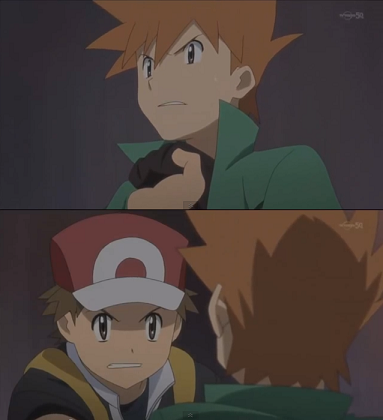
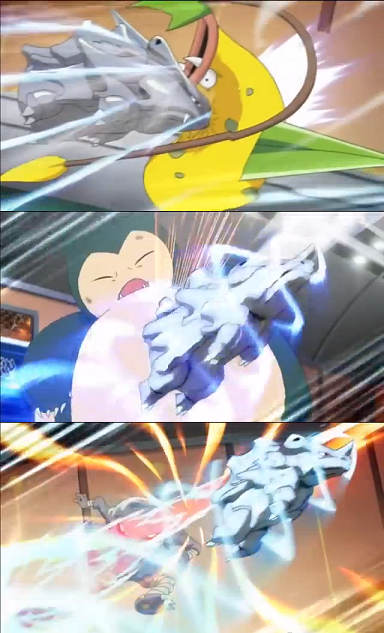
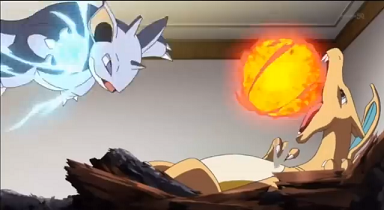
With Giovanni and Viridian City behind him, Red’s journey takes him to Indigo Plateau and the headquarters of the Pokémon League.   He narrates, briefly, his conquest of the Elite Four, accompanied by only brief clips from each battle, and is finally sent through by Lance to meet the Champion, who turns out to be – spoiler alert – Blue.  Red is surprised, but seems almost pleased to find him there.  Blue gives an adapted version of his classic overconfident and egomaniacal entrance speech, complete with his line about being “the most powerful trainer in the world,” and hurls his Pidgeot’s Pokéball to start the battle.  We skim through most of it in a few seconds – Blue’s team is the same as he would use with Blastoise in the games, while Red uses Jolteon, Lapras, Persian, Scyther, Dodrio and Charizard.  Eventually, of course, the battle comes down to their starters.  Although Blastoise shrugs off Charizard’s initial Mega Punch and then nearly ends the battle with Hydro Pump, Charizard is able to endure the damage, trap and weaken Blastoise with Fire Spin, and finally nail him with what I imagine to be a critical hit with Fire Blast.  Blue is confused and upset by his loss, but covers it up quickly – and then Professor Oak arrives.  Professor Oak’s lines in this scene were sort of forgivable in the games, where all the dialogue was pretty simplistic, but a lot more jarring in this medium: he initially ignores his grandson completely to give embarrassingly glowing praise to Red instead, and when he finally does acknowledge Blue, his first words are a condescending “what a shame…”  Blue shrugs that off – and gets accused of forgetting to treat his Pokémon with trust and love, something which rings a little hollow given that we’ve never really seen the way Blue treats his Pokémon.  Once Professor Oak has finished being a douchebag, he leads Red backstage to enter him in the Hall of Fame.  Red is a little self-conscious here, but is assured by Professor Oak that he’s earned it, so he vows to uphold the honour of the position.

Continue reading “Pokémon Origins: Episode 4”

Pokémon Origins: Episode 3

Silph's magnum opus, Team Rocket's ultimate goal: the Master Ball.
Silph’s magnum opus and Team Rocket’s ultimate goal: the Master Ball.

Because I am me, I had a great deal of fun with the episode in which Ash challenges the Viridian Gym.  Among my bigger regrets for that series, though, are that Ash never got a chance to confront Giovanni, his battle being delegated to Jessie and James instead, and that Giovanni himself didn’t get the kind of characterisation many other anime Gym Leaders enjoy in their keynote appearances.  Episode 3 of Origins has the chance to rectify this deficiency, and it does so with gusto.  Let’s take a look.

Red persuades Blue to help out against Team Rocket with his impeccable debating skills and smooth negotiating manner.

After winning his Rainbow and Soul Badges, taking on Team Rocket once more in Celadon City, and evolving his Charmeleon into a Charizard, Red finds himself in Saffron City, the home of the region’s leading producer of Pokémon-related supplies and technology, Silph Company.  Red and Blue briefly team up to rescue a woman being harassed by a pair of Team Rocket grunts, and learn that she is the secretary of Silph’s president.  Team Rocket has taken over the company headquarters in order to force Silph’s scientists to perfect the prototype Master Ball by performing unethical experiments on large numbers of wild Pokémon, and she has been given orders to escape and return with reinforcements.  Blue, though he seems to understand the worrying implications of a world where Team Rocket can commission Master Balls, doesn’t see what any of this has to do with winning Badges or becoming Champion and has no intention of sticking his neck out for anyone, though Red eventually manages to… ‘persuade’ him to escort the secretary to Celadon City and raise the police.  Red himself, meanwhile, is unwilling to let the Pokémon in the building suffer for even a moment longer than necessary, and decides to take a more direct approach: a frontal assault with all his Pokémon.  As we know from the games, this is a resounding success.  Red frees the imprisoned Pokémon and scientists from the Silph laboratories, then makes his way to the president’s office to confront Giovanni.  If Giovanni is frustrated by what he admits is the total ruination of his plans, he doesn’t show it, and is prepared to leave without a fight, but Red is having none of that, and vows to thwart Team Rocket’s plans wherever they go.  Irritated by Red’s presumptuousness, Giovanni calls on his Nidoqueen, who Double Kicks Charizard through a wall and counters his Flamethrower with Surf, causing an explosion that takes out most of the building’s top floor.  When the dust settles, Nidoqueen and Giovanni are standing unfazed, while Red and Charizard are lying crumpled on the floor.  Giovanni, almost disappointed by the ease of his victory, comments that Red’s failure to achieve more with Charizard is “a pitiful waste of such gifts.”  Red demands an explanation for Team Rocket’s actions, and he replies that Pokémon are a business, and success in business requires sacrifice – if Pokémon must suffer, then so be it.  Red angrily retorts that Pokémon should be a trainer’s friends, to which Giovanni points out, looking to Charizard, that Red is perfectly willing to let his ‘friends’ suffer as well.  Red has no answer to that, and Giovanni leaves by helicopter, cleanly escaping all police action.

Red's team nearly gets swept by the most badass Rhyhorn ever.
Red’s team nearly gets swept by the most badass Rhyhorn ever.

Fast-forward to Viridian City.  Red is effervescent at the prospect of meeting and learning from the strongest Gym Leader, whom Blue has already defeated, and is horrified when he realises that – spoiler alert – the leader is Giovanni himself.  He refuses, point blank, to acknowledge Giovanni as a Gym Leader at all, and instead challenges him as “the enemy of all Pokémon.”  Accordingly Giovanni, who had been perusing a selection of Pokéballs like the one we saw in Brock’s Gym, remarks that he won’t accept Red’s challenge as a Gym Leader either and instead selects two Ultra Balls from a hidden compartment.  Red knew Giovanni’s specialty ahead of time and came prepared with Grass-, Water- and Fighting-types, but his Pokémon simply aren’t powerful enough – Giovanni’s Rhyhorn crushes his Victreebel, Kabutops, Snorlax and Jolteon almost without effort, before his Hitmonlee manages to force a tie.  Throughout the battle, we get snippets of Giovanni’s inner thoughts on the battle – he finds Red utterly infuriating, but doesn’t quite know why; nor can he account for his disappointment that Red isn’t as challenging an opponent as he’d anticipated.  Though he hides it well, his smugness steadily fades to agitation and then intensity, until with only one Pokémon left on each side, Giovanni realises that the battle will come down to Charizard and Rhydon, and gloats that Red has made a critical mistake by not saving a Pokémon better suited to this fight.  Red replies that he always meant for Charizard to be his last, whatever happened, since the whole battle will mean more to him if he finishes it with his partner.  Giovanni’s façade cracks – he’s visibly furious now at Red’s overconfidence – but then he notices that Red throws his Pokéballs in the same way as Giovanni himself used to as a child, and he finally understands the emotions Red has triggered in him.  Giovanni recognises himself in Red (complete with a flashback scene in which Giovanni is revealed to have once owned a Charmander), and has been inspired by him to find excitement in their battle that he hasn’t felt in years.  He grows even more intense as he realises that Charizard really is a match for his Rhydon, and finally is left with a sense of satisfaction when Red manages to overcome him.  Apparently no longer mindful of their earlier conversation, Giovanni offers Red the Earth Badge – and, when Red refuses to accept it from the leader of Team Rocket, continuing to deny his status as a Gym Leader, he turns to his attendants and orders them to spread the word: Team Rocket is dissolved, and all of their operations are to cease immediately.  Red’s expression softens as he comes to perceive Giovanni’s change of heart, and accepts the badge.  Giovanni encourages him to continue seeking greater strength, since only one as strong as the Champion will have any hope of completing the Pokédex quest.  As Red leaves, Giovanni muses on his own future, apparently hopeful now for some sort of redemption.

Like a snake's, Charizard's jaw can stretch to incredible angles when he prepares to launch a Flamethrower.
Like a snake’s, Charizard’s jaw can stretch to incredible angles when he prepares to launch a Flamethrower.

Pokémon has always liked the idea, and has grown more fond of it in recent years, culminating with the player’s battle against N in Black and White, that Pokémon battles are a way for trainers and Pokémon to express their convictions to each other, a subtle but powerful medium of communication that functions on the level of one’s deepest emotions and most firmly held beliefs.  Neither of Red’s battles with Giovanni have practical aims.  In Saffron City, Giovanni fully intends to leave, and Red can’t really stop him (this should be contrasted to the way the same events are portrayed in the games, where it is only Red’s defeat of Giovanni that forces him to withdraw), but he fights Red anyway because he wants to send a message: this is beyond you, I am beyond you, and you must learn your place.  Likewise, Red’s motivation for challenging the Viridian Gym apparently goes out the window once he realises who his opponent is; he cannot have any reasonable expectation of breaking Team Rocket’s power with one battle, but he continues his course in order to make a statement of his opposition.  Similarly, while Giovanni makes it clear that he takes his duties as a Gym Leader seriously – he mentions his earlier battle against Blue, noting that he accepted that challenge despite being unimpressed by his arrogance because Blue’s potential intrigued him – he makes it equally clear that his battle against Red is something else entirely; he is again trying to put Red in his place.  Red’s decision to save Charizard for last is likewise built as much on symbolism as on strategy.  Their climactic battle can be seen as a parallel to his first Gym challenge against Brock – the lessons Red first learned from Brock, Giovanni now relearns from Red.  The same rising intensity and heightened synchronicity between trainer and Pokémon prompt a similar realisation: “Pokémon are not just tools” (whether “for battle,” as Red realises in the first episode, or “for business,” as he tells Giovanni repeatedly in this one).  Giovanni’s choice of Pokéballs is also significant: his initial selection implies that like Brock he is considering his opponent’s experience level in order to select appropriate Pokémon for a difficult but not insurmountable challenge, as he presumably did for Blue, but when Red declares that he does not consider this a real Gym battle, he instead picks two hidden Ultra Balls – this should be taken to mean that he is not moderating his own strength but now intends to crush Red with the full power of his two mightiest Pokémon.  This fact takes on a greater significance when we consider a fragment of gossip overheard by Red – that the Viridian Gym Leader has never needed even half of his true strength to defeat a challenger.  While this is likely hyperbole, it must prompt us to wonder just how long it has been since Giovanni has needed to invest himself truly in a battle, in the way he does with Red.  Perhaps spending too long without a real challenge is what causes Giovanni, little by little, to lose touch with his Pokémon and come to act with the callousness evident in his encounter with Red in Saffron City.

A young Giovanni and his Charmander.

At the end of their battle, Giovanni is taken aback when Red refuses to accept his Earth Badge, even though both sides made it clear from the start that this was not a battle between a Gym Leader and a challenger.  For Giovanni, though, the significance of the battle – the meaning of the conversation – changed greatly over its course.  His initial intention to break Red’s insolence lost its relevance once he started to liken Red to a young version of himself, and the battle instead became about finding himself and recapturing the energy and excitement of his youth.  A badge, aside from its importance to entering the ranks of the Pokémon League, is also a memento of a trainer’s battle with the leader who confers it and, as Red says before bringing out Charizard, that trainer’s understanding of the leader’s beliefs: Giovanni offers it because he wants Red to remember their battle as he undoubtedly will, as well as his new understanding of Red’s beliefs.  Red’s refusal is tantamount to a statement that their battle did not carry the same significance for him, and that he has no wish to remember it fondly – so Giovanni gives him a reason to (contrast, again, the way the games portray his decision to disband Team Rocket: he feels that, after losing even at his full strength, he is no longer worthy to lead).  In spite of the dramatic change Red brings about in him, though, Giovanni is still the same man who built Team Rocket; his final exhortation to Red is not the kind of sage advice about love for Pokémon that one normally expects from a defeated Gym Leader (after all, this would surely be hypocritical coming from Giovanni), but focuses particularly on the importance of accumulating greater strength.  Giovanni’s comments to Red after their battle in Saffron City make it clear that he considers struggle, ambition and sacrifice to be paramount, and none of those things are incompatible with Red’s idea of what it means to be a trainer; in fact, Giovanni would likely say that Red clearly sees the importance of all three.  As Red says before their battle, all Gym Leaders practice different philosophies for living and working with their Pokémon, having in common only their love for their Pokémon – something Giovanni, once again, shares.

There’s only one more episode to go in the Origins mini-series.  The Elite Four awaits… as do further challenges beyond…

Pokémon Origins: Episode 2

The Pokémon Tower.

After defeating Brock, Red continues his journey through the classic storyline – such as it is – of the first generation.  Most of this is related to us through a voice over by Red himself, with the help of dialogue boxes in the style of the original games (all direct quotes, of course), covering his victories over Misty and Lieutenant Surge, his initial skirmish with Team Rocket, Charmander’s evolution to Charmeleon, and a variety of other minor events from the games (mercifully, he sees fit to leave out all the Pokémon he is capturing during this time – we’d be here all day otherwise).  Red’s narration is bland, conveying only the barest hint of his own feelings about any of the events in question, and gives little detail.  I find myself questioning why things like receiving a bike voucher from the chairman of the Pokémon Fan Club even needed to be brought up if no attempt is going to be made to elaborate on them – and find myself answering that the only effect can be to call to mind viewers’ own memories of those same events.  Maybe for some of us, the Magikarp Red mentions buying outside Mt. Moon became a valued team member when it evolved!  It reminds us, essentially, that this is our story too.  If the whole show were just Red’s rather dull, functional account, though, there wouldn’t be much point in watching, so the story picks up again with a sequence that the writers thought worthy of special attention: Red’s experiences in Lavender Town and the Pokémon Tower.

Continue reading “Pokémon Origins: Episode 2”

Pokémon Origins: Episode 1

Professor Oak introduces us to the mysterious creatures of his world.

For those not familiar with it, Pokémon Origins is what might be called a ‘reboot’ of the Pokémon anime.  Released late last year, it is a four-episode miniseries which follows the adventures of Red – the protagonist of the original Pokémon games – and is closely based on the events of Red Version, Blue Version, and their third-generation remakes, Fire Red and Leaf Green (the visuals mainly taking their cues from the latter pair of games).  This stuff is pure nostalgia fuel, for people who were introduced to Pokémon by Fire Red and Leaf Green, for those of us who are old enough to have clear memories of when Red and Blue were first released, and, hell, probably for Game Freak and the animators too.  Each episode opens with the CONTINUE/NEW GAME/OPTIONS screen and ends with the SAVE screen from the original games, the first episode begins with Professor Oak’s “introduction to the world of Pokémon,” followed by the battle between Nidorino and Gengar familiar from the opening cinematic (on Red’s TV), and even the dialogue often quotes directly from the games.  This last point, if you ask me, may have been pushing it a bit far, since the English translations of Red and Blue didn’t exactly have the best-written dialogue in video game history – the quotes stand out for being, frankly, a little wooden.  Enough of the general style, though; let’s talk about the plot.

Continue reading “Pokémon Origins: Episode 1”