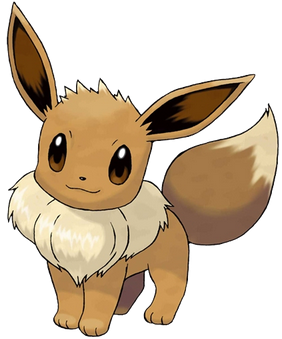
Final Thoughts: Eevee

Official art of Eevee, by Ken Sugimori; image copyright by Nintendo, yaaay.All these entries on Vaporeon, Jolteon, Flareon, Espeon, Umbreon, Leafeon, Glaceon… what about little Eevee?  Doesn’t she deserve some love too?  When you think about it, Eevee is actually the most important of the lot.  Without her, all the rest are just generic Pokémon of their own types, for the most part; many of them are well-designed, but they’re not really all that interesting on their own.  To no small extent, the thing that makes them worth thinking about is their common origin – a tiny Normal Pokémon with limitless potential.

Eevee is called “the Evolution Pokémon” – indeed, the word ‘evolution’ is the origin of her name, in both English and Japanese (where she is Eievui).  She pioneered the idea of a branched evolution, a concept that was originally unique to her, with her split into Vaporeon, Jolteon, and Flareon in Red and Blue.  When other branching evolutions were introduced in Gold and Silver, Eevee continued to have more branches than anyone else with the addition of Espeon and Umbreon, and today she has a grand total of seven possible final forms.  Eevee wasn’t just the first Pokémon to have multiple evolved forms, though – I think she actually got the whole idea spectacularly right, to an extent that subsequent Pokémon haven’t.  Split evolutions typically develop different ideas of a single design, and gain their real significance when you view them together, as pairs of Pokémon, but few of them go in radically different directions the way Eevee does, and the differences between their powers and abilities are often minor.  Slowbro and Slowking are probably the worst offenders – Slowbro has better physical defence, Slowking has better special defence and access to a few extra moves, and the opposition in their flavour is basically that Slowking is smart and Slowbro is dumb, because Slowking is high on Shellder venom 24/7 or something.  Bellossom and Vileplume are another pair where the differences are very subtle; Bellossom isn’t a Poison-type, but they have basically the same combat roles, and although thematically they represent an interesting day-night duality, it’s not something that comes through a great deal in their designs (largely because Vileplume was created first and Bellossom added later).  What all of these splits have in common is that, for the younger Pokémon who has the potential to go either way, it’s not a significant design element.  Poliwhirl doesn’t care that he could evolve into either Politoed or Poliwrath.  It doesn’t matter to Clamperl that she could become either a Huntail or a Gorebyss.  It’s just incidental that these Pokémon happen to have a choice.  For Eevee, it’s very different.  For Eevee, the choice is the whole point.

 Another piece by the inimitable Diaris (http://diaris.deviantart.com/), this time of Eevee rolling around in an orchard.

I believe that this is the key to Eevee’s consistent popularity throughout the franchise’s life: she offers something for everyone.  Her multitude of evolved forms represent not just many elements but many ways of appealing to players; whether you like cute Pokémon or tough Pokémon, beautiful Pokémon or mysterious Pokémon, Eevee can make it happen (just about the only aesthetic type missing is a brutish Pokémon).  This is a huge potential strength for the idea of branched evolutions, which most of them don’t fully exploit, and I think future designs could do some wonderful things by building on this model.  One of my pet ideas, which some of you might remember from my wrap-up entry on the starter Pokémon earlier this year, is to have a game with only one choice of starter Pokémon, but to give that Pokémon a branching evolution dependent the way your relationship with it develops.  Storyline-dependent split evolutions would, I think, be a very fun concept to work with and could produce a lot of cool ideas with interesting impacts on the way the games feel… but let’s get back to Eevee.  The point I’m making about the versatility of Eevee’s aesthetic appeal is also at the heart of one of my problems with Leafeon and Glaceon – I think that by the time Game Freak got around to adding Grass and Ice versions of Eevee, most of the possibilities for aesthetic development had already been exhausted.  Leafeon’s wide, alien eyes and foliage-covered body produce an aura of mystery and otherworldliness similar to that cultivated by Espeon, while Glaceon’s sleek, beautiful form shares a great deal with Vaporeon in terms of design goals.  I don’t think adding Leafeon and Glaceon was necessarily a mistake.  They could have been done well.  The problem is that, traditionally, Eeveelutions don’t have a whole lot of variety or detail other than those basic design choices and their elemental affiliations – their powers are typically very standard fare, and most of them don’t have particularly interesting behavioural traits or personalities.  As a result, they’re interesting only within the context of their family, not as independent Pokémon themselves.  Even this doesn’t have to be a bad thing, I should emphasise – because, of course, we always will view them as a part of that family – but it does, in my view, place a limit on how effective any future additions can be.  There are enough of them now that the essential point has been made already.

Someone asked me a few days ago which of the remaining ten elements I would most like to see used for a new Eeveelution.  Honestly this is one of those times where I have to begin my answer with “actually, I wouldn’t, but since you ask…”  After Leafeon and Glaceon, I think that continuing to add more would be rather labouring the point.  Eevee has more evolutions than any other Pokémon in the game, allowing her to express interesting themes of adaptability and diversity.  Most of the evolutions themselves are not especially interesting in isolation, and are more valuable for being part of that wider idea.  Why add more?  Only if you can do something different, something that casts a whole new light on the themes established by the existing members of the family.  Let’s talk about those themes for a bit because they’re important.  Evolution, as defined in the Pokémon universe, is of course a very different thing from the kind of evolution we talk about in modern biology, but in Eevee the two are fortuitously united.  Real evolution, of the kind first outlined in Charles Darwin’s On the Origin of Species, is the barely perceptible change of species (not – and this is important – individuals) over the course of generations in response to environmental pressures.  It does not aim in any direction.  It doesn’t make species stronger or faster or smarter.  It only makes them better suited to specific sets of environmental conditions.  The contrast with Pokémon evolution, which operates within an individual’s lifetime and (with a few notable exceptions) normally does make them stronger, faster, smarter and (again, with a few notable exceptions) larger, is obvious.  Eevee acknowledges the real-world concepts of evolution with her great spread of possible evolved forms – none of them superior or inferior (well, yes, okay, we all know Flareon is rubbish and Espeon is ridiculous, but it doesn’t seem like the designers intended for things to work out that way), merely different, and better adapted to different roles and different lifestyles.  At the same time, though, Eevee is still ‘evolving’ like a Pokémon, changing within her own lifetime to reflect the environment around her (this is actually more similar to the alternative, now discredited, model of evolution once proposed by Jean-Baptiste Lamarck, and I am becoming convinced that species of Pokémon actually develop by Lamarckian evolution – Google it; it’s fascinating stuff).  This creates a fascinating contrast, which is why I’ve been so interested in probing the environmental conditions that lead to each of Eevee’s evolved forms, and why I think this is the aspect of the design that Game Freak should be focusing on in the future – it doesn’t just have the potential to tell us some fascinating things about all Pokémon, it could even be educational too!
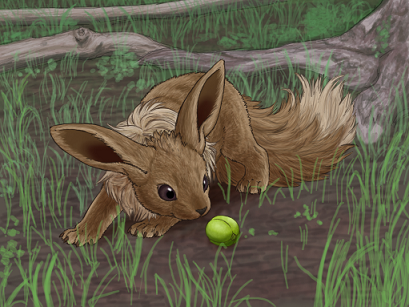
 A more realistic take on Eevee by RacieB (http://racieb.deviantart.com/).

The problem – and it’s one I’ve been trying to work around as I go – is that the designers’ level of commitment to this concept doesn’t seem to have been constant all the way through.  In particular, their use of the theme of environmental adaptation is rather haphazard.  As I mentioned in Glaceon’s entry, it makes sense to us on a certain level that Pokémon in hot places should fight with fire, and Pokémon in cold places should fight with ice, and Pokémon that live in forests should act like plants, and so on, because we expect them to take on the traits of the things around them.  When you think of it from an ecological standpoint, though, it starts to get quite odd.  It makes sense for Glaceon to resist cold, because she lives in cold places, but does it make sense for her to use the cold, when everything around her will resist cold as well?  Conversely, it makes sense for Leafeon to be able to use the plants around him, since he’s a jungle Pokémon, but does it make sense for him to adopt a lifestyle that leads him into direct competition with all those plants?  This is the reason I don’t place Flareon in a volcanic environment, even though this is something of a standard choice for Fire Pokémon – of course the fire-based creatures that live there already, like Slugma or Magmar, would innately be able to use fire, but if you were a Normal-type moving into a place like that, what survival advantage would be conferred by gaining fire abilities?  In the end, of course, a complete ecology of the Pokémon world is a long way off – if there’s even any possibility it will ever happen at all – but I think looking at Eevee in a more critical light might be a good place for any such project to start.
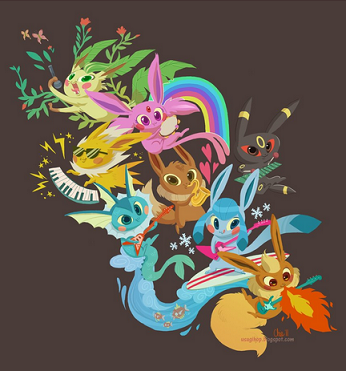
 Before today, you all had to trudge through the endless dreariness of your dull and unfulfilling lives without the awesomeness that is an Eeveelution rock band.  Now, thanks to Tinysnail (http://tinysnail.deviantart.com/), you no longer have to!

Let’s return to that question I was supposed to be answering.  What else could you evolve Eevee into?  Ground, Rock, or Fighting?  They would be obvious choices for filling that one remaining aesthetic niche, but I’m not sure the idea of a brutish Eevee is necessarily one that would achieve any particular appeal.  Poison?  What thematic aims would be served by creating a poisonous Eevee?  Flying, Bug or Dragon would be… odd, put it that way.  They would make our new Eeveelution very much an odd one out in the Field egg group, since those three types are some of those that map most closely onto corresponding breeding groups, and they also raise some concerns about what environmental stimulus, exactly, would prompt Eevee to sprout wings or additional legs.  Ghost could potentially bring up some points about Eevee’s interaction with humans, but I’m not convinced you could do anything with it that Espeon and Umbreon didn’t.  I’d prefer to leave Steel out of it, because that’s getting perilously close to drawing human modification into things, which I worry would rather miss the point.  In fact I think there’s really only one type you could do anything interesting with if you wanted to make an eighth evolved form for Eevee.  It’s Normal.  All the other forms focus on shedding Eevee’s flexibility in exchange for becoming supremely well-adapted to a particular environment; a Normal-type evolution could instead look at the idea of retaining that adaptability; instead of having the narrow movepools that signify the specialisation of the other forms, she could use a wide selection of moves to act as a ‘jack of all trades, master of none’ type character (something like, say, Clefable or Mesprit, except that it would be the whole point of the design rather than an unintended result).  I might abandon the traditional Eeveelution stat spread as well, and give it flat average stats across the board, just to ram the point home.  This is a Pokémon that travels widely and can live anywhere.  It can’t settle down and really force other species out of their permanent niches, but it can get by in just about any environment.  As a result, it’s both adventurous and capricious, preferring not to stay in one place for too long, and, like humans, prizes wide knowledge and varied experiences.  The unfortunate weakness to this design is that I really have no idea where I would take its art – all my concerns about retreading old ground still stand, and I’m not especially wild about the obvious route of just creating a bigger, fluffier Eevee either.

The point I am by slow degrees trying to make here is that Eevee, in my opinion, is a fascinating Pokémon, who can provide some interesting lessons in design that haven’t really been appreciated or explored, even by her own more recent family members.  Her massive popularity (and that of her older siblings) isn’t just a question of cuteness, because of course Eevee is cute, but there’s nothing really to recommend her over the legions of other cute Pokémon out there.  She succeeds because she can be many things to many people.  If you love your Eevee, she will grow with you, reflecting your own ambitions and your own choices – and that, when it comes right down to it, is what Pokémon is all about.
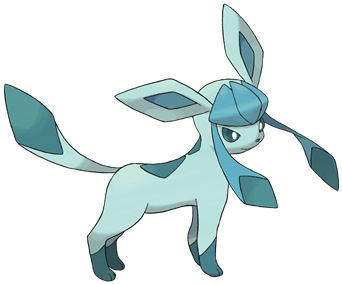
Glaceon

Official art of Glaceon, by Ken Sugimori; all glory to Nintendo.So, if you read my entry on Leafeon all the way to the end, you may have gleaned that I don’t particularly think much of Glaceon either.  It’s nothing personal.  I actually have a certain affection for Glaceon; she’s pretty cute, as Ice-types go, and she’s not exactly a terrible Pokémon either.  On sober reflection, though, I think she’s rather bland, and, much like Leafeon, struggles to develop an aesthetic or competitive niche within her large family.
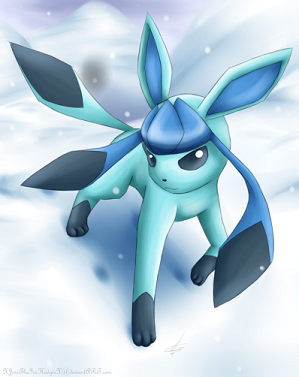
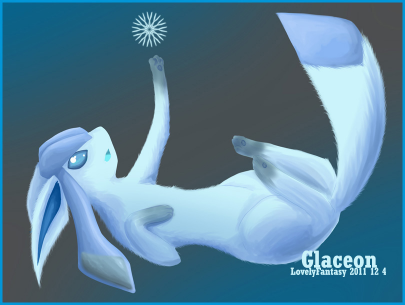
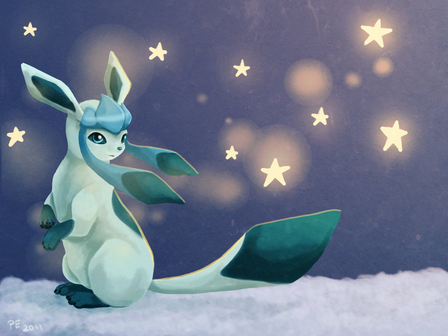
With an elegant, lithe exterior concealing incredible powers over ice and snow, Glaceon is certainly an adorable yet dangerous Pokémon… but there’s not really a lot to her.  She has a sort of diamond motif that I guess creates a pleasing allusion to snow crystals, and she’s… blue.  Which is good, because ice is sometimes blue.  As an Ice Pokémon, she is capable of causing her body temperature to plummet, draining heat from the air around her to create chilling gales.  This also freezes her fur into needle-like spines, which she can fire at her ene-

Wait.  Go go gadget Pokédex.

“It lowers its body heat to freeze its fur.  The hairs then become like needles it can fire.”

Game Freak, are you seriously telling me you got so lazy that you stole Jolteon’s flavour text?

 Glaceon trecking through a snowstorm, by Viperidaemon (http://viperidaemon.deviantart.com/).

Yes, that is exactly what they are telling me.  What’s more, because it worked so well for Jolteon, they chose to represent this power in game with a silly little move that no-one will ever use (I don’t care how badly you need a priority attack) because Glaceon’s physical attack stat is appalling – Ice Shard.  Unlike Jolteon, Glaceon doesn’t really look like she has any business using an attack like this, probably because it’s something that was pasted on at the last minute and not an actual part of the design.  I’m sorry, but if this doesn’t say “we ran out of ideas” then I don’t know what does.  Glaceon’s elegant and beautiful like Vaporeon, sure, but Vaporeon is a creative hybrid of terrestrial and aquatic features, whereas Glaceon is just a nice shade of cyan.  She has magical freezing abilities, but so do most other Ice Pokémon.  I don’t think I would be upset with this design if I thought there were an evolution on the way; it feels incomplete, as though it’s waiting for elaboration, and detail… but no; Glaceon is the evolution.  I find myself without any reason to care about her.

As with Leafeon, Glaceon’s method of evolution makes it obvious what kind of environment she’s meant for (if her icy powers weren’t already enough of a clue) – set off by the Ice Rocks found near Snowpoint City in Sinnoh and beneath Twist Mountain in Unova, Glaceon is a cold-adapted Eevee, at home in alpine and boreal forest terrain.  It’s strange that she doesn’t seem to have any of the features normally associated with cold-adapted species, like large size (to reduce your surface area to volume ratio) and thick fur (for insulation), but I suppose many of the normal rules for living in cold climates go out the window anyway for Glaceon and for several other Ice Pokémon, who are actually colder than their surrounding environments.  Glaceon fights by chilling the air around her, so for her a high surface area, and hence small size, makes sense to maximise her ability to drain heat from the atmosphere.  Glaceon and Leafeon are the first Eeveelutions to really embrace the idea that Eevee’s unusual properties are a result of her adaptability, which is great, because it’s a fun idea that gives Eevee and her weird split evolution a great deal of significance and some interesting implications.  However, they also neglect to do much of anything with the idea.  Forest Eevee is a Grass-type, alpine Eevee is an Ice-type; they take on the characteristics of the environment that they live in… but this leads to Leafeon competing with tall trees for light to photosynthesise, and Glaceon using cold attacks to defend herself from other cold-adapted species.  This is a slight problem that hides beneath a lot of Pokémon, but we tend to ignore it because there’s a certain intuitive rightness about it.  When you set up a species as ‘the adapter,’ though, it draws attention to the fact that it doesn’t actually make a lot of ecological sense for Pokémon to adapt in this way and develop these powers… more on that next time, though.

 Glaceon playing with a snowflake, by Lovelyfantasy (http://lovelyfantasy.deviantart.com/).

As far as battles go, Glaceon has one big, important selling point: she commands the most powerful Ice attack in the game (barring legendary Pokémon), a devastating Blizzard which, backed up with Hail to boost its accuracy, will level just about anything that doesn’t resist it.  Realistically, Ice Beam is a lot more reliable, and will still hammer the opposition pretty severely.  This, sadly, is where the good news ends.  Ice is a great offensive type, hitting four other elements for super-effective damage, including Dragon.  However, it is also hands-down the worst defensive type in the game, sporting only a single resistance (to itself).  This would not be such a problem if Glaceon were set up as a sweeper, but she isn’t – she’s actually quite slow.  Her greatest assets, after her monstrous special attack, are her defence and special defence, which, in combination with her poor HP, are good but not amazing (to be fair, she can boost her physical defence with Barrier and retaliate against special attacks with Mirror Coat, but that takes time and moveslots).  Glaceon will face a lot of hits from faster Pokémon as she attempts to freeze-dry her way to glory, and although she’s pretty bulky for an attacker, the lack of resistances makes it very difficult for her to handle repeated assaults.  It also reduces her suitability for using all the neat little support moves that her family has access to, like Wish, Baton Pass, Heal Bell and Yawn.  The other major problem for Glaceon is that, like all her brothers and sisters before her, her offensive movepool is quite small.  After Ice Beam, she’s got Shadow Ball and Signal Beam, which are helpful but don’t have a lot of power and are from fairly weak elements – and the truly damning thing is that, if she wants to manage neutral damage against most Steel-types, she has to resort to the decidedly lacklustre Water Pulse (available from a 4th-generation TM).  Basically, she has the wrong stats and movepool for a sweeper, the wrong type for a tank, and no other viable choices.

As far as I can tell, Black and White didn’t do much for Glaceon… if anything.  The new move tutors in Black 2 and White 2 seem to have added Hyper Voice to her movepool, along with those of all the other Eevee evolutions; I haven’t mentioned it in any of their entries because Normal attacks are generally less than stellar choices, but Glaceon is so desperate for weapons that it might be worth a shot.  Frost Breath, a weak Ice attack that always scores critical hits, is amusing against anything that favours Calm Mind or Amnesia but substantially weaker than Ice Beam otherwise.  Her abilities aren’t much help either; both improve her staying power in Hail, but weather strategies can be tricky to pull off at the best of times, Hail is easily the hardest to build a team around, and as we’ve already seen Glaceon has problems trying to act as a tank anyway.  Snow Cloak grants a helpful but unreliable 20% evasion chance (potentially good for use with Double Team, but Double Team is often frowned upon for its emphasis on luck); you’re probably better off with Ice Body, which lets Glaceon slowly regenerate in Hail, but that does invite rather unfortunate comparisons to Walrein, who does the same thing about a million times better.

 Cottondragon's (http://cottondragon.deviantart.com/) Glaceon against a sparkling night sky.

The really sad thing is that Glaceon isn’t even the only member of her family with powerful Ice attacks, because the rule that Water-types can use Ice moves seems to override the rule that Eevee’s evolutions aren’t allowed diverse offensive movepools.  Vaporeon’s Ice Beam is a lot weaker than Glaceon’s, naturally, but it’s also not the only thing she’s good at.   That, for me, sums up Glaceon’s problems; she simply doesn’t do anything special.  The designers seem to have decided that they needed a seventh evolved form for Eevee, but neglected to develop any sort of conceptual basis for what they were creating.  The end result is “Eevee, only blue and chilly,” which is a real pity because Ice is a fun type to work with and think about, and there’s nothing wrong with the idea of an Ice-type Eevee… it’s just not enough on its own.  Glaceon is just another of those Pokémon who needed a little more thought, never got it… and probably never will.

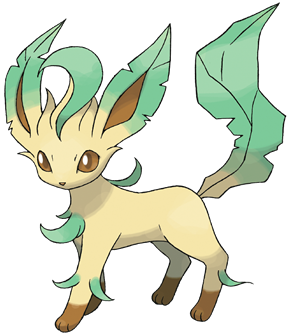
Leafeon

Official art of Leafeon, by Ken Sugimori; Ph'nglui mglw'nafh Nintendo wgah'nagl fhtagn.I’ve never been entirely sure what to think of Leafeon.  My initial impression, just to get it out of the way, was that ‘Leafeon’ is an incredible cop-out of a name; I’d always hoped a Grass-type Eevee would have a somewhat more creative name like ‘Arboreon’ or ‘Chloreon’ or something.  I guess the name isn’t that important, though – right?  Let’s look at what else he can offer us.
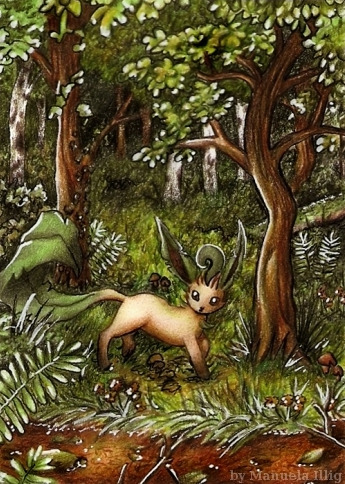
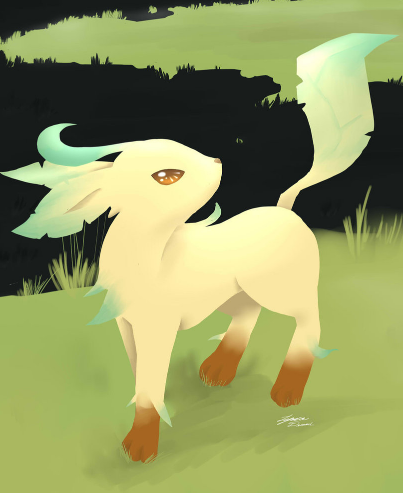
Leafeon is a pacifist.  He doesn’t fight if he can possibly avoid it, and frankly he doesn’t need to, because, unlike most of Eevee’s other forms, Leafeon isn’t carnivorous – in fact he doesn’t eat at all.  He’s instead adapted his cells to photosynthesise, like plant cells do, and spends most of his time basking in the sunlight.  Because of the way he sustains himself, Leafeon, in a reversal of the standard set-up for animals, breathes in carbon dioxide and releases oxygen, creating a permanent zone of fresh, clean air around his body.  The issue I take with this is that it’s really rather boring.  As I mentioned months ago when I complained about Sunflora, it’s just not interesting to talk up the fact that a Grass Pokémon photosynthesises when all Grass Pokémon photosynthesise, even the ones like Gloom and Amoonguss who are based on things that don’t.  This is, you may have noticed, something of a pervasive trend with Eevee’s evolved forms; often the most significant aspects of their designs are that they’re just like other Pokémon of their respective elements, which sort of makes Eevee more interesting by emphasising her potential for change at the expense of the evolutions themselves (more on this at the end of this series).  I suppose it’s true that the idea of purifying the air has never specifically been called out as an attribute of any other Grass Pokémon – again, it’s something that they all do, but the fact that photosynthesis, y’know, makes the air breathable is an aspect of the process that people often forget, and it does deserve to be emphasised once in a while.  I’d be much happier if it were actually related to Leafeon’s powers or art in some way, though.  It would make me feel like there’s some point to the design, which is currently rather lacking.

 A Leafeon surveying his forest domain, by Diaris (http://diaris.deviantart.com/).

Leafeon and Glaceon mark the point at which Game Freak finally committed to the idea floated in Gold and Silver that Eevee’s evolution into multiple different forms is triggered by exposure to different environments.  Leafeon will evolve in the presence of a Moss Rock, which is… well… exactly what it sounds like, a great big boulder covered in moss.  There’s one in the Eterna Forest in Sinnoh, and one in the Pinwheel Forest in Unova.  I’m not entirely sure why the rock is necessary.  Eevee doesn’t actually need to be near it; her evolution is tied to the whole wider game area in which the rock is located, the way Nosepass and Magneton are tied to Mount Coronet.  I guess the game designers just wanted to have some kind of marker.  Anyway, Leafeon’s evolution method makes the question of his environment relatively straightforward: Leafeon is an Eevee adapted to life in dense, old-growth temperate forests.  This, surprisingly, raises some odd questions.  Leafeon is an animal who is specifically adapted to use photosynthesis instead of hunting or grazing for food.  This makes absolutely no sense for a temperate forest environment, where biomass is plentiful but sunlight is at a premium, most of it drunk up by the tall, old trees that make up the forest’s canopy.  If you’re a plant anyway, it makes sense to go with it and learn to live on relatively little sunshine, or become an epiphyte and leech off larger plants, but if you started off as an animal (as Leafeon did), already reliant on eating plants or other animals for energy, there isn’t really any logical reason to make the change.  I suppose it would make some sense of things if Leafeon actually spent most of his time in the canopy, clambering around the highest branches where it’s reasonably bright and he doesn’t have to deal with tall trees hogging all the sun.  It would follow, then, that Leafeon is more dextrous and nimble than he appears, probably able to climb and jump with great speed and skill – like a peaceful version of the Malagasy fossa, a catlike relative of the weasel that can move on the ground and in the trees with practically equal ease.

It occurred to me, briefly, that I was probably reading way too much into this.  Then I remembered that reading way too much into things is kinda my schtick.

You people have no idea how awesome it is being me.  It’s like being a rich American on holiday; you strut around yakking, utterly fascinated by things that everyone else takes for granted, and people are nice to you for no discernible reason, even though no-one has any idea what you’re saying.

Anyway.

 A clean, minimalistic take on Leafeon by LyricaDreams (http://lyricadreams.deviantart.com/).

It is, unfortunately, one of Game Freak’s most important rules of design that Grass-Types Do Not Get Nice Things.  Furthermore, as we have established, it is another important rule that Eevee’s evolutions have an extremely limited selection of attacks.  These two factors conspire to make Leafeon very difficult to find a niche for.  His best stat is physical defence, but this is offset by his poor HP and special defence scores.  He has very good attack and speed, but his usable physical movepool is tiny.  Leaf Blade is an excellent start, but X-Scissor is almost totally redundant (Grass and Bug have four weaknesses in common and don’t really complement each other at all), Aerial Ace is just a little bit pathetic as far as damage goes, Normal attacks are Normal attacks, but at least they’re always good for neutral damage, and… and… yeah, okay, I think that’s it, actually.  I guess if you really enjoy basking in the awfulness of Leafeon’s movepool you can always give him Rock Smash; it’ll outshine all his other attacks against most Steel-types, not that this is saying much.  Leafeon can improve his attacks with Swords Dance, but they’re so easy to counter that this is unlikely to help.  He’s probably better off using Baton Pass to let someone else take those Swords Dance boosts, and with his good speed he’s actually not that bad at this.  The trouble is that, unlike his brothers and sisters who also favour Baton Pass, Leafeon doesn’t really have a niche here.  Jolteon is one of the fastest Pokémon in the game, and as such it’s very difficult to stop him from passing.  Umbreon is easily the toughest Pokémon capable of passing Curse.  Espeon was hands-down the best Calm Mind passer (aside from Mew) even before she got Magic Bounce.  Vaporeon’s massive HP stat allows her to create and pass very powerful Substitutes to soak enemy attacks.  When we come to Leafeon… well, there are quite a few Pokémon who can pass Swords Dance, and many of them are very good at it.  Leafeon has competition from the likes of Scyther and Scizor, Blaziken, Mienshao, Gliscor, Ninjask… hell, Scolipede is faster than Leafeon and has a much better physical movepool.  Naturally, Leafeon also has a few nice moves like Wish, Yawn and Heal Bell that the whole family shares… but if you use Leafeon for those moves, you sort of have to ask yourself why you aren’t using Vaporeon or Espeon.

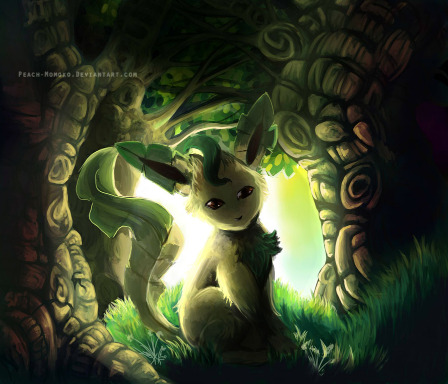
 Leafeon sitting in a secluded hideaway, by Peach-Momoko (http://peach-momoko.deviantart.com/).

The final insult is that Leafeon has a Dream World ability which would be absolutely perfect for a Swords Dance sweeper (as Sawsbuck demonstrates, in fact) – Chlorophyll doubles his speed in bright sunlight, allowing him to outrun practically everything that he could possibly want to.  Unfortunately, as we’ve established, Leafeon is not really a good sweeper because of his appalling physical movepool, and no amount of speed is likely to change that.  The Chlorophyll boost can’t be passed either (although it does, admittedly, make it easier for Leafeon to get off a Baton Pass without being knocked out).  His regular ability, Leaf Guard, makes him immune to poison, paralysis and the like in bright sunlight, which is very useful to have, certainly, but you don’t actually need status attacks to beat Leafeon anyway, and if he happens to take one while the weather is less than clement, Leaf Guard does him no good.

In the end, Leafeon is disturbingly reminiscent of Flareon; a theoretically powerful Pokémon who is utterly hamstrung by a lack of synergy within his skillset and a small variety of options.  He’s also, to my mind anyway, that most sinful of atrocities – a boring Pokémon with no clear design goals, and no particular niche to distinguish him from either the rest of his family or the rest of his element.  I realise this will probably sound like ‘new Pokémon hate,’ a pervasive evil which I prefer not to condone, but I really do think that Leafeon and Glaceon passed the ‘too much’ threshold for the Eevee family.  Better not give away too much of the next entry, though…

Umbreon

Official art of Umbreon, by Ken Sugimori; blood for Nintendo, skulls for their skull throne.Dark is a strange type.  Dark Pokémon aren’t necessarily connected with darkness or the night at all, although many of them do prefer the dark.  ‘Dark type’ is actually a somewhat imprecise translation of the Japanese term literally meaning ‘evil type,’ but that just throws up more questions – whole species of Pokémon that are just ‘evil’?  That can’t be right, can it?  Dark Pokémon are associated with evil, and also with trickery, and often with fear, but they aren’t necessarily evil themselves; they’re part of that old stereotype of the ‘misunderstood brooding dark hero.’  Dark Pokémon may well work towards good, but they can and will lie, cheat and steal to do so, and they will not on any account fight fair, because the ends justify the means.
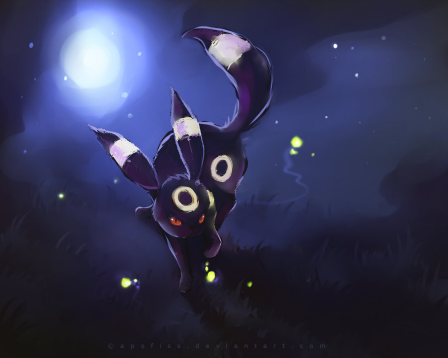
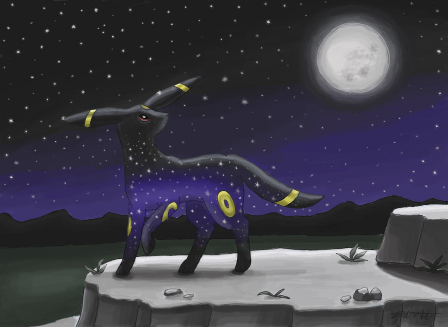
Umbreon is one of the game’s oldest Dark-types, and naturally he grabs this concept with both hands.  Umbreon is a badass, but in a very different way to Jolteon: dark and dangerous, but in an understated, subtle way.  The yellow-on-black of his ring markings is bold, like the light of the moon against the black of the night sky, but minimalistic.  This is not a Pokémon who goes in for glorious battle and flashy displays of power; this is a Pokémon who gets things done quickly, quietly and, if at all possible, without ever being seen.  He’s noted for his poisonous sweat (oddly, Umbreon doesn’t naturally have any Poison attacks – maybe Game Freak always anticipated that everyone would teach him Toxic?) and for his supernatural ability to cause fear in others when the rings on his body glow in the moonlight.  An ambush hunter, he prefers to move around at night, when he can remain hidden and wait for his prey to present a vulnerability.  Umbreon seems to be empowered somehow by exposure to moonlight (hence his in-game ability to heal himself with Moonlight, a move analogous to Espeon’s signature Morning Sun but shared originally by Clefairy and Oddish) but the exact nature of his powers seems to be mysterious.  The result of all this is that Umbreon’s particular brand of charm falls somewhere between Jolteon and Espeon, based on a combination of decisive power and elusive mystique, exactly the combination that captured the imagination of Karen, leader of the Johto Elite Four, all those years ago.  Personally Espeon is still my favourite, but I can definitely see Umbreon’s appeal too.

As I’ve been looking at Eevee’s evolutions so far, I’ve been interpreting them with a view to understanding the environments that might have caused Eevee to develop all of these forms in the first place.  In Espeon’s case I concluded, based on the stimulus that triggers her evolution and the nature of her powers, that she represents a form of Eevee specially adapted to domestication, and particularly to the defence of settled communities.  Now, Umbreon evolves from Eevee in more or less the same way as Espeon – by forming a particularly close bond with his trainer – except that Eevee can become Espeon during the day and Umbreon during the night.  Logically, one assumes that partnership with humans had some hand in the development of Umbreon as a species as well, but why the split between the two?  I think the answer is in what it means to be a Dark-type.  Espeon is all about community and empathy; she developed her psychic powers to defend homes and families.  Umbreon, by contrast, is all about solitude and individualism – this species evolved at the same time and for similar reasons, but for different purposes.  Espeon is a protector, active during the day, staying close to the settlement and looking after the old and the very young as they go about their domestic work.  By contrast Umbreon, a strain devoted to survival, efficiency, stealth and cunning, developed out of the Eevee who partnered with hunters and scouts whose tasks were related to the night – although they do live in settled villages, they fulfil their most important roles beyond the community’s borders.  This is where Umbreon’s whole attitude and demeanour come from.  The quintessential Dark-types, they do their work out in the wilderness where they have no-one to rely on but their human partners, and where no-one else will rely on them, hence the ‘ends justify the means’ approach they take to combat.  They work for the good of their communities, but out on the frontiers they have no time for rules.

Umbreon stalking the night, by Apofiss (http://apofiss.deviantart.com/).

Where his brothers and sisters tend to combine powerful support skills with dangerous attack options, Umbreon is instead a totally defence-focused Pokémon.  He’s slow, his attacks are weak, and like all the others, his movepool is limited, but for all-around defensive ability, Umbreon is difficult to beat.  Back in the heady days of Gold and Silver, an Umbreon with Rest or Moonlight and some nasty trick like Charm or Confuse Ray was nigh indestructible, free to fling Toxic around and then wait patiently for everything to die.  That was really all you needed to do with him (aside from keep him away from Poison- or Steel-types, obviously), although, like most of Eevee’s other evolved forms, Umbreon had a nifty trick to use with Baton Pass: Mean Look.  Mean Look traps an opposing Pokémon in play until Umbreon switches out or faints – wonderful if it’s something Umbreon can handle.  If not, though, Baton Pass will take Umbreon out of play and replace it with another Pokémon who can deal with the victim… and keep the trap effect, which would be ended if Umbreon were to switch out normally.  This would eventually become Umbreon’s main tactic.  He gained Taunt and Wish in Ruby and Sapphire, which were useful toys for ruining other support Pokémon and keeping his teammates healthy, respectively, and the addition of physical Dark attacks in Diamond and Pearl made it possible to use Umbreon as a slow physical tank with Curse (Payback, which is more powerful when the user moves after its opponent, is noteworthy – if you’re using Curse, you’ll be slower than anything else around anyway).  The combination of Mean Look and Baton Pass was his big trick, though; it’s a difficult strategy to pull off, but succeeding at it would almost certainly doom at least one opposing Pokémon, trapped in play against a Pokémon of your choice, and Umbreon is tough enough that he could and did make it work.

And then they took it off him.

For reasons that escape me, Mean Look was removed from the list of effects that can be transferred by Baton Pass in Black and White.  It couldn’t have been for thematic reasons, since there’s never been any real logic to what gets transferred and what doesn’t (and how is Baton Pass imagined to work, anyway?).  Could it have been for balance reasons?  Well, only a handful of Pokémon could ever do this anyway.  Absol was terrible at it, and murdering things with Swords Dance is a much better use of her time.  Smeargle, likewise, had better things to do unless you wanted to put him into a Baton Pass chain, and even then he has more important moves.  Essentially, the only things that changing the mechanics of Mean Look did were stealing Umbreon’s favourite specialty tactic and finally eradicating the only reason ever to use Ariados (who used Spider Web in place of Mean Look).  Since it is an inescapable truth that no-one in the world has ever actually used Ariados anyway, I am forced to conclude that Game Freak just woke up one morning and decided they hated Umbreon.  It’s just such a bizarre thing to change, when there are so many other inane things that they insist on keeping the same.

Okay; rant over.

Umbreon fading out against the night sky, by MusicMew (http://musicmew.deviantart.com/).  I'm pretty sure Umbreon can't actually do that but it looks awesome so who cares?

Don’t get me wrong.  Umbreon is still a wonderful defensive Pokémon – in fact, he’s the toughest Dark-type in the game; only Mandibuzz is comparable, and Umbreon leaves her in the dust for special defence.  His Wishes aren’t as potent as Vaporeon’s, but he’s still a decent Pokémon to put on healing duty, and he can threaten to put things to sleep with Yawn.  Curse remains an option too if you want a more aggressive Umbreon, and it looks like Black and White 2 have given him Foul Play, a powerful Dark attack that circumvents Umbreon’s poor attack stat by allowing him to use his opponent’s instead.  His abilities are fairly plain, as abilities go; Synchronise is nice to have but not particularly useful, as for Espeon, but unlike Espeon his Dream World ability is garbage – Inner Focus?  Immunity to flinching?  I guess if you really hate Togekiss or Jirachi… but Togekiss will just smack Umbreon in the face with a super-effective Aura Sphere, and Jirachi is immune to Toxic, which means Umbreon can’t actually hurt her anyway.  This is, essentially, the crux of the matter for Umbreon: passing Mean Look was easily the most threatening thing he could do; now anything immune to poison just doesn’t care about him anymore.  Steel-types in particular, who resist Dark attacks, no longer have any reason to pay attention to Umbreon.  They can just get along with their own thing, and Umbreon will have no choice but to flee, maybe dropping a Wish on the way out if he’s lucky.  Vaporeon, by way of contrast, is much harder to block completely; sure, Water-types will largely ignore her main attacks, but thanks to Water Absorb and her good special defence, she’ll ignore them right back!

In spite of my rant, I really do think that Umbreon works.  He’s sleek but bold, not quite like any of the others, and as such he appeals to, once again, a different segment of people.  His total defence focus is different as well, not just from his brothers and sisters but from the stereotypes of his element as a whole.  I just have to slam the mechanical change to Mean Look one more time because it actually reduces diversity and uniqueness instead of increasing it by eliminating a previously difficult but powerful and interesting tactic; I just find it fundamentally absurd on grounds of design philosophy.  Umbreon is far from ruined, though; if you need a bulky Dark-type, there’s none better.

Espeon

Official artwork of Espeon, by Ken Sugimori; do unto Nintendo as you would have Nintendo do unto you, etc.In Red and Blue, Eevee was unique, the only Pokémon in the game with a branching evolution.  The introduction of some of Gold and Silver’s new Pokémon, like Slowking, changed that – several others could now evolve in multiple different ways.  Tyrogue even had a three-way split, into Hitmonchan, Hitmonlee and Hitmontop.  Clearly this would not do, so Gold and Silver also added two more members to Eevee’s family; if she couldn’t be the only Pokémon with multiple evolutions, she could still have more than anyone else.  Thus we have Espeon and Umbreon, the evolutions connected with the day and the night – and for today, it falls to us to look at Espeon.
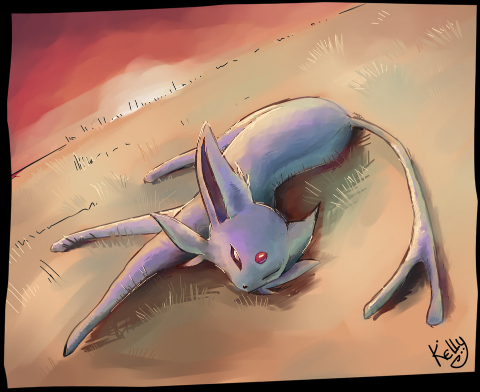
Much as Vaporeon, Jolteon and Flareon each play to a different set of aesthetic preferences, Espeon tries for another still different look; with her aloof, alien countenance, forked tail and intense, flashing eyes, Espeon’s air is one of mysterious, otherworldly power – appropriately enough for a Psychic-type.  Espeon is unusual for a Psychic Pokémon in that her most famous ability doesn’t actually result from psychic power at all; she can predict the immediate future with an uncanny degree of accuracy – everything from weather patterns to an opponent’s movements – but does it by reading subtle changes in air currents with her fine, sensitive hairs.  I almost suspect this is meant to make us ask whether all psychic power in the Pokémon universe actually has a more mundane explanation… but, then, we’re also told explicitly that Espeon does use “psycho-power” and she has the standard set of telekinetic and telepathic abilities available to all Psychic-types, so maybe I’m giving Game Freak too much credit here.  Like many Psychic Pokémon, Espeon is particularly associated with loyalty towards and protection of worthy trainers, which makes sense given the way she evolves.  Oddly, she’s also connected with the sun and daylight – oddly, because she has few powers related to it.  I imagine this was intended to set her up as an opposite to Umbreon, who is strongly linked with the moon and the night, and I suppose Psychic is the closest thing Pokémon has to a ‘light’ or ‘holy’ type, but I can’t help but think that this could have been done better if Espeon had been created later in the series’ life.  She does have Morning Sun as a signature move, and she can learn Sunny Day (along with just about every Pokémon in the game except for Water-types) but doesn’t get much benefit from it; surely it would make sense for her to learn Solarbeam, at least?  I don’t know; if I were designing Espeon today I would probably do her totally differently to emphasise the solar aspect, but I guess given the tools that were available in Gold and Silver (no abilities, fewer weather-related effects) what we have is fine.

 Espeon leaping into action, by Mewkitty (http://mewkitty.deviantart.com/).

 Gold and Silver are the games that introduced the idea that Eevee’s branching evolution is a result of adaptation to multiple different environments, so it’s odd that the two evolutions introduced in that very generation, Espeon and Umbreon, are the hardest to connect with any particular ecosystem.  A possible clue, though, is the stimulus that triggers Espeon’s evolution – close friendship with a trainer – and the suggestion from Ruby and Sapphire that “this Pokémon developed its precognitive powers to protect its trainer from harm.”  I suspect that Espeon arose fairly recently (in terms of evolutionary biology), after humans and Pokémon first began working together, and represents the result of a strain of Eevee who became adapted to domestication, the eventual descendents of the first groups of Jolteon and Flareon who took human partners.  She has telepathic abilities to allow her to sense the orders of her human trainers, and can predict the future to intercept attacks before they happen.  Furthermore, unlike the raw elemental forces wielded by Flareon, Vaporeon and Jolteon, Espeon’s telekinetic attacks are very unlikely to cause ‘friendly fire’ problems; she’s not going to hurt anything she doesn’t fully intend to hurt, making it safer to use her strongest powers around groups of people.  Furthermore, I’d suggest that Espeon isn’t a hunter – early domesticated Pokémon, one assumes, would have been involved with hunting like the first domesticated dogs, but a more predatory type like Jolteon seems better suited to that.  I think Espeon may be a Pokémon dedicated to the defence of the settled communities that developed later in humanity’s history, which makes some thematic sense given the connection between Psychic-types and more ‘evolved’ or ‘civilised’ states of mind.  The other forms are older, and joined with humanity out of convenience; Espeon actually developed with us, changing as we did.Espeon stretching out at sunset, by Kellykatz (http://kellykatz.deviantart.com/ or http://kellykatz.tumblr.com/).

When you want to fight with Espeon, many of the same issues arise as we encountered with Vaporeon, Jolteon and Flareon.  Espeon has extremely good special attack and speed, which ideally make her a sweeper of some kind, but her special movepool is less than stellar – in Gold and Silver, it was pretty much Psychic, Bite, and Zap Cannon.  Her signature move, Morning Sun, provides her with healing, but frankly Espeon is much too frail to be worrying about that.  I guess Charm might help her survive a hit or two.  Like her brothers and sisters, she can learn Baton Pass as an Eevee, but Gold and Silver didn’t really give her anything to do with it.  Ruby and Sapphire changed that.  Espeon only gained three things of value in Ruby and Sapphire: Reflect, Light Screen, and Calm Mind.  Reflect and Light Screen are great, but nothing to make a fuss about – Calm Mind, which increases both special attack and special defence, is what gives Espeon her niche.  Very few Pokémon could learn both Calm Mind and Baton Pass, and Espeon was (indeed, still is) the best of them; her own ability as a special attacker remained limited, but helping others to set up was another story.  Diamond and Pearl didn’t much change what Espeon was good at – like many Pokémon, she gained a lot of new attacks, notably Shadow Ball, Grass Knot and, in Platinum, Signal Beam, but, while useful, these new moves aren’t powerful enough to dramatically change her game.  Meanwhile, the conversion of Pursuit, along with every other existing Dark-type move, into a physical attack spelled disaster for many Psychic Pokémon whose defensive skills were far weaker on the physical side, including Espeon.  For a while there, things looked grim… until Black and White gave Espeon one last trick, the best of all.

 An Espeon wandering by a river at dawn, by Diaris (http://diaris.deviantart.com/).

The thing about Espeon’s ability, Synchronise, is that while it’s nice to have, it doesn’t really have great strategic implications.  If Espeon is poisoned, burned or paralysed by another Pokémon that is vulnerable to the same condition, she causes her attacker to suffer from the same effect.  This is a useful defence against a specific kind of attack, but it doesn’t help Espeon much; she’s still poisoned, paralysed or burned as well.  Her Dream World ability is something else.  Espeon’s Dream World ability is Magic Bounce, a truly absurd power shared only by Xatu, which effectively gives her a permanent Magic Coat – all incoming status moves (basically anything that harms a Pokémon without actually damaging it, from String Shot and Worry Seed to Stealth Rock and Dark Void) are reflected back upon their user.  This makes Espeon an utter nightmare for support Pokémon, since she can potentially ruin them just by switching in if you time it right; some moves, like Hypnosis, will potentially take a Pokémon out of the game if you reflect them back.  The fact that Magic Bounce also renders Espeon herself immune to all these techniques is nothing to sniff at either.  The other thing worth noting is that Espeon also gets a couple of new Psychic attacks for variety – Psyshock is a special attack that does physical damage, allowing Espeon and other Psychic Pokémon to break powerful special walls (i.e. Blissey), while Stored Power, an attack that does more damage for every buff affecting Espeon, synergises well with her normal role of Calm Mind passing.  Espeon doesn’t really ‘do’ sweeping – her stats look right for it, but her real talents lie elsewhere.  As support Pokémon go, she’s pretty top-notch; kept away from high-powered physical attackers and partnered with your own special sweepers who need a bit more oomph, Espeon is sure to reward you.

As I believe I’ve mentioned, Espeon is actually my favourite Eevee form.  This isn’t because of any particular excellence of design, though; it’s just personal preference.  I feel Espeon is, all around, reasonably well done, and Game Freak have actually built on her skillset over time to make up for her initial weaknesses – admittedly, this is probably by sheer coincidence, but don’t look a gift horse in the mouth (well… unless a Greek warlord is giving it to you).  Aside from the recent addition of that absurd Magic Bounce ability (which probably makes her the most powerful member of the family), there’s nothing about Espeon to get really excited over, either mechanically or thematically, but there’s nothing especially wrong with her either, and she has a solid, legitimate place of her own amongst Eevee’s varied evolutions.

Flareon

Official art of Flareon, by Ken Sugimori; I hereby pledge allegiance to Nintendo, etc.Oh, Flareon… I am so, so sorry.

The sad thing about Flareon is that she’s so like Vaporeon and Jolteon in so many ways.  Her stats, of course, are just as good.  She has an analogous ability, Flash Fire (rather than converting Fire attacks to health, as Volt Absorb and Water Absorb do, it converts them into extra power for her own Fire attacks, but the practical strategic implications are similar).  She has many of the same supports moves, like Baton Pass and Wish.  Somehow, though, it all just completely fails to come together.

Well, no, not somehow.  I know exactly why, and it’s incredibly boneheaded.


Let’s back up a bit.  Way back in Red and Blue, when Flareon was first introduced, Fire-types got shafted pretty badly: there were no Steel-types around for them to bully, very few of them had any attacks types outside of Fire and Normal, and the importance of powerful Rock Pokémon like Golem and Rhydon ensured that most teams had a very simple, no-nonsense way of saying “no” to them.  I mention this so that, when I say that Flareon looks back on Red and Blue as her glory days, you will understand exactly how grim things have been for her since then.  Back then, most Fire Pokémon relied on a moveset something like [Flamethrower/Fire Blast – Body Slam – Hyper Beam – XXX], where XXX is whatever rubbishy little support move that Pokémon happens to favour (maybe Reflect or something in Flareon’s case), and Flareon was actually very good at this moveset, thanks to her obscene attack stat and excellent special stat.  She was worryingly slow, but packed more power than any other Fire Pokémon with the exception of Moltres, which was something of a niche.  Sure, it was a crappy niche that made her a sitting duck against Golem, Rhydon, Onix, Kabutops, Omastar, and goodness knows what else, but it was hers nonetheless.  Then Gold and Silver split special into special attack and special defence.  Vaporeon and Jolteon suffered hits to their special defence, which hurt Vaporeon, but not terribly.  Flareon took the loss to her special attack instead.  Her Fire attacks were still quite potent, but were no longer the force they had once been.  On the other hand, she expanded her physical movepool with the addition of Shadow Ball and Iron Tail.  You win some, you lose some.  Curse is also an option from here on out, if you want to try turning Flareon into a physical tank, but I’m not convinced she’s really tough enough for that.  After that… well, honestly, after that Game Freak seem to have forgotten about Flareon.  She was mediocre, and mediocre she stayed.  Like all Fire Pokémon, she enjoyed the introduction of Overheat in Ruby and Sapphire, but did so while sighing wistfully at the memory of her long-lost special stat.

 The thing to remember about Flareon, as this piece by Viskamiro (http://viskamiro.deviantart.com/) attests, is that she will explode at the slightest provocation.

Diamond and Pearl, by all rights, should have revitalised Flareon, as they did so many other Pokémon whose stats and movepools were so sadly mismatched.  With physical Fire attacks on the scene at last, Flareon should finally have regained much of her former power… but she didn’t.  While Rapidash, Charizard and Arcanine paraded around showing off their shiny new Flare Blitz attack, Flareon sat in the corner with Fire Fang, wondering what she had done to deserve this.  Platinum gave her Superpower, which helped, and Lava Plume, which just rubbed salt in the wound, but Game Freak have never yet seen fit to let Flareon have a physical Fire attack that doesn’t suck.  Arguably, it might not help even if they did – Flareon’s offensive movepool suffers from the same narrowness that characterises her brothers and sisters, but with her weaker special attack, she can’t even rely on Shadow Ball as Jolteon can.  Superpower is great, and Fire and Fighting go well together, but it can only do so much, it makes Flareon’s physical stats weaker after she uses it, and it’s really all she’s got.  Jolteon and Vaporeon work around their restrictive movepools by adopting support roles, but Flareon is too fragile for Wish and too slow for Baton Pass – she has the weaknesses of both, and the strengths of neither.  Her stats seem to mark her out for some sort of Machamp- or Ursaring-like all-offensive approach, but she has nothing to attack with.  I… guess you could use Flareon as a special tank, since she does still have excellent special defence and good special attack, but it’s not like she’s good at that either; she doesn’t have a lot of hit points and her special movepool is even more limited than Jolteon’s (she doesn’t even get Signal Beam, for goodness’ sake).  Even her Dream World ability taunts her; Guts, which boosts a Pokémon’s attack in response to poison, paralysis, and so on, is an awesome ability for a physical attacker to have, but Flareon doesn’t actually learn any damned physical attacks.  In short, Flareon is terrible.  She really doesn’t deserve to be terrible, and there’s no real reason she should be terrible, but she is, and she will likely remain so until the end of time because, let’s face it, if Game Freak had any intention of fixing her, they would have done it by now.

Right; now that that unpleasantness is out of the way…

Flareon is a Fire Pokémon, and because she is a Fire Pokémon, the Pokédex feels a pressing need to explain to us, repeatedly and insistently, just how hot she is (just a hair under 900 degrees Celsius, her resting body temperature is hot enough to vaporise sulphur).  Her fluffy fur, apparently, is supposed to radiate heat to help regulate her body temperature, which… is not really how fur works; animals lose the most heat from regions that get a lot of blood flow, and fur doesn’t have blood in it, but I suppose we can guess that her hairs have some kind of dense heat-conducting core or something.  In terms of physical appearance, she’s the most like Eevee, and retains a similar aesthetic angle, aiming to be simply adorable where Vaporeon tries to achieve more of an untouchable beauty.  In fact, apart from her fiery colour scheme, Flareon barely changes at all from Eevee!  It’s not a bad thing, per se, that Flareon shares aesthetic goals with her juvenile form, and of Eevee’s seven evolutions, one of them had to be the one who was least altered.  It’s just something of a shame that it happened to be the perfectly generic Fire-type whose main distinguishing feature is just a little bit nonsensical, and even more of a shame that it happened to be the one who’s so very severely handicapped in battle.  I don’t dislike Flareon, and she fills an important place on the spectrum of Eevee’s evolved forms – two, actually, with both cuteness and firepower – but she’s one of those Pokémon that, in my opinion, have never been given the kind of attention they should have had.

 Kirree (http://kirree.deviantart.com/) has put Flareon in a very different, but rather more intuitive, environment to the one I have in mind.

Since it seems to be a theme I’ve talked myself into discussing, I should really look at Flareon’s environment.  What kind of ecosystem is she adapted for?  Well, first of all, we know that radiating body heat is a concern for her; that suggests that, contrary to the stereotype that Fire-types like to live in hot places, Flareon actually prefers a temperate climate.  A wet environment would cause problems for her since she relies on fire, but at the same time she probably wouldn’t live in a very dry place either; she’d risk causing perpetual wildfires.  We’re probably looking at somewhere with moderate temperature and humidity, then – somewhere like temperate grassland.  I imagine Flareon lying down for a nap in whatever shade she can find during the hottest part of the day, the way lions do, and letting her internal fire slowly burn down, burning just hot enough to keep going.  She hunts in the mornings and evenings, loosing sheets of fire to scorch patches of grass and flush out prey.  Flareon’s hunting practices actually serve an important ecological purpose too; by regularly engaging in controlled burning of small areas, she constructs natural firebreaks that prevent uncontrolled fires from getting out of hand.  Flareon’s own flames are so hot that they reduce the grass to ashes in moments, burning themselves out and exhausting all the available oxygen before they can spread.  That’s my story and I’m sticking to it.  In summary, then, Vaporeon is a coastal or aquatic Eevee, Jolteon is a desert Eevee, and Flareon is a grassland or savannah Eevee.  More on what all this means later.

I don’t want to be too harsh on Flareon, because she’s likeable enough, but I honestly think they did her wrong.  She’s far from irredeemable; you could fix her mechanical problems by just, y’know, giving her attacks that don’t suck, and you could fix her flavour problems just by coming up with some way for her to be different from every other Fire Pokémon with a core temperature of 900 degrees.  Her art is fine; she’s maybe not as interesting as Vaporeon and Jolteon, but she still has, and achieves, clear aesthetic goals that distinguish her from the other two, so it’s not all bad news.  The good news for me is that Flareon is something of a low point – she has some of the trickiest problems of the family.  Not to say that her newer brothers and sisters don’t have their problems too… but we’ll burn that bridge when we come to it.

Jolteon

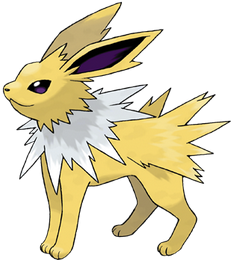
Official art of Jolteon, by Ken Sugimori; for Nintendo's is the kingdom and the power and the glory, yada yada yada.Of Eevee’s original three evolutions, Jolteon is the tough guy, the cool kid, the badass.  He appeals to a very different kind of player and a very different style of play to Vaporeon, emphasising speed and power in both his design and his skills.  This kind of variation on the basic form of the Eevee evolutions is part of Eevee’s strength – there’s something for everyone.  In Jolteon’s case, if you need a blazing-fast special attacker with serious attitude, look no further.
Like most Electric Pokémon, Jolteon’s thing is that he can hurl massive blasts of lightning at people.  He is often ill-tempered, prone to volatile swings of emotion, and his electrical charge builds rapidly when he is agitated.  His power is drawn from a rather unlikely source – his fur.  Jolteon’s fur is made up of innumerable rigid bristles that rub together to create static electricity as he moves, charging him up for electrical attacks.  The bristles also help him defend himself – they’re sharp and stiff, and stand out from his body because of the static charge, like a porcupine’s quills.  He can even launch bunches of them at his enemies to skewer them – an ability represented in-game by the sadly useless Pin Missile attack.  As Electric Pokémon go, Jolteon is a little generic, although the static fur is a nice touch to explain the source of his power while giving him a touch of character and some interesting abilities.  It’s just a shame those interesting abilities are so useless.  I’m pretty sure there’s no serious reason ever to use Pin Missile, which is a shame because, like Vaporeon’s Acid Armour, it was almost a signature move once (shared only with Beedrill).  Anyway, the really nice thing about Jolteon’s prickly fur is that the spiky starburst profile it gives him is pleasingly evocative of a jagged lightning bolt, or the crash of thunder – a neat way of working his element into the design without actually scribbling lightning bolts all over him.  Overall, I’m not terribly excited about Jolteon’s visual design, but it’s appropriate, it works, and it plays to a very different aesthetic to Vaporeon’s – sinuous and dynamic, harsh rather than elegant.

 This beautiful sparkling Jolteon is brought to us by Shiropanda (http://shiropanda.deviantart.com/).

I mentioned last time, in relation to Vaporeon, that one of Eevee’s alleged themes is adaptation to the environment – her plethora of evolved forms supposedly reflects the development of features to cope with or exploit particular aspects of a variety of habitats.  It’s a fitting enough theme to build around Eevee, since she’s supposed to be inspired by the workings of real-world evolution, which is really all about adapting to different environmental conditions; some organisms work well in one habitat, some in another, but it’s meaningless to talk about one being ‘better’ or ‘more evolved’ than another – just like Eevee’s evolutions.  The adaptation thing was written into the Pokédex in Gold and Silver, and probably wasn’t actually on the designers’ minds when they originally created Vaporeon, Jolteon, and Flareon.  This is probably why Jolteon and Flareon, quite clearly, aren’t associated with any specific habitat at all.  I can’t blame them for this, naturally, but I can make some suggestions for fixing this and bringing them in line with what seems to be Eevee’s theme now.  What kind of environment would suit Jolteon best?  Well, he can run extremely quickly, so it would make sense if he were adapted for wide open spaces; that rules out forests, hills and mountains.  Eevee and all of her evolutions sport long, broad ears which make me think of a jackrabbit or a fennec fox, who use their large ears to help dissipate excess heat and cope with life in desert climates; none of them (except, for obvious reasons, Glaceon) would look out of place in a tropical or subtropical climate, and Jolteon in particular, with his stiff, straight, bristly fur, doesn’t seem to be particularly concerned with heat retention.  Perhaps most importantly, Jolteon’s primary means of attack, his lightning, is charged by the build-up of static electricity, which is much slower and weaker in humid conditions.  Jolteon seems to be a Pokémon adapted for a hot, dry and relatively flat climate, somewhere like central Australia, or the Mojave desert in North America.  Given that this is supposed to be a theme for Eevee, I’m going to look at all her other evolved forms in the same way when we come to them, and figure out which environments they seem to match.  For now, though, let’s talk about Jolteon’s in-battle abilities.

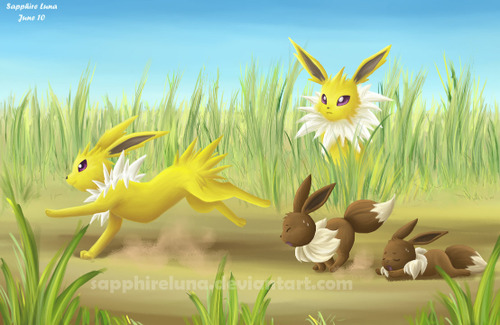
 A pair of young Eevee trying to keep up with their Jolteon parent; a little slice of adorableness by Sapphireluna (http://sapphireluna.deviantart.com/).

Jolteon’s greatest asset, the thing that sets him apart, is his speed.  Most Electric Pokémon are fast, but Jolteon is a blur of motion; in Red and Blue, he drew even with Mewtwo and Aerodactyl, outrun only by Electrode.  Even today, only a few more Pokémon can claim to be faster: Accelgor, Ninjask, and Deoxys, with Crobat just managing to keep up with him.  His excellent speed makes him rather good at sniping opposing Pokémon with his spectacular Thunderbolts, and also makes him one of the better choices for taking advantage of a rare move that all of Eevee’s evolutions have in common: Baton Pass.  This has given Jolteon a nice little niche since Baton Pass was introduced in Gold and Silver, and remains one of his most useful skills today.  He doesn’t have a whole lot of buffs to pass – Agility, Charge Beam, Substitute and maybe Work Up are pretty much the extent of it – but his Thunderbolts are frightening enough that he can usually get the free turn he needs to pull it off, and his absurd speed ensures that he doesn’t stay in play any longer than he absolutely has to.  Jolteon’s main weakness is that, like most of his siblings, he suffers from a rather small offensive movepool, which is what keeps him from being a really top-class sweeper despite having perfect stats for it.  Any Ground-type with halfway decent special defence will stop him in his tracks unless, heaven help you, you have time to breed a Jolteon with the right Hidden Power element (and even then it’s not exactly airtight; Swampert, Gastrodon and their ilk murder you if you pick Ice, Landorus and Gliscor if you pick Grass).  If you’re going to rely mainly on a single attack type, though, Electric is one of the better ones to be stuck with, and, thanks to Platinum, Jolteon can learn Signal Beam and doesn’t have to worry about Grass-types either.  Shadow Ball is Shadow Ball, but it helps with a few Pokémon, mainly Ghost-types and Ground-types.  Jolteon is relatively frail, and shouldn’t be expected to take much abuse, especially not from physical attacks, but with a bit of judicious switching and Baton Passing to keep him out of harm’s way, you should be able to nail a good few Pokémon with some Thunderbolts.

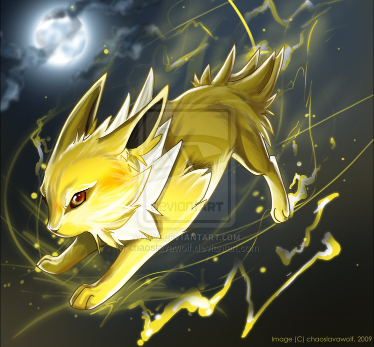
 I love this one.  This is by Chaoslavawolf (http://chaoslavawolf.deviantart.com/); I think it really captures Jolteon's energy and dynamism.

This is basically the core of Jolteon’s skillset, but he has a few other moves worth mentioning.  Volt Switch, Black and White’s great gift to Electric-types, lets a Pokémon attack and then immediately switch out, avoiding the opponent’s counterattack, and is especially effective on a fast Pokémon like Jolteon, but many Jolteon are likely to have Baton Pass anyway, and you don’t really need both; they serve a similar purpose.  Fake Tears might be interesting – catch one of those big Ground-types switching in to wreck their special defence, and they might feel less confident about eating a Shadow Ball and have to switch right back out again.  Jolteon learns Thunder Wave, but doesn’t benefit much from it since he outruns everything important already, and isn’t tough enough to pull team support duty.  Wish, likewise, is an excellent move but ill-suited to Jolteon’s capabilities.  The final nice thing about Jolteon is his ability, Volt Absorb.  In much the same way as Vaporeon’s Water Absorb, Volt Absorb negates Electric attacks and converts their energy into health, healing Jolteon by 25% of his maximum HP every time he takes one.  This is significantly less useful for Jolteon because, unlike Vaporeon, he can’t take many hits anyway and may not survive long enough to heal up, but it does still let him switch into Electric attacks with impunity, which is very useful for a frail attacker.  His Dream World ability, Quick Feet, is interesting but ultimately not worth much.  It gives him a speed boost whenever he’s paralysed or poisoned or what have you – but, being Jolteon, he’s already so fast that this isn’t likely to do much for him.  The biggest advantage to it is that it negates the massive speed penalty connected with paralysis, which makes Jolteon all but useless.  However, a Jolteon with Volt Absorb is immune to the most common and effective paralysing attack anyway (Thunder Wave) so in the end Quick Feet is a dubious choice.

As you may have gathered, what I like best about Jolteon is how very differently he handles compared to Vaporeon.  This is another of those themes I’m going to keep harping on throughout this series, and will probably talk about in some detail in the final entry on Eevee, so keep it in mind.  For now, I’ll just say that Jolteon works.  He’s not really my style, but he’s a very fun Pokémon to use, and won’t disappoint you – and, you have to admit, he’s pretty badass.

Vaporeon

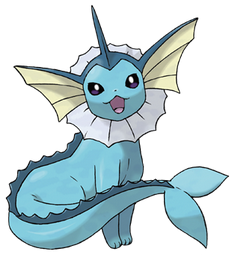
Official art of Vaporeon, by Ken Sugimori; all hail Nintendo, etc.Eevee’s enigmatic and mesmerising aquatic evolution, Vaporeon is not only the form of choice for players who are fans of elegant, beautiful Pokémon, she’s also one of the most dependable of the seven, with surprisingly good defensive skills and useful support powers.  Personally, I think she’s one of the better-designed Pokémon of the original 150 – kind of a hard act for the other six to follow, but hey, it’s not her fault she comes first in the Pokédex, so let’s see what makes her tick.
Vaporeon is an Eevee who has adapted to life in the water – her fur has been replaced by smooth, shiny skin, her fluffy mane with a webbed frill, and her puffy tail with a long, sleek dolphin-like one.  People who have seen just the tail have apparently been known to mistake Vaporeon for a mermaid.  Vaporeon is more than just an aquatic-adapted Pokémon, though.  She can actually control water to a degree that few other Water-types can match, can predict the approach of rain, and can even dissolve her own body into water in order to move unseen (this ability is represented in-game by the Acid Armour technique, which is not quite a signature move, but is restricted to only a handful of Pokémon who have similar powers, like Muk and Cryogonal).  The official explanation for how Vaporeon does this strikes me as a little bit suspect – apparently her “body’s cellular structure is similar to the molecular composition of water,” which is fundamentally absurd on a number of levels – but I’m willing to chalk this one up to the Pokédex being written by ten-year-olds who don’t know any better.  I’m tempted just to call it “magic” and move on, but then again, I suppose if all living things are mostly made of water anyway, it’s not all that impossible for Vaporeon to be able to flood her system with water in such quantities that she appears to dissolve into the water around her, even while the solid structures of her cells actually remains intact.  At least, it’s no more impossible than any of the other stuff that Pokémon do on a daily basis (actually, I think that in order to do this Vaporeon would need to have rigid-walled cells like a plant’s, in order to stop all her cells from bursting with the osmotic pressure… but let’s face it; now I’m just using fancy words to sound clever). 

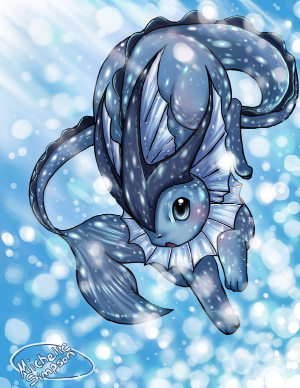
 An adorable leaping Vaporeon, by Michelle Simpson (http://michellescribbles.deviantart.com/ - if you like what you see, she does commissions).

Vaporeon succeeds at her design goals in a number of ways.  Her aquatic characteristics are smoothly blended with the basic Eevee shape she evolves from, resulting in something that isn’t just a rehash of a real water animal, the way so many Water Pokémon are, but a new and elegant combination of attributes.  Her unique water powers are also a neat point of difference from the zillions of other Water-types out there, even today with so many more to compete with than when she first took the stage.  She also fits very well with an aspect of Eevee’s design that developed a bit later, something I’m probably going to come back to a few times in this series: the idea that Eevee’s split evolution is all about adapting to the environment.  As far as I can tell, this idea isn’t present in Red, Blue or Yellow version, or the early seasons of the anime for that matter, where the presence of radiation from the elemental stones is all that’s necessary for any change.  Obviously, in the games, the stones prompt the change; there’s no question of evolving your Eevee into a Vaporeon by getting her to spend a lot of time in the swimming pool.  I do like the possibility that Eevee is able to grow in so many different directions because she’s evolved to be adaptable to many different environments, though.  Jolteon and Flareon, notably, aren’t good fits for the idea.  I can’t blame them for that, clearly, since they were designed before anyone ever suggested that adaptation to the environment was key to Eevee’s growth.  It is a nagging little inconsistency, though, which I’ll address as I move on through this project.  For now, it’s just good to note that Vaporeon fits the pattern so nicely, as an aquatic Eevee.  Moving on, then; Vaporeon is a very well-designed Pokémon, but how does she measure up in a fight?

A quick aside on the Eeveelutions’ stat spreads – all seven of them have the same absolute values for their six stats, just rearranged.  They all have three stats that are average to poor, one that’s very good, one that’s excellent, and one that’s amazing.  Vaporeon’s particular specialty is endurance; she has a ridiculous amount of hit points, enough to compensate for her poor physical defence (especially with a bit of focussed training), as well as a good special defence score.  What’s more, Black and White gave her (along with most of the other Water-types in the game) one of the nicest gifts a special tank could ask for – the ability to burn physical attackers with Scald, crippling their offensive capabilities.  Vaporeon’s support movepool is not wide – mostly, she can force switches and occasionally put things to sleep with Yawn, or kill them slowly with Toxic.  If you want to boost her physical defence (or someone else’s, by way of Baton Pass), there’s always Acid Armour, but using defence boosts is generally just begging to take a critical hit in the face.  The real kicker is Wish.  All seven of Eevee’s evolutions get Wish, a healing spell that kicks in one turn after it’s used, potentially allowing other Pokémon on the user’s team to receive the healing in place of the user.  Vaporeon, however, is by far the best at it, because the amount healed by Wish is equal to half of the user’s maximum HP – and Vaporeon’s HP is massive.  She can deliver some of the strongest Wishes in the game – surpassed only by Wigglytuff and Alomomola – making her brilliant for giving a wounded Pokémon a second bite at the apple, or helping a healthy Pokémon to switch in with impunity by healing any damage it takes as it comes in.  The other side to Vaporeon is what makes her so much better than Alomomola; unlike the sunfish Pokémon, she can actually fight.

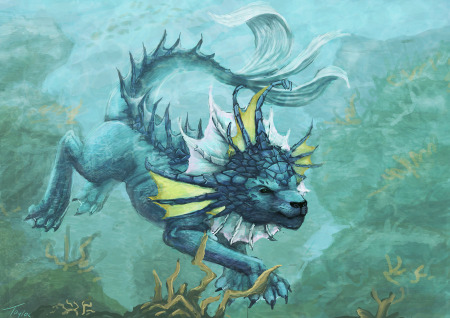
 A more realistic take on Vaporeon, by Ruth Taylor (http://ruth-tay.deviantart.com/ - she has more Pokémon fanart in the same style, and it is glorious), drawing inspiration from wolves, turtles and otters.

This is where another brief aside on the Eeveelutions in general might be a good idea.  Just about all of them have very poor offensive movepools.  Most of them have a powerful attack from their own types, plus Shadow Ball and Signal Beam, two fairly weak attacks from fairly weak elements.  None of them are suited to all-out assault.  Vaporeon, however, has one major advantage over her brothers and sisters: almost all Water Pokémon have power over ice as well.  What’s more, Water/Ice is actually a fairly strong combination.  Between Scald, Ice Beam, her excellent special attack, and Toxic, Vaporeon is pretty dangerous for a defensive Pokémon.  Most Pokémon with strong special defence that don’t mind Toxic can still ignore her fairly safely, but unlike Alomomola she isn’t just an invitation for a hyper-offensive Pokémon to jump in and start setting up, and if she’s in trouble, she can always drop a Wish and switch out.  The icing on the cake for Vaporeon is her choice of two wonderful abilities.  Her Dream World ability, Hydration, allows her to heal instantly from status problems during rain, which isn’t really as brilliant for her as it is for some of the other Pokémon who like to use it, since its major benefit is one-turn Rests, and Vaporeon relies heavily on Wish for healing anyway.  Water Absorb, on the other hand, is wonderful; by converting incoming Water attacks into a source of healing, it gives Vaporeon opportunities to switch in for free against some of the most common attacks in the game (Surf and Scald) as well as bonus healing, which a defensive Pokémon will always appreciate.  All in all, Vaporeon did very well in the great lottery of Pokémon, with everything she needs to back up her excellent stats.  Ever since Ruby and Sapphire introduced Wish and Water Absorb, she’s had an easy life; before then she was a fairly unspectacular but still above-average Water-type.  Some Eevee forms, despite having equally high stats… did not do so well.

As a matter of personal taste, Vaporeon isn’t actually my favourite Eevee evolution – that honour goes to Espeon – but as an objective assessment of her design and powers, I’m rather tempted to say that she is the ‘best’ of the seven.  Again, a hard act to follow, since it seems that, for some of the others, I’ll be talking partly in terms of how they fail to measure up to Vaporeon.  Still, at least she was a good beginning, her position among the original trio helping to establish Eevee as the universally adored Pokémon she is today.

The Ethics of Pokémon Training

When you get a title like that, you know there’s some serious sh*t gonna go down.

So, I’m writing this because of a question that turned up in my ask box a couple of weeks ago, which I will reproduce here:

“You’ve touched on the moralistic complaints about the Pokemon franchise before (your post on Torchic, Combusken and Blaziken). I’m on a similar ground to you, seeing teamwork etc being more of what Pokemon is about, but you can’t ignore the fact that violence and animal abuse seem to be essential in fostering that partnership between trainer and Pokemon, can you? Teamwork it may be, but the Pokemon take 100% of the physical side of things. Would you consider doing a post on this issue?”

This is, as it happens, a particularly good time to be talking about this.

PETA (People for the Ethical Treatment of Animals) has just gotten a lot of attention in the Pokémon community for producing a short online video game, Pokémon Black and Blue http://features.peta.org/pokemon-black-and-white-parody/, in which Pokémon free themselves from their cruel and sadistic trainers and start a rebellion with the intention of showing humanity a better way.  I urge readers to take a look at the page and the game for themselves, however the gist of it is as follows: Pokémon trainers are horrible people who keep their Pokémon trapped in Pokéballs most of the time, keeping them from getting exercise, and let them out only to have them beat each other bloody, and provide them with medical care only so they can send them back into the arena more quickly.  PETA has gotten a lot of flak for this, as they do for a lot of their stunts; from what I can tell, even the people who are theoretically on their side often think they’re insane.  Naturally, jumping on the bandwagon and attacking them would be too easy.  As always, I like to think I can outline a more nuanced view of the matter.  Here goes nothing.

I’m actually not convinced any of this is meant seriously.  I think the game itself was clearly made by someone who has more than a passing familiarity with Pokémon Black and White – in fact, I half suspect it was made by a fan with a black sense of humour.  I strongly doubt anyone at PETA actually believes that Pokémon is a genuine threat to their cause; it’s more likely that the game is a tool for sparking controversy and drawing attention to PETA than a real attempt to damage Pokémon.  I think there is something of a risk that going after Pokémon like this will risk trivialising the very real abuses they spend most of their time trying to tackle; however, I also think that attacking not just real instances of animal abuse in the world but also the cultural phenomena that appear to tolerate those abuses (in, I must again emphasise, what seems to me like a fairly tongue-in-cheek way) is actually a quite insightful strategy.  They’re probably not going to make any Pokémon fans change their mind about the franchise (they certainly haven’t changed mine), and I think they must know that, but they are going to make people react to what they’re doing, and in the course of that reaction people will be made to think about what makes real animal abuse different from Pokémon battling.  This, of course, means that people are thinking about animal abuse and why it’s horrible, which is exactly what PETA wants you to do, so the moment we even start having this conversation, the game has done its job.  Since I actually quite like what they seem to be doing here, I’m going to go along with it and discuss some of these ideas myself.

First of all, I wish to acknowledge one very important fact: they have a point.  Pokémon is a game about capturing wild animals, stuffing them into tiny balls, keeping them in there most of the time, and letting them out mainly so they can fight other animals, often for the amusement of spectators.  You can argue – and I’m going to – that this is a very simplistic reading of the ideas in the franchise, but bear in mind that it’s actually not the absence of good, wholesome ideas in Pokémon that’s the problem.  It’s very easy to point out the themes of partnership, discovery, charity, heroism and all the rest that we see everywhere in the Pokémon franchise; this is exactly what you see hordes of fans doing whenever PETA’s recent stunt is discussed.  The problem is that this doesn’t actually address their complaint at all.  It’s not the absence of good, wholesome ideas in Pokémon that they’re objecting to – it’s the way those family-friendly themes are mixed up and bound together with a premise that potentially has a lot of morally repugnant implications.  To quote the game’s website, “the difference between real life and this fictional world full of organized animal fighting is that Pokémon games paint rosy pictures of things that are actually horrible.”  Of course cockfighting is okay – after all, it’s no different to Pokémon training, and Pokémon don’t seem to mind… right?  That train of thought probably sounds as ridiculous to you as it does to me, but people believe and do ridiculous things every day.  Can you imagine that train of thought passing through the head of someone who already endorses cockfighting anyway?  How about an eight-year-old kid who’s never heard of cockfighting before and doesn’t know whether it’s supposed to be good or bad?  Frankly… I can.  For most people Pokémon is only going to be one of a hundred different influences pushing and pulling in different directions, but it’s still there, pushing very subtly in a direction the creators never intended.  So, again, yes: I actually do think PETA have a legitimate point here.

How, then, do we avoid this problem?  Don’t even try to, says I: tackle it head on.

The basic premise of the Pokémon franchise is really quite morally ambiguous.  That’s part of the reason I find it so interesting, and part of the reason I write for this blog at all.  In general Game Freak likes to avoid touching on the moral ambiguities, but when they do it creates some of the most fascinating stuff the franchise has to offer.  This is exactly why I’ve always felt that Black and White leave all the previous games in the dust as far as storytelling goes – the idea of Pokémon liberation trumpeted by Team Plasma (whom many people see as a pastiche of PETA) is potentially a perfectly noble goal.  Black and White, for the first time, actually acknowledge that there is something slightly fishy about the basic assumptions on which the series operates.  Maybe Pokémon shouldn’t be forced to battle – are we really so sure this is right?  Many of the characters in the game are indeed won over by Team Plasma’s questioning of the established order, and even the Castelia Gym Leader, Burgh, admits that they might be onto something.  The problem is that the debate eventually winds up being very one-sided.  The Team Plasma grunts you meet are brutal, unthinking zealots.  Their leader, Ghetsis, is cynically manipulating his followers to achieve his aims of conquest.  Even N, the undoubtedly benevolent spiritual leader of Team Plasma, turns out to have been deliberately raised in the company of Pokémon who had been hurt by humans in order to influence his worldview, which begins to collapse once he sees what real Pokémon trainers are like.  What about the Pokémon N was raised with?  What about the people in this world who really do mistreat Pokémon horribly, like Team Rocket, such a major fixture of earlier games?  What about Team Aqua, Team Magma, and Team Galactic, who tried to destroy the world by enslaving Pokémon?  N is presented as naïve, his worldview as noble but warped… but would he really seem that way with Team Rocket on the scene?  I think the best path for Pokémon to take from here is to look at what Black and White have done and improve on it: find ways to highlight the moral ambiguities instead of whitewashing everything, and explain through their storytelling “this is good, and this is bad, and here’s why.”

What’s my take on the ethics of Pokémon training, then?  Well, if you’ve read a lot of my anime commentaries, you’re probably aware that I think there are a lot of unwritten and unspoken rules connected with Pokémon training, a code of conduct that regulates the way trainers and Pokémon relate to each other.  Although explicit references to this code are few, I believe that most characters in the franchise do implicitly follow it.  The first and probably the most important point to discuss is what it means to “capture” a Pokémon.  The anime rarely presents capturing a Pokémon as requiring a trainer to beat it into submission; often, particularly in the later series, it’s more a question of winning a Pokémon’s respect.  Furthermore, when the villains capture Pokémon, they rarely use Pokéballs.  When they do, no-one seems to mind.  When they try to capture Pokémon in other ways – even wild Pokémon, who should in theory be fair game – all the law-abiding characters are outraged.  I think what this implies is that the process of battling a wild Pokémon and capturing it in a Pokéball is in fact about convincing it that you are worthy of being its trainer.  This, in fact, is the reason knocking out a Pokémon in the games renders it impossible to capture: if you’ve beaten it completely unconscious, you’ve deprived it of the opportunity to test your skills and perseverance to its satisfaction.  Capturing a Pokémon under such circumstances would be an unforgivable transgression of the rules that govern interaction between humans and Pokémon.  Capturing Pokémon without Pokéballs – by physically restraining them, for instance – likewise violates the somewhat ritualised process of capture.  So, now that we’ve established that Pokémon have to permit trainers to catch them, why would they even want to?  The obvious reason is that they become more powerful under human training, but this is an oversimplification of the issue.  Gaining “levels” represents a Pokémon gaining a greater understanding of its own innate powers, coming closer to becoming an ideal paragon of its species.  This is most noticeable in species that experience evolution, of course (which, incidentally, I believe to be closely connected to the removal of psychological blocks and the achievement of a more advanced state of mind) but all Pokémon have unique abilities which even they may not fully understand by instinct alone.  At the same time, travelling with humans forces Pokémon to learn a wider range of skills and use their abilities for a wider range of purposes than they ever would in the wild.  As a result, they develop greater versatility and creativity than their wild counterparts.  They may even gain skills of leadership and cooperation as a result of working together with Pokémon of other species (if you watch the anime episode Bulbasaur the Ambassador you’ll see exactly what I mean).

But what good does all this serve, beyond making them better able to serve humans and fight in human tournaments?  Simple.  I don’t think Pokémon are ever necessarily supposed to spend their entire lives with humans once caught.  Many may decide later to stay with their humans forever, but I believe most Pokémon initially join trainers with the assumption that, like Ash’s Butterfree and so many of his other Pokémon, they will eventually leave, either returning to the wild to use their newfound powers there, joining other trainers to explore their abilities from a different perspective, or even assimilating completely into human society in one way or another, like Squirtle eventually did.  Pokémon, in short, should not be viewed as passive tools to be used and discarded by trainers.  They are independent, thinking beings who may partner with humans, temporarily or permanently, in order to further the goals of both, in accordance with an unspoken but well-established and very complex code of honour that dictates the actions and conduct of both sides.

Yes, I did just try to completely change the way you view every aspect of Pokémon training from the ground up.

Damn, it feels good to have my honours dissertation finished.

Pokémon and Gender

So, I’ve been wanting to write this entry for a while, but haven’t because I can’t make it fit into any of the series I want to do.  In that sense, it’s actually something of a cool opportunity that I’m not committing to writing anything in particular at the moment, because I can just do whatever.  I will warn you, though, that this will be one of my most trippy and speculative entries yet.  Brace yourselves.

The premise of what I’m going to be talking about today is a choice of vocabulary that just about every person on the planet has probably taken for granted, but which has always stuck in my craw (because, as we know, I’m obsessed with languages): “gender.”  The word “gender,” unbeknownst to many, doesn’t actually refer to the biological distinction between male and female.  Male and female are sexes, not genders.  Masculine and feminine are genders.  Traditionally the word has referred to the concept of grammatical gender, an idea present in every major European language except English, whereby all nouns are considered masculine, feminine, or (in e.g. Latin, Greek, and German) neuter, and adjectives must change their forms to suit the gender of the nouns they describe (for instance, in Latin, ‘tall’ is altus if you’re talking about a mountain, but alta if you’re talking about a tree).  There is no real rule to these, and they’re not always consistent across languages either (the Latin word for tree, arbor, is feminine; the ancient Greek word, δένδρον, is neuter, and the French word, arbre, is masculine, even though it’s clearly derived from the Latin word).  In short, something that has ‘gender’ is associated with maleness or femaleness (or absence thereof) in some vague and unspecified way.  In modern usage, this meaning has expanded to include descriptions of a person’s general psychological disposition, certain traits being regarded as ‘masculine’ – typical of a man, but not exclusive or necessary to men – others as ‘feminine’ – typical of a woman, but not exclusive or necessary to women.  We’ve all met masculine women and feminine men; I’ve been called ‘feminine’ once or twice (by my best friend, no less).  Things get much worse when we throw sexuality into the mix, because that’s even more complicated and doesn’t necessarily line up with sex or gender, but honestly I don’t want to go anywhere near that particular can of worms.  Anyway, here’s the thing…

Pokémon don’t have sexes.  They have genders.

I’m aware, of course, that this is probably a mistranslation caused by squeamishness about exposing ten-year-olds to the inherent horror and immorality of the word ‘sex’ (never mind that you’re selling them a game in which Pokémon engage in ‘breeding’).  I think we can all agree, though, that just letting it go would be far less entertaining than grabbing it with both hands and following it to its most insane possible conclusion.

The Pokémon franchise in general has always been extremely closed-mouthed about how Pokémon reproduce.  None of the characters seem to have any idea how the process works.  A number of NPCs pointedly insist that it hasn’t been proven that Pokémon lay eggs, because in thousands of years of recorded history no-one has ever actually seen it happen.  Until the events of Gold and Silver, likewise, it hasn’t been conclusively proven that Pokémon hatch from eggs either; that’s why Professor Elm is so excited when your Togepi egg hatches.  A Pokémon egg is an incredibly rare curiosity, the preserve of obsessive collectors like Mr. Pokémon.  The kind men and women of the various day-care centres, likewise, are utterly mystified whenever eggs show up in their backyards, no matter how many times it happens.  There is also a whole string of little discrepancies in the system as it’s given to us.  There are a few single-gendered species, which creates obvious problems – female-only Pokémon, like Kangaskhan and Lilligant, would need to breed with males of other species in the same egg group to maintain a population (because, of course, inter-species breeding is not especially problematic for Pokémon), while male-only Pokémon can’t even do that, since all baby Pokémon are of the same species as their mothers; players can only get babies of those species with the help of the ‘breeder’s wildcard,’ Ditto.  According to everything we have been told, Sawk, Throh, the Hitmon triplets, Braviary and possibly Tauros cannot reproduce in the wild.  The same goes for ‘genderless’ Pokémon, like Electrode and Starmie.  Now, I realise biology has never exactly been Pokémon’s strong point, but it doesn’t take a genius to work out that a species which is completely incapable of reproducing cannot exist.  It doesn’t seem to make a whole lot of sense for Chansey, Petilil, Mandibuzz, Kangaskhan and Jynx to be totally reliant on hybridisation to continue their species either.  There’s a little question mark over Ditto as well – Ditto can Transform into an exact duplicate of a Pokémon standing in front of it… so, by all common sense, a Ditto presented with a biologically male Pokémon should Transform into a biologically male Pokémon.  Ditto might be able to alter its form to a small extent, but the games don’t really provide any evidence for that, and the anime implies that it can only make superficial changes, so I doubt it could reconfigure an entire organ system without help.  In short, whatever goes on in day-care centres, it’s not straightforward sexual reproduction on the model of real-world animals.

Here’s my weird-ass take on it all, then…

Pokémon, I will repeat, don’t have sexes.  They have genders.  That is, they don’t actually have differentiated reproductive systems; they are all, in essence, single-sex species.  They do have an unusually large degree of variance in the levels of different hormones they produce, which leads to significant variation in their psychological traits, and in many species (most notably Nidoran) this is linked to some physical aspects, creating the appearance of sexual dimorphism, though in the vast majority of cases the differences are actually superficial.  Reproduction takes place via a ‘mind-meld’-like process (I sort of imagine them pressing their foreheads together, murmuring to each other, and glowing softly); genetic information is exchanged, but selectively – the vast majority of a baby Pokémon’s genes come from its mother.  Most of the exchange actually involves psychological traits.  As a result, a baby Pokémon will be quite close to being, physically, a clone of its mother (which is why inter-species breeding always results in a Pokémon of the mother’s species – the father contributes only a few genes, selected out of those that are compatible with the mother’s species) but will have closer to an even mixture of psychological traits from both parents.  The father (as, of course, we know) is additionally capable of passing on a number of conscious mental traits and learned abilities, which become ingrained in the child’s instincts.  For most Pokémon species, mental health requires a mixture of masculine and feminine traits, so instinct dictates that two masculine Pokémon will not mate willingly, and nor will two feminine Pokémon.  The entire process is far more low-key than what real animals have to go through, and consequently much more difficult to observe, which is why the whole subject is surrounded by such abject confusion.

So, how does this help to resolve the problems with how Pokémon breeding appears to work in the games?

The thing about the all-masculine species, like Hitmonchan and Braviary, is that – being universally and excessively ‘masculine’ – they are extremely pugnacious and aggressive (this, again, is something we already know – just look at the all-masculine species).  As a result, practically everything they do is constantly simmering with potential to break into outright violence.  What passes for ‘courtship’ among these species is no exception, and is simply so confrontational that human observers have never actually made the leap to identifying it as courtship (if you’re familiar with Homestuck, the concept of a ‘caliginous romance’ is a decent analogy, though it’s far more developed and laden with cultural baggage) and, as I suggested, the actual reproductive act itself is surprisingly easy to miss.  The kind of aggression and conflict necessary for a pair of Pokémon from an all-masculine species to develop an intimate relationship simply isn’t allowed to happen in the context of a day-care centre, where the staff normally discourage fighting.  Thus, Pokémon from all-masculine species can and do reproduce in the wild, but never get the chance in a day-care.  Pokémon from all-feminine species have a similar, but opposite set of issues.  They are universally and excessively ‘feminine,’ and therefore extremely passive, gentle, and cautious in their relationships with each other.  Courtship is an extremely slow, drawn-out process that can last for months or years; in captivity, there normally just isn’t time to observe it happening, and even in the wild it’s so long-term that human scientists haven’t actually been able to recognise it yet.  Many Pokémon from all-feminine species will take masculine partners from other species in order to create social diversity, and this generally happens much more quickly.

‘Genderless’ Pokémon are another kettle of fish entirely.  I want to suggest that they don’t necessarily all work in the same way; rather, they’re a ‘miscellaneous’ group.  Many of them aren’t actually ‘genderless’ but actually have three, four, five or even more genders, none of which match up exactly with ‘masculine’ or ‘feminine’ – as a result, humans are totally unable to understand the rules that govern their reproductive compatibility.  Some of them reproduce in groups of three or more, making it impossible for a day-care centre, which takes two Pokémon at most, to observe their reproduction.  A few reproduce by fission, splitting into two or more children only at the moment of death.  In short, their reproductive practices are just so weird that human observers don’t have a hope in hell of understanding what’s going on.  This, of course, brings me to the most important Pokémon of the lot: Ditto.  Ditto, in the games, does not reproduce; it only helps other Pokémon to do so, presumably using its ability to Transform into any other species.  Although Ditto forms a perfect physical copy of its partner, psychologically it doesn’t change at all when it Transforms; since Ditto is neither masculine nor feminine, it adopts a totally different role and all the usual rules of courtship go out the window when it gets involved, which is why universally masculine Pokémon can reproduce in captivity with a Ditto.  Ditto is likewise capable of overriding whatever whacked-out reproductive norms are in play for ‘genderless’ Pokémon, even producing eggs of Pokémon species that don’t naturally lay eggs at all.  It contributes very little to the child, physically or psychologically, but does provide a way to scramble the genes provided by the other parent and throw up new combinations of dormant traits.  So, then… question: why, in evolutionary terms, does it make sense for a species to focus its energy on helping other species to propagate themselves?  Answer: the relationship is symbiotic.  Ditto actually feeds on the leftover energy of cell division to revitalise its own cells.  It gets… a bit metaphysical, but the practical result is that, as long as a Ditto continues to help other Pokémon reproduce, it will never die.  Absorbing a huge excess of cellular energy allows Ditto to split and form two new Ditto; this doesn’t happen often, but accounts for the Ditto that are inevitably killed by other Pokémon or die in accidents.

As for where the Ditto came from in the first place, I’m inclined to accept the fan theory that they’re closely related to Mew – the only other Pokémon with the ability to Transform, courtesy of her genetic library, who also happens to be bright pink – mostly because it fits well with my ideas about Mew, which suggest that her whole purpose in the world is to absorb DNA from other Pokémon and store it.  Ditto have lost the ability to store borrowed DNA on a long-term basis, and as a result their physical form has degenerated, but they retain the ability to absorb DNA and rapidly assimilate it into their own systems.  That, naturally, brings me to the last category of Pokémon I need to talk about: legendary Pokémon, who (with the notable exception of Manaphy) cannot breed at all, Ditto or no Ditto.  Most of them are also genderless.  Many legendary Pokémon are heavily implied to be unique (and presumably immortal) anyway, which means I don’t have to worry about them, but a few seem to exist as entire species; most significantly, a baby Lugia appears in a few episodes of the anime.  They’re sufficiently different from other Pokémon that they can’t breed normally with anything else, and their lifespans are so long that humans just can’t observe them properly.  Mating season might come around once every three or four centuries and last for a month or two; even then, eggs might take years to hatch.  In short, some legendary Pokémon do breed, but for all intents and purposes it’s not something humans can take advantage of.

I think that’s enough from me for now – it’s not every day I try to totally redefine the way we look at a major aspect of the Pokémon games.  As always, I’d love to hear your thoughts on my latest weird-ass theory; if you point out something that doesn’t make sense, I might be able to improve on it.  Anyway, that’s all from me – thanks for reading, and have a fun day!