Adamfrolick asks:

Really love your blog! I was wondering if you could clear something up between the relationship of a pokemons type and there relation to a pokemons physicality or physiology. Like, rock types are weak to fighting cause they are made of rocks and with enough strength, someone could shatter one. But in the case of, lets say, a ground type, it isn’t necessarily made of ground? Like, Hippowdon is just a sandy hippo, so why would it be weak to grass?

Ground is… tricky… I tend to sort of recuse myself from attempting to explain anything to do with the Ground type because I don’t think it actually makes sense and I’m not sure there’s a good reason for it to exist.  You could probably explain those particular relationships by positing that they have sort of porous exoskeletal plates which can become waterlogged very easily, and from which Grass Pokémon can also drain water effectively (that being notionally the same reason Grass is strong against Water).  Honestly, though, I’m not totally convinced there is a consistent relationship between type and physiology.  We know that the same type can encompass Pokémon with radically different biology, and we know that Pokémon within a type do not necessarily share a common ancestor.  I kinda lean towards thinking that “type” is just something humans came up with to describe how Pokémon behave in battles and create a heuristic for which of two Pokémon is likely to be favoured in any given match-up, not a real biological phenomenon.
Anonymous asks:

How do you feel about natures? There are 25 of them in total, but for almost every Pokemon, only 2-4 of them are viable. Even then, many Pokemon strongly prefer 1 of those few, and having anything else might actually be hindering said Pokemon? Espeon, for example, would really appreciate Timid, is also cool with Modest, and doesn’t hate Calm or Bold even if Espeon doesn’t get much out of them. Any other Nature either doesn’t grant any benefits at all, or actually hurts Espeon.

I feel like natures work the way they do at least partly as a result of their interaction with generation III’s contest mechanics, which failed to survive in most of the later games, and in that respect they’re sort of emblematic of the way Pokémon is now composed of a whole bunch of legacy systems that no one is quite willing to get rid of.  I don’t think you would design natures the same way if you were creating that system from scratch in generation VII without reference to things like the five contest stats, or berry flavours.  Some discussion of what you could do here, here and here.

Anonymous asks:

All things considered (gameplay, graphics, nostalgia, Pokémon Roster, storyline, miscellaneous shit… you name it), what is your Top 7 Pokémon Generations?

Without getting into detail (because you could spend hours, maybe days, arguing about this without coming to a conclusion anyone would agree on, and I just don’t want to go there and don’t think it’s particularly useful): Continue reading “Anonymous asks:”

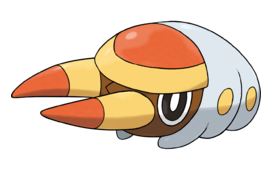
Grubbin, Charjabug and Vikavolt

Today’s Pokémon are probably the strangest thing Alola has thrown at me so far, and definitely spice up the early game a bit – electrical Bug-types with battery-like abilities, which (thank all the gods) conspicuously do not become butterflies or moths.  We’ve had beetle Pokémon before – Heracross – and even stag beetle Pokémon – Pinsir – but Grubbin, Charjabug and Vikavolt have little in common with either, as we’ll see.

Grubbin.
Grubbin

Grubbin is… well, a grub – a soft-bodied beetle larva.  As far as I can tell, it’s not based on any one species in particular; beetle larvae mostly look pretty similar to non-specialist eyes (unlike caterpillars, which are often brightly coloured or have bristles, or eye patterns that make them resemble dangerous snakes).  Grubbin instead achieves a distinctive look by exaggerating the mandibles of a beetle grub into two brightly coloured, striped horns as long as the whole rest of its body – in fact it kinda winds up looking like a stag beetle or Hercules beetle pupa. Continue reading “Grubbin, Charjabug and Vikavolt”

Burrow Behind the Stars asks:

i have an idea on how to resolve the Yungoos and Gumshoos thing. What if there would be like a place in area where you could trade Yugooses and Gumshooses you caught for money or useful items or something? You would be told that the Pokémon are transported in their Pokéballs to their native region and released to wild, thus, in the long run, hopefully getting them all back where they belong. It’s just an idea though.

I kinda like this idea.  It does run into the slight difficulty of drawing more attention to Yungoos’ home region, which doesn’t exist yet, but otherwise, it presents a significantly more sane approach to an invasive pest that’s still compatible with Pokémon’s baseline ethical framework.

Anonymous asks:

I was wondering what you thought of the pokedex entries on Mega Glalie from Sun and Moon – “The excess energy from Mega Evolution spilled over from its mouth, breaking its jaw. It spews endless blizzards” and “It envelops prey in its mouth, freezing them instantly. But its jaw is dislocated, so it’s unable to eat them.” This seems like pretty direct evidence that Mega Evolution is harmful, and known to be such, by the people who put the dex together. Why are the professors pushing this?

I don’t know how harmful it can possibly be, seeing as mega evolution never lasts more than a few minutes and all the changes are instantly reversed.  I think lines like this stress that mega evolved forms are not actually viable organisms and aren’t supposed to be; they’re ridiculous super-overpowered battle modes that exaggerate everything about the base Pokémon to the point that it becomes self-defeating in non-combat situations.

Anonymous asks:

Do you think it’s possible that GF don’t actually WANT to make Pikachu clones every gen, but they’re forced to by, I dunno, Nintendo or some such for marketing’s sake? A bit of Executive Meddling, if you will. Maybe Mimikyu hints at this by poking fun at the needless (and desperate?) attempt to capture Pikachu’s appeal and popularity?

I think if there were a top-down policy on that, we’d probably see more of them in promotional materials than we do, likely at Pikachu’s expense.  That, and… well, I don’t know how Nintendo manages its creative teams, but I would have hoped Game Freak had earned a bit of independence by now.  I think they do it specifically to annoy me.  Having said that, this is an interesting way of looking at Mimikyu; I’ll have to talk about it in my review.