
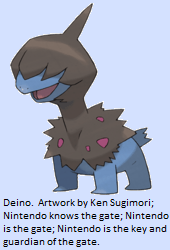
 Remember Dragonite? I liked Dragonite; Dragonite was nice and enjoyed helping people. Not all Dragon Pokémon are nice, of course; Flygon, Haxorus and Altaria are, but Kingdra and Druddigon are basically crazy old men shouting at the kids to get off their lawns, Garchomp is ill-tempered though not malicious, and Salamence is just slightly insane and prone to extremes of anger and joy.
Hydreigon, on the other hand, is utterly, completely, irredeemably, certifiably, three-eggs-short-of-an-Exeggcute WHACKO.
Deino, Zweilous, and Hydreigon, whose names come from the German ein, zwei, drei, in reference to the number of heads they each have, are the only Dark/Dragon dual-type Pokémon. Dragon-types are (Druddigon and Altaria notwithstanding) among the strongest of all Pokémon, while Dark-types tend to be pathological liars, brooding loners, manipulative jerks, creepy stalkers or outright psychopaths. This is a recipe for disaster. I love recipes for disaster. Continue reading “Deino, Zweilous and Hydreigon”
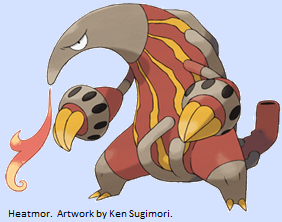 I’m doing Heatmor and Durant together because, although they aren’t part of a single evolutionary family, they do in a sense ‘go together.’ Heatmor is a bloody great anteater that some delightfully mad person has decided to splice together with a blast furnace or something, and Durant is an angry giant ant plated from head to abdomen in steel, and Heatmor’s favourite food. Durant, the Pokédex insists, covers itself in steel plating specifically to protect itself from Heatmor, which makes absolutely no sense in a world of elemental ‘types’ with distinct strengths and weaknesses relative to one another. Why does this make no sense? Because Heatmor is a Fire Pokémon, and relying on metal armour to protect yourself from a Fire-type is tantamount to suicide according to everything we have ever seen about the way this world works. Now, evolution (in the real-world biological sense, not the Poké-world pseudozoological whacko sense) is an insanely complicated phenomenon, this I will grant you, but no-one and nothing is going to convince me that natural selection would actually push a species to become more vulnerable to its own major natural predator.
 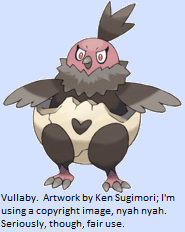 I think I’m just about through the Pokémon that are genuinely bad now. A lot of what’s left is, for want of a better term, so-so – like the female counterparts to Rufflet and Braviary, the vulture Pokémon Vullaby and Mandibuzz. I see some initial sensible choices here. Vultures are a nice choice for a starting point; their associations are specific and evocative, and Dark/Flying makes sense and isn’t overdone; there’s only one other Pokémon of that type, Honchkrow, who’s sufficiently different from Mandibuzz that it doesn’t bother me. Honchkrow is into plots and schemes, while Mandibuzz is a far more straightforward opportunistic predator. She also has a macabre fashion sense: Vullaby and Mandibuzz ornament themselves with bones and even build their nests out of bones. This was Cubone and Marowak’s thing, of course, but that’s not such a problem; they wore skulls as (I think) some kind of creepy honour thing, whereas for Vullaby and Mandibuzz it’s mostly about protection and decoration. No, the thing that bothers me about Vullaby and Mandibuzz is how silly their bones make them look. Vullaby is known as the “diapered” Pokémon, so yes, that eggshell-shape around her lower body (which is actually made of plates of bone) is indeed meant to look like a nappy. I don’t know whether Mandibuzz is supposed to look like she’s wearing an apron but that’s certainly what I think of, and the domestic imagery of Vullaby’s nappy makes me think this is exactly what’s meant to be conveyed here.
 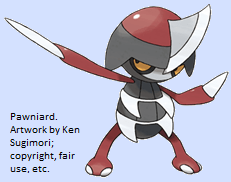 It was, of course, a statistical inevitability that we would eventually get a set of chess-themed Pokémon – and here they are, the sword-wielding Dark/Steel Pokémon, Pawniard and Bisharp. In fact, not content with merely using bladed weapons, these Pokémon are literally made of interlocking blades, just to make absolutely sure that they can cut you to ribbons just by running into you. As always, the first question is: what were Game Freak thinking here? I don’t mean that rhetorically or sarcastically, I’m genuinely curious. This design seems to be going in a couple of different directions and I’m not sure which one they started from or where they’re trying to take them or how they’re supposed to fit together. Their vicious and aggressive personalities seem to follow sensibly from the blade theme, which seems to be Pawniard’s main schtick (or alternatively, simply from the fact that he’s a Dark-type; the vast majority of them are born to be jerks). Then, on a completely different tack, we have the chess idea, with their names referencing the pawns and bishops of European chess.
 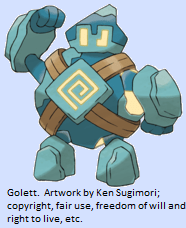 *Ahem* Today on Pokémaniacal I’m looking at Golett and Golurk, the automaton Pokémon. These two are based on golems (as distinct from Golem, the evolved form of Graveler), humanoid guardian creatures from Jewish folklore originally associated with the city of Prague, which have since worked their way into a number of high fantasy settings as the magical equivalent to robots. Nowadays golems can be constructed from just about any material you care to name, the more outlandish the better, but as Ground-types Golett and Golurk seem to follow the original in being made primarily out of clay. They are likewise believed to have been created by ancient people to act as protectors (goodness knows how the things are still around after all this time). So far, so good.
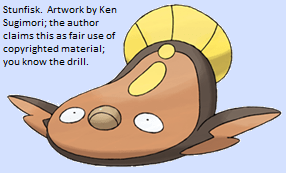 This one is tricky; I’m not sure whether to love it or hate it… Today I’m looking at Stunfisk, the trap Pokémon, a flat-bodied bottom-dweller with a penchant for frying anything unlucky enough to step on him. My first thought was that Stunfisk is pretty clearly based on a perfectly ordinary flatfish like a flounder or plaice, but with added lightning because everything is better with lightning (kind of arbitrary, but also fun). I have since learned, however, that there are actually fish, called stargazers (so named because their eyes, like a flounder’s, are on the tops of their heads), which behave in more or less the same way as flounders – they spend most of their time half-buried on the seafloor, waiting for prey to stumble across them – but can also produce electrical current in much the same way as an electric eel.
 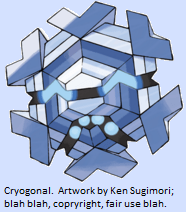 Ice is one of the more underrepresented elements in Pokémon: the original games had only five Ice-types (Articuno, Jynx, Dewgong, Lapras and Cloyster), single-typed Ice Pokémon didn’t exist until Snorunt, Glalie and Regice in Ruby and Sapphire, and even now, with more than six hundred Pokémon in the game, fewer than thirty of them are Ice-types. Black and White have made two valiant efforts already to expand the number of pure Ice-types but have failed to impress me, producing Beartic and Vanilluxe. Well, third time’s the charm, so they say, so let’s have a look at Cryogonal, the crystallising Pokémon.
 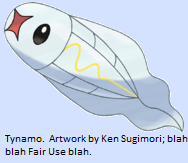 Today’s Pokémon are the latest addition to the stable of Electric Pokémon: Tynamo, Eelektrik and Eelektross. These ugly-looking things are the misbegotten spawn of two similar-looking but very distinct creatures: the electric eel (which isn’t really an eel at all, phylogenetically speaking) and the lamprey (which isn’t an eel either but looks like it should be). Tynamo are about as close as you get to Magikarp in Black and White: they’re distinctly based on larval eels and they’re extremely weak on their own (but can co-operate to produce more powerful attacks). This is aptly reflected in their total inability to learn any attacks aside from the ones they start with: Tackle, Thunder Wave, Charge Beam and Spark.
 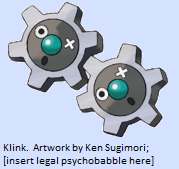 Pokémon, it is known, may not all be completely natural; many owe their existence to human activity in the last few centuries. Voltorb and Electrode, whose bodies are modelled on Pokéballs, are almost certainly artificial in some way. Grimer and Muk were born from the toxic waste of human industrialisation. Magnemite and Magneton certainly seem artificial but their true nature is extremely mysterious. Today’s Pokémon, Klink, Klang and Klinklang, continue the theme. These bizarre Steel-type Pokémon seem to be entirely mechanical and evolve by adding on extra components. The resident Professor Tree of the Unova region, Professor Juniper, investigates Klink during the course of the game and determines that they did not exist in Unova more than one hundred years ago, when they appeared suddenly in an area called the Chargestone Cave. How she can possibly have figured this out is beyond me, but (in fairness to Aurea Juniper) she’s probably the least incompetent of the regional professors to date, so I’m inclined to take her word for it.
  Pokémaniacal