
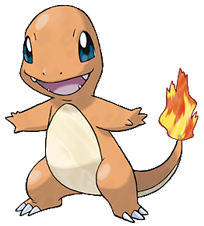
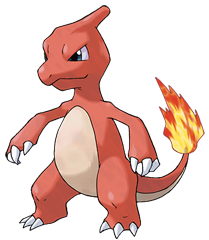
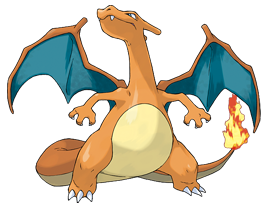
 There’s something about Charizard. Maybe it’s the inherent awesomeness of Fire as an element. Maybe it’s the allure of his base set trading card, whose Fire Spin was pretty much the most powerful attack in the game. Maybe it’s the fact that he’s a goddamn freakin’ dragon. Charizard is easily the most popular of the first-generation starters and, despite my perpetual love affair with the Grass type, I have to admit that it’s easy to see why. Charmander may be cute as a button but one look at his burning tail shows that he means business nonetheless. Charmeleon has the look of a proud fighter who loves to punch above his weight. Charizard simply demands respect, and incinerates anyone who denies him. What more could we possibly want?
Charmander and his family are just what you’d expect from Fire-types: figuratively and literally hot-headed Pokémon who believe quite firmly that if there is a problem that can’t be solved with fire, it’s only because you aren’t using enough fire. Although this seems like it would be the default stance for most Fire Pokémon, none of the other first-generation Fire-types (with the possible exception of Flareon) embrace “Flamethrower first, ask questions later” with the same gusto that Charmeleon and Charizard do. Similarly, Charmander’s connection with fire is so strong that his tail flame is actually an indicator of his life force – the stronger and brighter the flame, the healthier the Pokémon. It’s a very straightforward idea, but again, it helps to establish Charmander as the archetypal Fire Pokémon, to a much greater degree than Bulbasaur or Squirtle can be considered exemplars of their elements, which probably goes some way towards explaining his popularity. The dragon factor is significant as well, especially since Charizard was – and arguably still is, even with Salamence around – the closest thing in Pokémon to a traditional Western dragon and, for much of Pokémon’s English-speaking audience, that’s a pretty big deal. The actual Dragon-with-a-capital-D Pokémon of Red and Blue, for a Western audience anyway, don’t quite deliver; Dratini and Dragonair clearly have Eastern dragons in mind and, while Dragonite’s physical form owes something to the European conception of what a dragon is, he’s a softer-toned, almost ‘cartoonish’ (if I can even say that) representation of that idea; like a gentle parody of what Charizard is playing straight. Dragonite’s personality, too, comes from a profoundly different tradition; he’s a benevolent ocean-dweller, very much at odds with the European dragons of, say, the Icelandic sagas. Charmeleon and Charizard, on the other hand, have a definite malevolent streak, which brings me to something else I like about them, or rather about the way they’ve been handled – there’s definite evidence that the writers of the Pokédex have been trying to build up different aspects of their personality over the years to create a more detailed picture of these Pokémon. The obsession with combat, for instance, seems to be something Charmeleon developed after the release of Red and Blue. Also, remember the way Ash’s normally disobedient Charizard would voluntarily step up to the plate if he felt there was a worthy opponent on offer? As of Ruby and Sapphire, that’s actually a recognised trait of Charizard as a species; in nature, they search constantly for powerful opponents to fight, and never use their fire against weaker enemies. If you’ve been hanging around here long enough to be familiar with my philosophy of ‘doing more with less,’ well, this kind of thing – the gradual accretion of details that expand our view of a Pokémon’s nature and powers – is a big part of what I mean. It’s really not that hard.
As Pokémon types go, Fire is pretty high up in terms of awe-inspiring elemental fury. However, in Red and Blue, Fire actually got shafted pretty badly. In a world where a lot of Pokémon relied on Normal attacks like Body Slam and Hyper Beam for type coverage, having primary attacks that were resisted by Rock Pokémon was not an enviable position, especially since most of the Fire-types had nothing else worth using – Magmar got Psychic and our dear friend Charizard managed to score Earthquake, but that was it. Charizard had a further specific problem, which was that in Red and Blue his attacks were – despite what that awesome trading card might suggest – actually fairly lacklustre. Not exactly bad but Venusaur, believe it or not, could do better; Charizard’s strength was not power but speed – very useful if you wanted to abuse the way Fire Spin worked in Red and Blue, but honestly, if Fire Spin abuse is your thing you’d probably be better off with Rapidash or Ninetales anyway. Charizard’s attacks were lacklustre because neither his attack stat nor his special stat was particularly high – pretty good, but nothing to write home about. Then, of course, Gold and Silver split special into special attack and special defence, and suddenly Charizard’s Fire attacks started looking a lot more attractive. Until Diamond and Pearl came along he still had few workable special attacks other than Fire-type ones, but Gold and Silver also brought Charizard the gift of Belly Drum, which can turn him into a devastating physical attacker at the cost of half of his health. Again, speed is his strength – Charizard was, and remains, the fastest Belly Drummer in the game (well, tied with Linoone now, but who’s counting?), an important attribute to keep other Pokémon from preying on his weakened health bar.
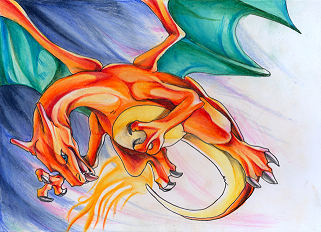
Diamond and Pearl eventually gave Charizard physical Fire attacks to use with Belly Drum and special Flying attacks (as well as Focus Blast and Solarbeam) to bulk out his other sets. Unfortunately, they also gave the world Stealth Rock, a pox of a move that almost every serious player uses. It’s similar in concept to Spikes, introduced in Gold and Silver, in that it creates a trap to damage Pokémon as they switch in, but with a number of differences. Stealth Rock can be set up in a single turn, while Spikes takes two uses to match Stealth Rock’s average damage output, and three to exceed it. Spikes is a relatively exclusive move, while Stealth Rock was available as a TM and therefore accessible to all and sundry. Finally, Stealth Rock accounts for weaknesses and resistances. Pokémon doubly weak to Rock attacks, like poor Charizard, lose 50% of their health just for switching in against a team with the foresight to set up Stealth Rock. The notion of game balance has never really existed in Pokémon anyway, but if it had, Stealth Rock would have killed it by making a weakness to Rock attacks far more important than any other single aspect of a Pokémon’s resistance profile. The point for us here today is that, from Diamond and Pearl onwards, you can’t use Charizard without a Pokémon with Rapid Spin to clear away Stealth Rock when it turns up. Well, I mean… you can. You’ll just lose. Repeatedly.
The transition to Black and White didn’t significantly alter Charizard’s movepool; he’s never been much of a tank, so losing the potential for healing with Roost doesn’t bother him much, and Thunderpunch was nice but it’s not like he doesn’t have plenty of other physical attacks to toss around. The big change for him, as for Venusaur, was his Dream World ability. There’s nothing wrong with the standard Fire starter ability, Blaze, which adds a little spice to Fire attacks when your health is low, but Charizard’s new Solar Power ability – like Chlorophyll for Venusaur – is something else. Only two other Pokémon, Sunflora and Tropius, possess this lovely ability, and both of them are far too slow to take advantage of it. Charizard is another story. Solar Power burns a little of Charizard’s health every turn while Sunny Day is in effect, but in return boosts his special attack by 50%. Meanwhile, the normal effects of Sunny Day will be jacking up his Fire attacks anyway. Keeping a solar Charizard alive for any length of time is profoundly difficult, since Charizard isn’t exactly renowned for toughness anyway, but even the toughest of Water Pokémon will wither in the face of his Fire Blast.
In some ways I think that Charmander, Charmeleon and Charizard provide the best example from the first generation of what a starter should be, a Pokémon that embodies the essential characteristics of its element – in this case, Fire’s destructive nature and passion for combat. Unfortunately Red and Blue let them down a little, as they let down all Fire-types, but ever since Gold and Silver, Fire has held a prestigious position as one of the few elements able to reliably damage Steel Pokémon, and Charizard has been generally well-supported throughout the games’ development, in spite of his present difficulties in dealing with Stealth Rock. In summary, then, while they aren’t my favourites, I believe these Pokémon are the result of strong designs that have been quite well-handled from start to finish – good pieces of work.

 Pokémaniacal
Noice
LikeLike
stupid, it sucks
LikeLike