House Komala: Life is But a Dream

One lunatic's love-hate relationship with the Pokémon franchise, and his addled musings on its rights, wrongs, ins and outs. Come one, come all, and indulge my delusions of grandeur as I inflict my opinions on anyone within shouting distance.
House Komala: Life is But a Dream
I’ve been a little bit swamped lately with teaching; my students have just handed in their first big assignment and taken their first test of the semester (don’t worry; only a few of them will be executed). I haven’t finished writing my next Pokémon review, Komala, so instead you’re getting a spiel about some of what I’ve been teaching recently, as well as some pictures of my first attempt at something resembling an English-style pork pie. Continue reading “No Pokémon review this week, have some democracy and pie instead”
Have you ever wondered if I have feet under my leaves or if my leaves do the “walking” for me?
HOLY $#!T A TALKING BELLOSSOM
…
…well, Bellossom, I think we can extrapolate from when you were an Oddish. The Pokédex describes Oddish’s feet as actually being “roots” – and, well, presumably you do still need roots to absorb water and nutrients from the soil. They might not look exactly like an Oddish or Gloom’s, but I’d say you probably have some sort of tuber-like structure under there somewhere.
Like it or not, you’re now a Pokemonologist. You’re Dr… BAOBAB
Baobab? Seriously? Come on, can’t I at least have a New Zealand tree? I’d be happy with Professor Totara, or Professor Rata; hell, Professor Pohutukawa’s a bit of a tonguetwister but I’d still take it!
Can’t they SEE I’m not done reviewing the seventh generation Pokémon yet!?
Sooo… Apparently this is a “mythical Pokémon,” meaning one of the subset of legendary Pokémon that can’t be obtained through normal gameplay. It started appearing in Pokémon Go earlier this week… or rather, Ditto that have transformed into Meltan started appearing. The workaround with Ditto is odd, but the idea of introducing a new Pokémon through Go is neat, and creates a cool feeling of discovery for people who stumble upon it without already knowing it’s there. This is also a pretty clever way to quietly advertise generation 8 to players of the mobile game (many of them players who had dropped Pokémon for a number of years, and were drawn back by nostalgia and Go‘s low barriers to entry).
Meltan is apparently a Steel-type Pokémon made of living, liquid metal, capable of absorbing other metal objects into itself. It’s apparently based on a hex nut, which is… weird… but the liquid body, and being based on something that is only a part of larger machines or constructs, could both point towards multiple Meltan being able to combine into more powerful entities. There is a distinct and worrying possibility that Meltan will be only one of several weird-cute little Steel-types in the shape of machine parts, and then when you bring them all together they assemble into the fµ¢&ing dragonzord or something. Where there’s a nut Pokémon, there must be a bolt Pokémon, and why stop there? Washers, nuts, screws, the sky’s the limit. THERE, I made a damn prediction about something; I hope you’re happy, because that’s officially 100% of my prediction quota for the leadup to generation 8.
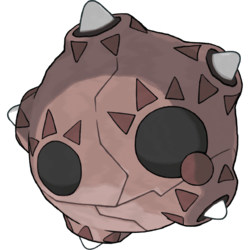
Pokémon Sun and Moon are, as the names imply, games that always have one eye on the heavens. A lot of the time this manifests as a day/night theme, but they are interested in other celestial phenomena as well – Cosmog is a nebula that gives birth to a star, one of the games’ prominent locations is an observatory, and of course the Ultra Beasts have a certain sci-fi aesthetic to them and emerge from wormholes. A lot of Alola’s ordinary Pokémon draw on themes related to the real Hawaiian islands (or at least tropical islands in general) but today’s Pokémon is one that cares a lot more about Alola’s relationship with the sky. Meet Minior: the Meteor Pokémon. Continue reading “Minior”
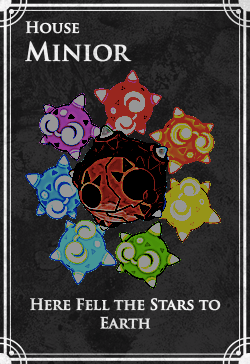
House Minior: Here Fell the Stars to Earth
why does sableye have stall? it was already one of the absolute weakest pokemon in the game prior to prankster or its mega, it was introduced a generation after sableye itself was made, it’s on nothing else, and as far as i can tell there’s no flavour reason for it, so why?
I suppose it could be a joke ability – something that intentionally made Sableye worse than it already was in generation III – but that seems unlikely; Sableye was bad all right (and believe me, I know; one of my partners on my first playthrough of Sapphire back in the day was a Sableye), but not comically so. I think it has to be a flavour reason, right? Because nothing else makes any damn sense; Stall is too weak an ability to have been intended as any kind of buff to Sableye. We’re told that Sableye (a lot like Wobbuffet) are reclusive Pokémon that spend most of their lives in darkness. When attacked, their instinct is to keep to the shadows, to hide and try to avoid combat. That instinct can be overpowering even in a serious fight, to the point that, in most exchanges, they will hang back and wait for their opponents to attack first.
I am sorry but reading your last answer to Ty and seeing the part where you said “unless Mewtwo is somehow half human, which I don’t think is what anyone ever intended to imply”… well, that is actually the case in Pokémon Aeventures manga at least in which Blainehad to use some of his own cellsto create Mewtwo as they did not have enough Mew cells. I am just curious to know what you think about that.
Well, Pokémon Adventures does tend to have a lot of independence and I don’t think it necessarily says much of anything about the “intent” of writers working on the games or anime. I suppose more than anything I think it’s a little encouraging that I’m not the only person who played the games and thought “you know what would be a plausible explanation for Mewtwo’s background? Human DNA.”
Why do you (and so many other people) tend to refer to pokemon as if each entire species is one, individual being? We had a bit of a conversation about this in the Comfey comment section, but I didn’t phrase my question well and it ended up getting lost.
I think because we tend to imagine Pokémon as designs in the abstract, or as essentially playable characters. When we play the games, we almost exclusively deal with Pokémon as individuals, and the games are largely devoid of ecological realism, so it’s really only in some episodes of the anime that we encounter them as species in a natural context. We’re not thinking so much “Mightyena, the doglike pack-hunting Pokémon native to Hoenn” as “Mightyena, the Pokémon with a Dark type and attacks X, Y and Z, that was put into the game as an option for me to have in my party, as an individual.” When I am talking about Pokémon in the context of communities and ecological relationships and their existence in an environment and so on, I think I am a bit quicker to shift over to a generic plural, whereas when I’m talking about using a Pokémon to battle I almost exclusively use singular, often gendered forms. Also, this actually isn’t totally without precedent in the real world; like, naturalists commonly do refer to animals in the singular and using singular pronouns – “the giant anteater,” “the reticulated python,” “the Magellanic penguin” – even when they’re clearly talking about the general behaviour of the species, not the actions of individuals.
 Pokémaniacal