Team Flare

Team Flare grunts showing off their trademark poses and 'stylish' uniforms.

Just like I had to talk about Iris and Diantha because I’ve done all the other Champions before, I have to talk about Team Flare and Lysandre because I’ve done all the other bad guys before.  If you followed my playthrough journal of X version, you may have picked up that I have some rather strong opinions about Lysandre and his underlings, and the way the games portray them, so I think it makes sense now to take a deeper retrospective look at their involvement in the whole of the plot.  What do Team Flare really want, what makes them tick, and does Lysandre deserve our forgiveness?

Our first encounters with Lysandre are in Lumiose City, first in Professor Sycamore’s lab and then with Diantha in the Café Soleil.  Here we see the face Lysandre presents to the world: utterly dedicated to the preservation of beauty and the betterment of the world.  He speaks admiringly of Professor Sycamore’s brilliance as a scientist and Diantha’s ability as an actress to bring joy to millions, associating them and their careers with his own quest to build a beautiful world.  Even here, though, there are strong hints that he’s up to more than he lets on – on X, he declares that he wishes to “make this world unchanging and eternal so all beauty will last forever.”  In another game, I would not take such a clearly poetic sentiment seriously, but this is Pokémon, and Pokémon is not especially known for its subtlety.  On Y, he is far less circumspect about it: “I would end the world in an instant so that beauty never fades.”  Again, it’s probably meant to sound hyperbolic, but since ending the world is something that people have tried to do before in this series, that probably escaped many players; I played X, of course, but I find myself wondering how anyone could doubt that Lysandre was an enemy after hearing a line like the one he delivers on Y.  Ultimately, what he’s actually trying to do (on both versions) falls somewhere between the two – end the world of human civilisation in order to preserve what remains of the beauty of nature.  In addition to his potentially apocalyptic foreshadowing, I also noted in my entry on Diantha that this scene hints at some degree of superficiality (even sexism?) in Lysandre’s character – he focuses on Diantha’s physical beauty as the thing that makes her a good person and contributes to building a better world, considering that the loss of her own beauty with age would diminish her ability to make the world more beautiful too.  Much as he admires her devotion to making people happy, he downplays her ability to take action towards that goal and looks to her passive qualities – this represents an important flaw in his character that is going to recur later in the story.
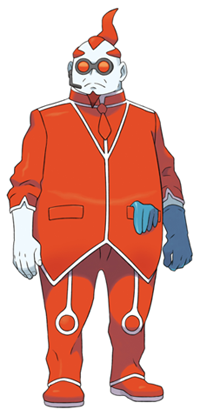
 Xerosic, mastermind of the Expansion Suit and chief scientist of Team Flare.

Lysandre’s minions, in their first appearances in the Glittering Cave and outside Geosenge Town, display none of his semblance of nobility.  Their stated aim is to help and advance members of their own organisation, regardless of the cost to others (and to pursue the heights of fashion…).  The idea of “a more beautiful world” never comes up, even in the later dialogue of the five scientists who run the group’s more pedestrian activities while Lysandre is busy: Aliana, Bryony, Celosia, Mable and Xerosic.  It annoys me a little that there are so many of them, because it means that each of the four girls doesn’t get to do much, but they do have distinct personalities, which is nice.  Aliana, who supervises the attack on the Kalos Power Plant to gather electricity to power the Ultimate Weapon, seems to enjoy battling the most, and may be slightly unhinged.  Celosia and Bryony (who are together in both of their appearances – I unashamedly ship these two) are responsible for raiding the Pokéball factory in Laverre City to gain the Pokéballs necessary to catch many powerful Pokémon whose life energy will fuel the weapon; they seem detached, nerdy, and a little philosophical.  Finally, Mable, who goes after one such Pokémon, the Abomasnow in the Frost Cavern… well, frankly, Mable is a callous b!tch.  “Allow me to spell it out for you! It’s so Team Flare – and only Team Flare – can survive!” she declares as she torments the gentle Ice Pokémon.  “After all, why should we care about saving people who aren’t on our side?”  Xerosic’s appearance in the story’s climax in Geosenge Town establishes him as a man utterly without conscience or remorse, willing to activate the Ultimate Weapon and slaughter billions even against Lysandre’s orders (if the player wins Lysandre’s bet about the two buttons in Xerosic’s lab) simply for the joy of what he considers scientific achievement.  He also features, of course, in the little post-Elite Four Looker vignette as Emma’s employer and tutor, a position which he exploits heinously.  The message of his involvement in that story seems to be that even thoroughly evil people are capable of love and affection and that, even though those things cannot and should not absolve Xerosic of his actions as part of Team Flare, they still deserve recognition.  Also appearing in the Looker sequence is Malva of the Elite Four, apparently a member of Team Flare, who makes no secret of the fact that she despises you, but seems to hate Xerosic more for abandoning Team Flare’s grand mission in favour of petty crime.  Her dialogue in Elite Four rematches thereafter suggests that Malva has developed something of a grudging respect for the player’s strength, despite her intense hatred, and believes that the strength to force one’s beliefs upon the world is all that really matters in life.
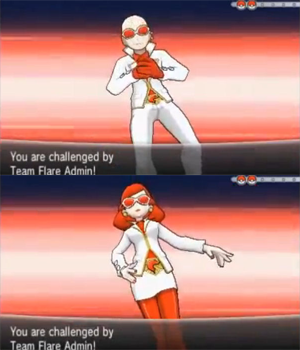
 Whatever else may be said about them, I love the Team Flare Admins' ridiculous pimp outfits.

Interspersed with your actual encounters with Team Flare, a few more interviews with Lysandre himself take place, one in person with Professor Sycamore and a couple by Holo-Caster.  His speech and ideas remain grandiose throughout, and he encourages us to give thought to how we will use our power, but only when you see him in Lysandre Café do we receive more ominous hints about his plans – as with many Pokémon villains, the problem is in his absolutism, his willingness to divide all people in the world into “those who give and those who take” and declare all of the latter, most emphatically, “filth.”  This is the conversation that first suggests the existence of the Ultimate Weapon, and hints at Lysandre’s willingness to use it.  When he finally reveals his Team Flare allegiance to the world and explains his plans to wipe out the rest of humanity… well, it surprised me that he was willing to go so far for his “beautiful world,” but it’s not a total shock, put it that way.  His criteria for who gets to survive the imminent devastation are disheartening – “anyone who is a member of Team Flare, and no-one else,” which makes me question how well he really knows his members.  Would all of them really satisfy his idea of a person who will give and sacrifice to create a beautiful world?  Most are selfish, short-sighted and callous – exactly the kind of person you’d think Lysandre would normally deride as ‘filth’ – and they are able to enter his select group of followers not by proving that they will help to build and preserve a beautiful world, but by paying a truly mind-boggling membership fee.  The interesting thing is that, when we battle him for the first time in his lab beneath Lumiose City, Lysandre seems open to the possibility of letting the player join him and live in the new world.  More so than any other Pokémon villain, Lysandre is interested in our passion and the way we express our beliefs through battle – he’s a little like N that way.  Like N, he also seems almost like he might want a way out, like he might want to be stopped, on some level; he encourages us to fight him and his underlings, and is even willing to let us decide (after a fashion) whether the Ultimate Weapon will be activated.  In the end, though, Xerosic intervenes and we are forced to pursue Lysandre to Geosenge Town to confront him once more.

This is when we learn the dirty little secret, the part of his plan that disturbs even Lysandre: that there will be no place for Pokémon in his new world, not even those who belong to Team Flare.  Lysandre loves his Pokémon; his ability to harness Mega Evolution proves that, as Shauna observes.  In some ways his willingness to sacrifice them speaks to the strength of his convictions, but his reasoning is concerning.  As long as Pokémon exist, Lysandre believes, and as long as some people have Pokémon while others do not, people will use them to take more than their share and seize more power than they deserve.  Some of his research notes back in Lysandre Labs take the form of a broad sketch in anthropological terms of the genesis of inequality in civilisation (a problem that, in the real world, is one of the major areas of study in prehistoric archaeology), and place the impetus squarely with Pokémon – people who commanded Pokémon were able to amass wealth and influence, becoming great leaders.  He makes essentially the same point to us, far more briefly, in person.  The problem is that, despite all his love for his own Pokémon, he never considers that they might have a choice, or that their decisions might impact the way things turned out.  He thinks about the way their powers can be used, for good or ill, but not about how they will allow people to use them.  Remember what I said about the way Lysandre views Diantha as essentially passive?  He’s doing the same thing here.  He’s denying agency to Pokémon, who are clearly intelligent beings, and thinking about them as though they were little more than the extensions of their trainers’ will.  In short, by taking such a deterministic view of the effect Pokémon have on human society, he is committing one of the franchise’s cardinal sins: viewing Pokémon as tools.
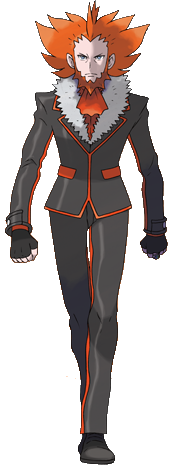
 This man.  What a dick.  Seriously.

Lysandre reminds me – and many other people, I’m sure – very strongly of Cyrus (even sharing two Pokémon, Gyarados and Honchkrow, with his predecessor).  Both are acknowledged as intellectually brilliant, and their goals and beliefs are quite similar.  Both felt driven to crime by despair at the human condition and a belief that an ideal world could only be brought about by drastic and destructive means; Cyrus’s goal was to create a world without suffering – the problem was that he believed the ‘incomplete’ nature of the soul made suffering inevitable – while Lysandre wanted to create a utopia where the world’s resources were shared fairly and sustainably, but came to believe that the greed and laziness inherent in human nature made his vision impossible.  Both are charismatic leaders who command blind obedience, both have keen engineering skills, and both meet mysterious ends.  My trouble with Team Flare and Lysandre though, is that I think we’re supposed to have much more sympathy for them than I can muster.  No one ever asked us to like Cyrus.  The more generous amongst us might have appreciated a certain nobility in his desire to end all suffering, but there was never any question that he was Evil with a capital E.  People regularly ask us to like Lysandre, from Professors to rivals to random townspeople – largely because, unlike the cold and emotionless Cyrus, Lysandre actually cares, and seems to feel genuine remorse even as he continues to work towards his goals.  He seems like he’s meant to be a tragic figure, but having seen so little of his famed philanthropy, I find it difficult to empathise.  In some ways, I think, Lysandre is even worse than Cyrus, because Cyrus’ decisions and actions were very impersonal.  Cyrus felt that life itself was fundamentally broken; killing everyone wasn’t exactly part of his goals, but he felt it was a reasonable sacrifice to make for the chance to create a perfect universe.  Lysandre, on the other hand, just unilaterally decided that most of the people in the world deserved to die for wasting the planet’s limited resources.  As for Team Flare – well, they may not have been pleasant people, but at least Team Galactic and Team Plasma were genuinely in the dark about the true extent of their leaders’ motives (even one of the Galactic admins, Saturn, had no idea Cyrus was trying to destroy the universe and become a god).  Team Flare seem to have known all along what havoc their master was planning – they regularly speak of their desire to create a beautiful word, just for them, and as far as we see no-one abandons Lysandre in shock when he announces his plan to all of Kalos – yet even at the end, Malva is able to claim with a straight face that she did what she thought was right.

I keep coming back to Serena’s words in the battle with her on Victory Road, because I think they encapsulate what the writers intended us to take from this story, and how far that is from what I actually took from it: “Lysandre chose only Team Flare.  You and I chose everyone but Team Flare.  But since our positions forced our hands, you can’t really say any of us were right.  So maybe if both sides have something to say, it’s best to meet halfway.”  Well, okay; that would have been fair enough if we had met Lysandre ten years ago and he had been saying “we need to move Kalos in a more socialist direction and commit ourselves to sustainability.”  Unfortunately, it seems pretty clear that even by the time we first meet him he has already gone off the deep end and is merely hiding it, so that his position is actually “I have no choice but to kill all of you, and your pets.”  How exactly does one “meet halfway” with that?  As far as I can make out, the writers were trying really hard to make Lysandre a tragic and morally ambiguous villain, and even thought they had succeeded, but we get little opportunity to see his positive traits for ourselves, are given the chance to understand his descent into evil only in retrospect, and are eventually asked to sympathise with a man who tried to destroy everyone we have ever loved for the ‘greater good’… of himself and his band of thugs.

Honestly, I think there’s only one way now to achieve the aims the writers actually had in mind for Team Flare and Lysandre: the next sixth generation game has to be a prequel.
Speaking of fairy type, if they ever remake the 2nd generation games again, or just reintroduce Whitney in some way, what do you think they’ll do to Whitney’s team? Do you think they’ll acknowledge that a normal-type specialist has a pure fairy on her team, or will they either replace clefairy or miltank with a normal or fairy type respectfully? Or will they just give up and make her one of the only gym leaders with more than one type preference?

Well, I can’t really speak for what they will do, mostly since I don’t think they’ll remake the second generation games again.  I can talk about what I think they should do, or what would do – which is to say “f*ck it” because what Whitney likes are “cute Pokémon” and Normal and Fairy both have those in abundance.  It’s not like she’d be the first major opponent to look outside her speciality; Sabrina has a Venomoth, Candice has a Medicham, Volkner has an Ambipom and an Octillery, the Striaton triplets all have Lillipup, and several Elite Four members are all over the place.  They could even reference the fact that Clefairy was once thought to be a Normal-type until Fairy Pokémon became better-understood.

Also, there’s a fourth possibility you haven’t mentioned – make Whitney a Fairy-type specialist, keep Miltank as a lone Normal-type and give her a different signature Pokémon, like Clefable.  Why not?

Reading your reviews of Unova Pokemon, I notice you condemned quite a few of them for tricks they didn’t have when you wrote the article, but obtained later. For example- Braviary was damned for a lack of Roost, which he got through BW2 tutors and XY TMs, and Genesect partially because Techno Blast was an inferior Flamethrower/ Thunderbolt/whatever, while it is now more accurate and more powerful than Thunder, Fire Blast, etc. Would you think about reconsidering these Pokemon?

It sounds like a lot of work.  Someone should totally do that.

Champions of the Pokémon League, Part 8: Diantha

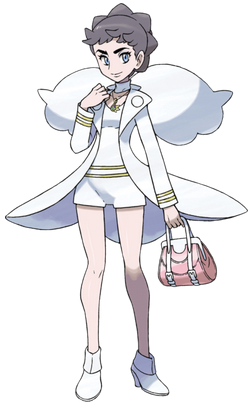
Diantha in her angel-winged white coat.  Note the jewelled necklace - that's her Digivice.

Glamorous but relatable, ethereal but down-to-earth, the Kalosian Champion, Diantha, is everything you want in an actress – but how does she stack up as a Pokémon League Champion?  She certainly has the look down, with an extravagant costume reminiscent of angel wings, and more importantly she also has the right kind of attitude to Pokémon and training.  Sadly – and I may as well be up front about this – the story of X and Y doesn’t give Diantha very much of an opportunity to do anything, something that was rather a disappointment to me.  Still, she gets a few good lines, and when you get her into a battle she’s the equal of any of her predecessors, so let’s take a look at her and see what makes this Champion tick.

We first meet Diantha in Lumiose City at the Café Soleil, and this scene is probably her most interesting because she has the opportunity to speak directly to Lysandre and set up a compelling argument against his beliefs – even here, the game doesn’t let her have many lines, but she makes them count.  Lysandre puts to Diantha the question of whether, as an actress, she would prefer to stay young forever, since it is her duty to inspire people with her beauty.  He clearly expects the answer ‘yes,’ but Diantha finds the question bizarre – being forever young would mean playing the same kinds of roles forever, but she views change and age as essential parts of the experience of human life, and eagerly anticipates the variety of more mature characters she will play as she grows older.  Their conversation betrays a certain narrowness and superficiality on Lysandre’s part; despite his comment that Diantha’s great contribution consists in “[moving] the multitudes with her excellent acting,” it seems clear that he regards her physical beauty as the most important aspect of her craft – to him, Diantha really is just a pretty face.  Her second appearance makes it clear that Diantha herself has a very different understanding of what she does.  We meet her again in Coumarine City, where she is talking with Professor Sycamore at the monorail station.  Diantha offers some comments on Mega Evolution, suggesting that perhaps the reason it seems to be limited to Kalos is because it has something to do with the legendary Pokémon of the region (if Professor Sycamore is correct in his eventual conclusion that Mega Stones were evolutionary stones irradiated with the energy of the Ultimate Weapon three thousand years ago, she’s not far off – although Xerneas and Yveltal don’t seem to have been directly involved with the weapon’s first use, they command similar powers).  More interesting from a characterisation perspective, though, is what she talks about after he leaves.  Sycamore had mentioned the bonds between trainer and Pokémon as a critical component of Mega Evolution, and Diantha makes an interesting comparison with the way she approaches acting: she sees it as an exercise in empathy.  In order to enjoy a role and play it effectively, Diantha says, she needs to put herself in her character’s shoes and understand what they have in common.  She also believes in taking the same approach to interacting with both people and Pokémon.  Essentially, the reason she’s both a successful actress and a great Pokémon trainer is because she’s figured out that the two professions share a key skill – empathy – and made it a part of her general approach to life.

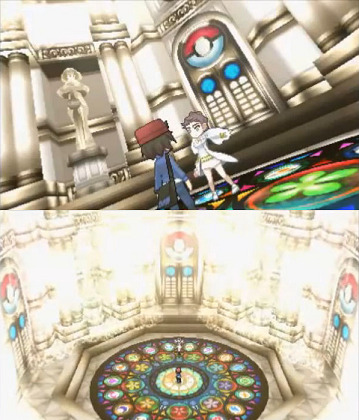
 Diantha's Radiant Chamber, in all its stained-glass glory, seems intended to be 'heavenly' in its appearance, like her costume.

And that… is the last we see of her.  Diantha doesn’t take any further part in the storyline of X and Y until your troubles with Team Flare are all over and you reach the cathedral of the Elite Four.  Realistically enough, she seems to have almost forgotten you herself by this point, but quickly realises that she does know who you are and what you’ve done for Kalos after all – which brings us to the battle.  Like Blue and Cynthia, Diantha is very hard to pin down to a preferred Pokémon type or battling style.  She appears to favour Rock- and Dragon-types, with two of each on her team, but her signature Pokémon, the strongest in her line-up, whose physical appearance is recalled in the flaring white skirts of her coat, is a Fairy/Psychic dual-type, Gardevoir.  In Hawlucha, her opener, Diantha has a strong and fast physical attacker with excellent type coverage thanks to Flying Press, Hawlucha’s idiosyncratic signature move, while Tyrantrum adds a sledgehammer to her tool kit.  Aurorus provides Reflect and Light Screen support, though with two double-weaknesses it may not last long enough to set up more than one.  Goodra is a resilient special tank with a wide variety of powerful attacks.  Gourgeist is surprisingly tough and can hit almost anything for super-effective damage by adding the Ghost type to Pokémon with Trick-or-Treat.  Last, but most definitely not least, is Gardevoir, who proves that Diantha can put her money where her mouth is when it comes to empathy and bonding with her Pokémon – by using her Mega Charm to Digivolve Gardevoir, Diantha can turn her partner into as great a threat as the whole of the rest of her team put together (as I learned to my cost when I first challenged her and won with my Venusaur’s last three hit points).  Mega Gardevoir’s Moonblast and Psychic attacks are phenomenal, more powerful than anything a Champion has brought to bear against us before, and without a Steel-type to resist her primary attacks she is one of the most dangerous single opponents the games have ever produced.  Ironically, Diantha’s greatest vulnerability is probably to Fairy Pokémon, since she has three Pokémon that are weak to their attacks, none that resist them, and only one super-effective attack to hit back with (Hawlucha’s Poison Jab); she also has great difficulty with Ice- and Steel-types.  Still, her weak points are certainly less easy to exploit than those of predecessors like Water-type master Wallace and the closeted Flying-type specialist Lance, making her a solid end-game challenge.

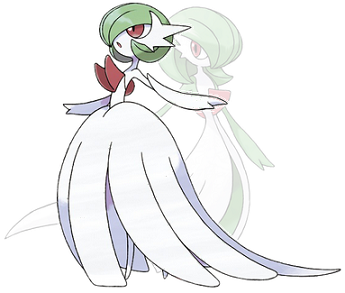
 Diantha's partner, Mega Gardevoir.

(Of course, if you’ve been using the Exp. Share consistently throughout the game Diantha is probably a walk in the park, but hey, who’s counting?)

The variety of Pokémon we see on Diantha’s team – in terms of not only their types and skills but their personalities and dispositions – may be intended to recall her desire for variety in her career and her life.  Partly I’m just saying this because I can’t find any other sort of theme to link her team together, but it seems to me that a wide variety of popular film genres have Pokémon representatives on her team; she has action (Hawlucha), horror (Gourgeist), family/comedy (Goodra and Aurorus), disaster (Tyrantrum) and, of course, romance (Gardevoir) all covered.  Perhaps that’s entirely in my head and the designers just wanted to give her a diverse bag of the new Pokémon the sixth generation has to offer, but it makes sense, given Diantha’s stated interest in playing a variety of roles, that she might have acted in many different genres, possibly meeting many different Pokémon in the process.

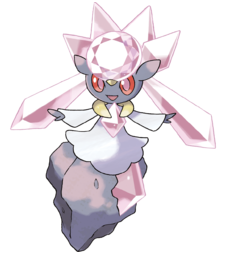
 The recently-revealed legendary Pokémon, Diancie, whom I'm bringing up because I know someone else will if I don't.  A lot of people speculate about a connection between Diantha and Diancie, but I don't believe there is any, because the similarity between their names doesn't exist in Japanese, where Diantha's name is Carnet, and because it makes as much sense for the design of her coat to be based on Gardevoir as on Diancie.

One last thing that’s worth mentioning about Diantha is her reappearance in the Café Soleil after the end of the game.  Diantha here offers you the opportunity to trade for a Ralts holding the Gardevoirite Mega Stone, so that you can raise a Mega Gardevoir of your very own.  This is not in itself particularly interesting; what is noteworthy is that she actually takes the time to think about how the Pokémon involved in this trade feel about it – something I can’t recall any other character in the games ever doing (although, granted, most in-game trades are with random NPCs who have no other discernable purpose in life).  “We Trainers all feel a bit nervous when trading Pokémon,” she comments as the trade begins, “but I’m sure it’s nothing compared to how the Pokémon must feel!”  When the switch has been completed, she even takes a moment to address the Pokémon you’ve given her directly, asking “was it a bit shocking to be traded?” and promising to care for it to the best of her ability.  A tiny detail at the very end of the game, but one that once again demonstrates that Diantha really does know what she’s talking about when it comes to empathy and consistently makes an honest effort to understand the perspectives of her Pokémon on their lives together.

On some level Diantha’s non-existent involvement in the Team Flare crisis makes sense, since she’s very clear that she’s only a Pokémon trainer “in [her] off time” – acting is her real career, and for all her power, she’s not really a ‘saving the world’ kind of girl.  Still, I find her remoteness from the actual plot as disappointing as I did Iris’s, and I don’t think Diantha even gets as much screen time (ironically) as Iris did in Black and White.  Having said that, she makes a good effort to stay relevant in the time she does get – and I can always hope for more in any future games.  Though she never gets the chance to be a hero, through her dialogue she does manage to establish herself as a role model for Kalos’ trainers and a champion of a worldview opposite to Team Flare’s.  Lysandre wants to put the beauty of the world on a pedestal and keep it from changing for all time, but Diantha wants to engage with and understand beauty, and prefers to embrace change, for better or worse, which, ultimately, is what the central conflict of X and Y is about.

Would you ever like to see Pokemon Origins continue with the Johto games’ protagonist?

Hmm.  Ambivalent.  The anime starts to follow the games more closely from the Johto series onward, so although Ash never, say, encounters Giovanni at Silph Co., he does help Lance fight Team Rocket at the Lake of Rage.  He never meets Mr. Fuji or battles Gary himself in the Kanto series, but he does spend episodes with Kurt, the Kimono Girls, Eusine, and Jasmine’s Ampharos.  There’s a lot more overlap in terms of what the anime has done already, so I’m kind of lukewarm about the whole prospect.  There’d be material for an episode at the Goldenrod Radio Tower, it’s true, but a hypothetical Origins: Gold, Silver, Crystal series would still need to have an episode in Mahogany Town to introduce Lance – either that, or completely gloss over the Champion battle, which (though not unthinkable) would be weird.  An extended treatment of Ethan’s battle with Clair and her subsequent refusal to hand over the Rising Badge might be neat though.  I think the big draw would have to be the opportunity to cover Ethan’s battle with Red on Mount Silver, but how to present that in a way that makes sense with Red’s characterisation in Origins?  There might be other sequences that could possibly be dealt with in interesting ways, but overall… meh.

Why do you think retconning is such a big issue with Game Freak’s Pokemon games?

Is it?

I assume you’re referring to their reluctance to introduce new evolutions for old Pokémon with existing evolution methods, presumably in order to provide consistent explanations for why those Pokémon hadn’t been available before (i.e. if Eevee could be evolved with a Leaf Stone, Leafeon should have been obtainable in Red and Blue).  The reason I find this so odd, though, is that there are lots of other changes which apparently aren’t ‘big issues’ at all – things like which moves a Pokémon learns as it levels, or Magnemite’s type, or the minor adjustments to their base stats received by many Pokémon in X and Y.  Heck, you could even argue they’ve retconned an evolution method by what they did with Feebas and Milotic.  I think the reason this particular aspect is so privileged is probably because obtaining Pokémon is a central objective of the game – they’re not so much interested in providing a reason why we couldn’t get Leafeon (or whatever); they’re interested in providing a reason why Professor Oak didn’t require us to.  That’s just a guess, though.

Pokémon: Twitch Version

In memory of the recent astonishing victories of Twitch Plays Pokémon, now you too can experience the frustration and insanity of the hit stream on your very own Nintendo 3DS! (If someone with more programming skills than me actually wants to make this into a hacked rom, I will love you forever)

Features:
–          Choose your starter Pokémon: Pidgey, Rattata or Nidoran!
–          Start the game with a powerful item to provide guidance in times of need: the Helix Fossil!  Consult the Helix Fossil to learn whether this is the right time to use an item, or which move to use against your opponents!
–          No more Pokéballs – instead, wild Pokémon will join your party at random!  Be careful – if your party is full, you might need to brave the PC to retrieve them!
–          A surprise around every corner when learning new moves – you never know what your Pokémon are going to forget!
–          Bill’s PC – the classic villain of Twitch Plays Pokémon is back, with some all new tricks!  Deposit one Pokémon, get one back – but if you want to choose which ones those are, you’d better be prepared to make a sacrifice!  What’s more, the longer you spend using the PC, the more likely it is to demand blood – make sure you release Pokémon regularly, or Bill may take matters into his own hands!
–          Classic RBY mechanics – the Special stat!  15 types!  No held items, abilities or breeding!  No decent attacks for Bug, Grass, Flying, Ghost or Dragon Pokémon!  TMs of powerful moves like Teleport, Dragon Rage and Razor Wind!
–          Meet all your favourite characters from the original Twitch Plays Pokémon, like ABBBBBBK( and JLVWNNOOOO!
–          Powerful new skills for certain Pokémon: Pidgeot gains a boost to all base stats; Venomoth can learn all HM moves; Rattata’s level-up move pool is expanded with attacks like Thunderbolt and Bubblebeam; Gastly starts with Sing and Rollout – explore the game and find out what all your Pokémon can do!
–          Pokémon with field moves like Dig and Teleport will use them on their own initiative to get you out of tight spots, back to the safety of the Pokémon Centre – but be careful, or you might end up leaving a dungeon before you’re done!
–          Hours of play time in every area with engaging ledge-jumping puzzles!
–          Listen for Bulbasaur’s cry to help find hidden items and areas!  Make sure to play it from your Pokédex regularly so you remember what it sounds like!
–          Beat Misty, the Cerulean City Gym Leader!
–          And much, much more (or less, depending on your perspective)!

With seven exciting game modes to unlock!  Switch between modes at a Pokémon Centre, or when the Helix is pleased with your progress!

–          Anarchy – The default setting.  All Pokémon disobey orders, regardless of the number of their trainer’s badges, and movement commands in the overworld are scrambled.  When you try to use an item, there is a 50% chance of tossing it instead.
–          Democracy – All Pokémon disobey orders, regardless of the number of their trainer’s badges, and gameplay speed is reduced by 80%.  When you try to use an item, there is a 33% chance of tossing it instead.  Unlock Democracy mode by finding the mysterious Dome Fossil!
–          Dictatorship – For online play only.  Connect your game to the controls of a random player on the internet and let the blind lead the insane!  Unlock Dictatorship mode by resurrecting Kabuto!
–          Capitalism – Every step costs money, and Pokémon centres charge for healing.  Pokémon will charge for using their attacks, and become more expensive at higher levels – hey, you can’t expect them to put in all that effort for no reward, right?  Unlock Capitalism mode by amassing 50,000 Pokédollars!
–          Communism – All Pokémon share experience equally, including those in Bill’s PC, you cannot earn money or buy items, and gameplay speed is reduced by 60%.  Unlock Communism mode by evolving Eevee into Flareon!
–          Theocracy – Choose one of three divine patrons – the Helix, the Dome or the Amber – and give yourself over to your god’s will.  Each one has exciting Intervention powers that allow them to take a hand in battle when you least expect it, rewarding you for your good decisions by resurrecting your defeated Pokémon or improving their stats, and punishing you for your sins by cursing your Pokémon with weaker moves or striking them with confusion.  Unlock Theocracy mode by resurrecting Omanyte!
–          Monarchy – Tired of all this bull$#!t?  Just switch to Monarchy and control your game normally for a while.  Unlock Monarchy mode by connecting to Nintendo Wi-Fi while no-one else in the world is online!

A gripping psychological plot, focusing on Red’s spiral into insanity as he loses control over his own actions and watches his friends perish!

–          Seek out the eight Gym Leaders and lose to them in battle to gain precious insights into your condition!
–          Obtain the SS Ticket and help Aaabaaajss lead his loyal disciples to the promised land!
–          Climb the 101 floors of Pokémon Tower and rescue Mr. Fuji!
–          Find Flareon, the False Prophet, and through your actions decide how his story ends!
–          Relive the events of Bloody Sunday from the perspective of Dux, X(araggbaj and AAJST(????, and experience the horror first hand!
–          Learn the forgotten origins of the Pokémon world, and the hidden truths of the Helix and the Dome!
–          Descend into the depths of the PC to battle Bill himself and reclaim the souls of your fallen!  Will you recover your precious Pokémon?   Or will you only fall prey to the PC’s horrifying snares yourself?

Discover the epic story of madness, grief, perseverance and triumph!  Get Pokémon: Twitch Version today!

latearegion:

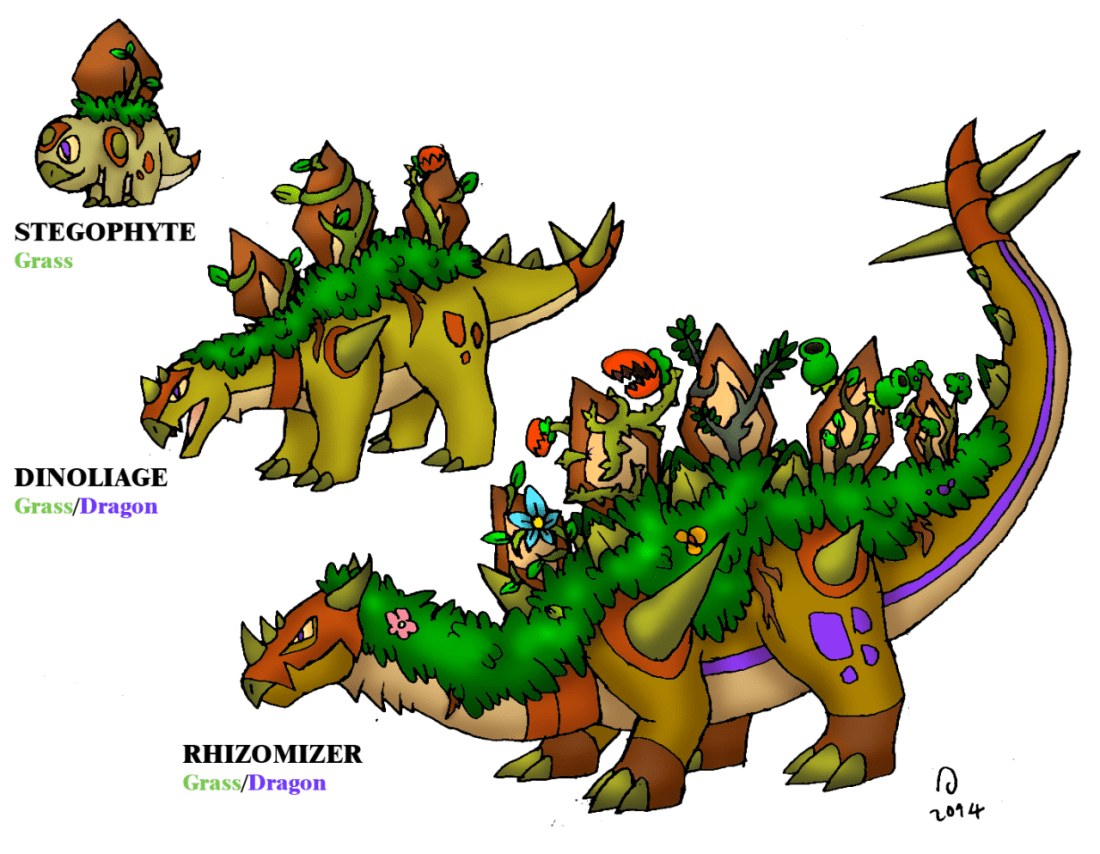
Stegophyte (Stegosaurus+Ephiphyte)
– Plated Pokémon

Dinoliage (Dinosaur+Foliage)
– Plated Pokémon

Rhizomizer (Rhizome+Thagomizer)
– Grove Back Pokémon

One thing I’ve noticed was that most of the Grass starter entries focused primarily on the stegosaur design itself rather than tying it to any specific myth. So for mine, I decided to build upon an idea originally described by Pokémaniacal, specifically a giant dragon with plants growing on its body. Combining this with the stegosaur basis, I came up with the idea of the plates being used as a trellis (which has been used before with a fakemon on deviantART, but that one is based on an Edaphosaurus so it doesn’t quite count). The specific dragon I used as influence was Fafnir, that guy from Norse mythology who was slain by Sigurd and whatnot. Rhizomizer’s neck came out a little long for a stegosaur, but then again, we do have Miragia…

Stegophyte begin their lives as small, vulnerable creatures – the single bony plate on their backs offers little protection. Thus, they rely on camouflage to survive in their forest habitat, covering their bodies with moss and lichen. It is easy to mistake a hiding Stegophyte for a plant root covered in vegetation even with that large back plate, especially since it doesn’t take long for some of the seeds it has planted on itself to sprout, covering the otherwise conspicuous feature. Over time, the plants on its back take root on the Stegophyte itself, giving it a source of extra nutrition to go with their original function. Once it evolves, Dinoliage becomes large and strong enough that it can be a little more picky with the plants it grows on itself, preferring the tastiest or most interesting ones it can find. The plants on its back somehow wrap around its back plates as they grow, and by turning its plates to face the sunlight streaming through the forest canopy, it can warm up its body and give its plants the energy to keep growing. Dinoliage is very protective of its plant life, and it can and will put its powerful tail to use if it feels that its mobile garden is threatened.
Rhizomizer (I wanted to call him Dragomizer, but that name was taken by another fakemon on dA) were among the first Grass-types to be featured in folklore, often as a forest-dwelling horror that emerged along with the sun to terrorize the land. Though this portrayal was somewhat unfair, it was somewhat understandable at the time, for although these Pokémon are exclusively herbivorous, they are also aggressively territorial. These dragons are dedicated to protecting the diversity of forest life, so they see it as their mission to collect and preserve the rarest and most valuable plants they find, like a living seed bank for endangered flora. Of course, many of the plants that grow on their backs are highly sought after by collectors as well, and it does not help that anyone dumb enough to bother the Rhizomizer that’s protecting them will inevitably have to deal with tail spikes as long as a man’s arm, among other issues.
According to legend, the first Rhizomizer was not originally a Pokémon, but a transfigured prince. The king of the land had collected a treasure trove of exotic flora from distant lands, some of which were rumored to possess magical powers. When the king passed away, his jealous sons fought over their collection, and in his attempt to gain ground, the eldest transformed himself into a huge Dragon-type, who promptly hid all the plants between his scales and fled the kingdom, setting his lair deep within the dark forest nearby. This did not deter the hero of the myth who would later be convinced by the younger brother to obtain the vanishingly rare flower that grew upon the dragon’s head, and although it would be wiser to simply pack up and move elsewhere, conventional wisdom did not deter the hero from defeating the otherwise well-protected Dragon-type with a combination of a well-placed Dig and an Icicle Spear to the heart. It is said that the younger prince, who had also planned to steal the flower, tried to transform into another Rhizomizer, but was also slain before he could get that far.
Even in modern times, this famous myth has permeated the modern consciousness, portraying the Stegophyte line as savage, untameable abominations, and Rhizomizer were thus both persecuted and exploited to the point that they no longer existed in the wild. However, with the conservationist movements of the recent decades, a number of biologists took a second look and, upon realizing how subjective the original story was, decided to begin raising orphaned Stegophyte in captivity to see what would happen. Perhaps unsurprisingly, the myth of the killer Stegophyte was proven wrong when the little Grass-types proved to be as docile and affectionate as any other Pokémon, even in their adult forms. To this day, the captive breeding of the Plated Pokémon is considered a blessing by the public, scientists, and Pokémon trainers alike, for a properly raised Rhizomizer is not only an Arceus-send for forest conservation and the species itself, but an immensely powerful and invaluable ally in competitive battling as well.

The standard ability is Overgrow of course; I’ll let the community decide the Hidden ability but possible suggestions include Intimidate, Mold Breaker, Grass Pelt, Harvest, Multiscale, or Sap Sipper.

I love it when the internet draws things for me.  Shout out to SkarmorySilver for making this pretty thing, and to the Latea Region, which you should check out if you haven’t already so you can get in on the ground floor.  Some interesting-looking entries in the Grass-type starter category…

Well, looks like Twitch finally managed to beat the Elite Four. Now that that it has ended I have two questions for you. First, how was the experience, and two, did you have any doubts they would manage to complete the game?

Are you kidding me?  I still can’t believe they got through Victory Road!  I guess that just goes to show how godlike Zapdos was in RBY – nothing really stops him but Rhydon, Golem or Onix.

I haven’t spent much time actually watching the stream, but a friend has been regularly sending me links to all the interesting nonsense that it generates in its wake.  It’s a very neat exercise in pareidolia, the human propensity for recognising patterns in randomness.  Red’s chaotic flailing and regular tragic mishaps have prompted some very creative interpretations of what’s been going on – the whole helix fossil religion, of course, but also the various ‘heresies’ of that (like dome-worship, or the alternate interpretations of Flareon), the depictions of Venomoth as an all-terrain vehicle, the way the Anarchy/Democracy system has turned into some kind of weird allegorical social commentary… it’s meaning crafted from meaninglessness, which actually says something very profound about the human condition, I think.

And now there’s a countdown to the next game.  I wonder whether the next one will be as popular.  I do hope so – but how will the mind hive find its way without the guidance of the Helix?