
On the last day of March this year, I set out to pass judgement on all one hundred and fifty-six of the new Pokémon of Black and White. I have spent the intervening nine months whining constantly about the general incompetence of Game Freak’s designers and the total unworthiness of the name “Pokémon” of such creations as Unfezant, Emolga, and (shudder) Garbodor. So, here’s the big question: what’s the final score?
Out of one hundred and fifty-six Pokémon, I have:
Condemned eighty,
Spared seventy-five,
And shaken my head in confusion and given up on one.
Wait, that can’t be right! I’ve let almost half of them live! I must have been far too nice! Let me see those…
I let them keep Liepard? What was I thinking? Continue reading “My Quest Concludes”
 Kyurem is a mysterious and powerful Dragon Pokémon who lives hidden in a crater known as the Giant Chasm, near Lacunosa Town in north-eastern Unova. The people of Lacunosa Town don’t know what lives in the Chasm, but they regard it as a place of ill omen and are afraid to go near it. The town is surrounded by a wall to keep out whatever lives there, and the people of the town normally stay inside their homes at night, since old legends warn of a monster that fell from the sky long ago and takes away people and Pokémon at night to eat them. Their fear is understandable; Kyurem’s hard, almost skeletal visage is not a welcoming sight. As far as I can make out, though, he just wants to lurk in his dark cave at the back of his meteor crater and be left alone. The information we have on Kyurem from the Pokédex seems to suggest that he’s unwell – maybe sick, injured, or just plain old – and can’t control his own ice powers properly anymore. His own body has long since been frozen by his own chilling aura, leaving him a shadow of his former self. So, what was his former self like? The air is thick with speculation.
 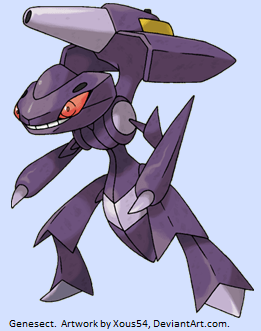 Okay, sure, there are differences. Genesect was the brainchild of Team Plasma (and presumably of their de facto leader, Ghetsis), the villains of Black and White, who enhanced the deadly prehistoric insect with metal armour and a devastating portable photon cannon, while Mewtwo, who was commissioned by Team Rocket’s shadowy master Giovanni, gained his incredible psychic abilities courtesy of a truly frightening amount of gene splicing (although, in the TV show, Giovanni does also equip him with a suit of armour designed to focus and augment his powers). Also, it seems pretty clear that Genesect was always a vicious hunter even before Team Plasma got to it, whereas Mewtwo’s predecessor, Mew, is one of the most peaceful and carefree Pokémon you’ll ever find. As I alluded earlier, though, the similarities are striking, to say the least. The Genesect project was actually shut down, since Team Plasma’s spiritual leader, N, held a very different attitude towards Pokémon to Giovanni’s; specifically, N believes that Pokémon are perfect beings, and came to the conclusion that the technological enhancements made to Genesect by his scientists were a corruption of its natural purity. The lab where Genesect was developed was not abandoned, though; a couple of scientists continued to haunt the place and eventually brought their creation to a state resembling completion.
 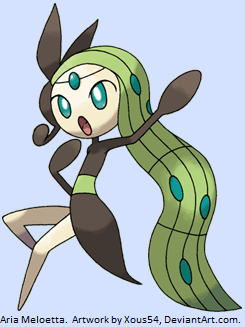 Meloetta is a dainty humanoid Pokémon with powers related to music. Her arms and hands, as well as part of her headdress, are shaped like musical notes, and her wavy hair is reminiscent of a musical score. She can influence the emotions of people with her song, helping them to achieve the right state of mind for composing music, and could well be based on the Muses, the ancient Greek goddesses of inspiration, or possibly on less ancient interpretations of the same concept. There were traditionally supposed to be nine Muses, but Meloetta has only two forms (I’m not particularly bothered by this, incidentally; nine forms would be interesting but it would have been difficult to achieve enough differentiation between them to make it worthwhile), which are related to the two main ways humans can participate in music: song and dance. In her “Aria” form, Meloetta’s hair is green and flows out behind her, while in her “Pirouette” form, her orange hair is wrapped up around the top of her head like a turban and her skirt blows up around her like a ballerina’s tutu. Meloetta can switch from her Aria form, in which she is a Normal/Psychic dual-type, to her Pirouette form, in which she is a Normal/Fighting dual-type, by using an attack called Relic Song, a technique she forgot long ago but which she can remember with the help of a musician in Castelia City who will also tell you Meloetta’s story.


 Remember Dragonite? I liked Dragonite; Dragonite was nice and enjoyed helping people. Not all Dragon Pokémon are nice, of course; Flygon, Haxorus and Altaria are, but Kingdra and Druddigon are basically crazy old men shouting at the kids to get off their lawns, Garchomp is ill-tempered though not malicious, and Salamence is just slightly insane and prone to extremes of anger and joy.
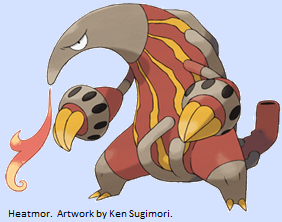 I’m doing Heatmor and Durant together because, although they aren’t part of a single evolutionary family, they do in a sense ‘go together.’ Heatmor is a bloody great anteater that some delightfully mad person has decided to splice together with a blast furnace or something, and Durant is an angry giant ant plated from head to abdomen in steel, and Heatmor’s favourite food. Durant, the Pokédex insists, covers itself in steel plating specifically to protect itself from Heatmor, which makes absolutely no sense in a world of elemental ‘types’ with distinct strengths and weaknesses relative to one another. Why does this make no sense? Because Heatmor is a Fire Pokémon, and relying on metal armour to protect yourself from a Fire-type is tantamount to suicide according to everything we have ever seen about the way this world works. Now, evolution (in the real-world biological sense, not the Poké-world pseudozoological whacko sense) is an insanely complicated phenomenon, this I will grant you, but no-one and nothing is going to convince me that natural selection would actually push a species to become more vulnerable to its own major natural predator.
  Pokémaniacal