
At some point after Blue loses the title of Champion to Red, the player character of the original games, Red buggers off to spend the next few years sitting at the top of a godforsaken mountain in the middle of nowhere gazing into the distance as the snow gradually piles up around his ankles. Blue has evidently lost interest in the Championship by this point, which leaves the top spot open. Eventually – whether this happens by election, or contest, or promotion is unclear – the position falls to the most senior member of the Pokémon League’s peerless death squad, the Elite Four: an eccentric dragon master from Johto by the name of Lance.
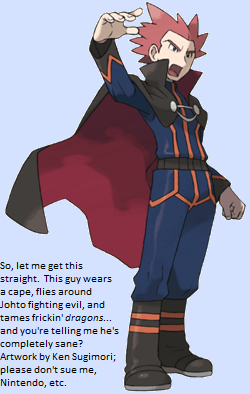 Never without his trademark cape (of which, rumour has it, he owns several), Lance is a proud, confident young man with absolute faith in his Pokémon – and justly so, since his “virtually indestructible” Dragon-types are among the most powerful Pokémon in the world. In Red and Blue, where Lance appears as the leader of the Elite Four, that’s pretty much all we learn about him, but he gets more characterisation along with his more important role in Gold and Silver, and extra titbits of information pop up in the remakes of both sets of games. The cape isn’t just an affectation; Lance is basically the closest thing in Johto to a superhero, flying around the region on his Dragonite, investigating suspect activity, righting wrongs, fighting for justice and being a general all-around good guy, if a somewhat overly dramatic one. When Team Rocket shows up in Mahogany Town and causes trouble by forcing all the Magikarp in the nearby Lake of Rage to evolve into Gyarados, Lance follows along to sort them out, revealing the entrance to their hideout for you and figuring out what they’re up to. Once he’s conscripted you as his partner in the investigation he gets surprisingly lazy about everything and leaves you to do most of the fighting, in spite of his vastly greater power and experience, although he comes through for you in the end when you’re attacked by the hideout’s commanders. Based on what he has to say on the subject, this could be out of a desire either to test your potential or to let you have your share of the glory. Alternatively he might have snuck back to the Lake of Rage while you weren’t looking to see whether there was another red Gyarados in the area. You know he totally wanted it for himself. After his intervention in Mahogany Town, it’s striking that Lance doesn’t make an appearance in the far more dramatic crisis of Team Rocket’s later takeover of Goldenrod City. In fact, it’s striking that no-one at all bothers to do anything when they put the entire city under lockdown and start broadcasting their plans on national radio. I can understand the local police being overwhelmed, and the Goldenrod Gym seems to have been barricaded with the Gym Leader, Whitney, and all her minions inside, but I would have thought that the repeated and insistent public radio announcements might draw a little attention from outside the city. Did Lance really have better things to do that evening than liberate a city from a villainous organization planning to take over the whole damn country? Was he ironing his cape? Dyeing his hair? Doing naked bloody cartwheels in the flipping moonlight for a pagan fertility ceremony?
Sorry. I’m allergic to plot holes; they set off my cerebral haemorrhaging.
Anyway. Lance.
Various characters across various games can tell us a few more things about Lance. He’s a member of the ancient family of Dragon Pokémon trainers who rule Blackthorn City, and the cousin of the Gym Leader, Clair (who has all of Lance’s pride and elitism with none of his compassion or honour). He apparently commands a great deal of respect there and seems to be by far the strongest trainer his clan has produced in a generation; the very suggestion of his displeasure is enough to shut Clair up when she refuses to hand over the Rising Badge after being defeated. Lance’s clan regard Dragon Pokémon as sacred, treating them with reverence because of their boundless life energy, and only allow their members to train dragons once they have proven themselves “worthy.” Given this background, Lance’s utter conviction in the supremacy of Dragon-types makes a great deal of sense. The dragon-user characters of Blackthorn City are an interesting bunch, and one of the many things in this world I’d rather like to see developed more – where did their beliefs originally come from, and what is it that makes Dragon Pokémon so special?

Those of you who’ve fought Lance in Gold, Silver or Crystal (or the remakes) probably remember one thing about him more clearly than anything else: Lance is a cheating bastard. As any truly dedicated Pokémaniac knows, Lance’s signature Pokémon, Dragonite, evolves from Dragonair at level 55. Lance’s strongest Pokémon in those games is only level 50, yet he has not one but three of the damn things, two of them as low as level 47. You could probably handwave this by saying that Lance’s heritage and upbringing give him special insight into training Dragon Pokémon, but I prefer to say that he’s a cheating bastard. Fudging the numbers like that really was necessary, though – by this point, you’ve already fought Clair, who uses a trio of Dragonair (two Dragonair and a Gyarados on Heart Gold and Soul Silver), so more of them would get repetitive, not to mention a bit easy, since Dragonair starts to get quite lacklustre in the high 40s and early 50s compared to the other Pokémon that have reached their final forms already. Funnily enough, however, this is not the only reason Lance is a cheating bastard, just the most obvious. He also has a history of teaching his Pokémon attacks that they can’t actually learn. In Gold, Silver and Crystal, Lance’s Aerodactyl knows Rock Slide, which Aerodactyl doesn’t get in those games (he can learn it from Ruby and Sapphire onward, but in Red and Blue this made him profoundly useless because he had no decent attacks from his own types). There’s absolutely no reason, thematically speaking, that Aerodactyl shouldn’t learn Rock Slide, and I think what happened is that the designers thought he could learn it and didn’t bother to check, which just goes to show that some of Game Freak’s decisions regarding which Pokémon should learn which attacks make so little sense that even they don’t understand them (see also: Aerial Ace). In this case, Lance’s cheating bastardry is merely correcting an unfortunate oversight anyway. In the case of his Dragonite from Red and Blue inexplicably knowing Barrier, which has never been a TM, which Dragonite has never been able to learn by any means, and which isn’t a markedly appropriate move for Dragonite to have anyway, especially considering that Dragonite, compared to Aerodactyl, has a vast movepool… yeah, I’ve got nothing on that one.
The vaguely interesting thing about Lance’s line-up is that, for a Dragon master, he doesn’t actually use all that many Dragon-types – principally because there weren’t all that many in Gold and Silver. Other than Dratini, Dragonair and Dragonite, the only true Dragon available was Kingdra – and Kingdra is already Clair’s signature Pokémon, so Lance can’t easily get away with using her. As a result, Lance fills out his team with Pokémon that aren’t really Dragons but look like they should be: Gyarados, Aerodactyl, and Charizard. Oddly enough, I like this – choosing Pokémon that are thematically appropriate to a given trainer rather than necessarily being restricted to ones of that character’s favoured element – because it adds a bit of depth to team composition and makes trainers a bit more interesting, but it’s something that Game Freak generally avoid, and they seem to have gotten worse at it lately. Compensating for the small number of Dark-types in Gold and Silver by giving Karen a Vileplume and a Gengar, two Pokémon strongly associated with night, made sense. Compensating for the miniscule number of Fire-types in Diamond and Pearl by giving Flint a Steelix, a Drifblim and a Lopunny, three Pokémon that… randomly happen to learn one Fire attack each… didn’t. I really think Game Freak would have benefitted from taking a close look at some of the line-ups used by trainers from the first two sets of games (Lance is just one example) and giving some serious thought to which choices made sense and which ones didn’t, because often the most obvious answer isn’t the only one.
That’s all I think there is for me to say about Lance, really. He’s the first ‘sitting’ Champion we get to see, and therefore our first introduction to the responsibilities of the position, a theme that comes up a fair bit in Black and White. Together with Clair, he also did a lot of the work of defining what the Dragon type means in the world of Pokémon, which is kind of important, given how vague a type it really is, when you think about it. And… okay, I guess I have to admit it, even the cape does grow on you after a while. He’s a bit over-the-top, but that’s what makes him fun… in stark contrast to the next Champion in the series…


 Kyurem is a mysterious and powerful Dragon Pokémon who lives hidden in a crater known as the Giant Chasm, near Lacunosa Town in north-eastern Unova. The people of Lacunosa Town don’t know what lives in the Chasm, but they regard it as a place of ill omen and are afraid to go near it. The town is surrounded by a wall to keep out whatever lives there, and the people of the town normally stay inside their homes at night, since old legends warn of a monster that fell from the sky long ago and takes away people and Pokémon at night to eat them. Their fear is understandable; Kyurem’s hard, almost skeletal visage is not a welcoming sight. As far as I can make out, though, he just wants to lurk in his dark cave at the back of his meteor crater and be left alone. The information we have on Kyurem from the Pokédex seems to suggest that he’s unwell – maybe sick, injured, or just plain old – and can’t control his own ice powers properly anymore. His own body has long since been frozen by his own chilling aura, leaving him a shadow of his former self. So, what was his former self like? The air is thick with speculation.
 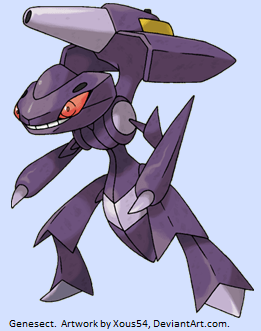 Okay, sure, there are differences. Genesect was the brainchild of Team Plasma (and presumably of their de facto leader, Ghetsis), the villains of Black and White, who enhanced the deadly prehistoric insect with metal armour and a devastating portable photon cannon, while Mewtwo, who was commissioned by Team Rocket’s shadowy master Giovanni, gained his incredible psychic abilities courtesy of a truly frightening amount of gene splicing (although, in the TV show, Giovanni does also equip him with a suit of armour designed to focus and augment his powers). Also, it seems pretty clear that Genesect was always a vicious hunter even before Team Plasma got to it, whereas Mewtwo’s predecessor, Mew, is one of the most peaceful and carefree Pokémon you’ll ever find. As I alluded earlier, though, the similarities are striking, to say the least. The Genesect project was actually shut down, since Team Plasma’s spiritual leader, N, held a very different attitude towards Pokémon to Giovanni’s; specifically, N believes that Pokémon are perfect beings, and came to the conclusion that the technological enhancements made to Genesect by his scientists were a corruption of its natural purity. The lab where Genesect was developed was not abandoned, though; a couple of scientists continued to haunt the place and eventually brought their creation to a state resembling completion.
 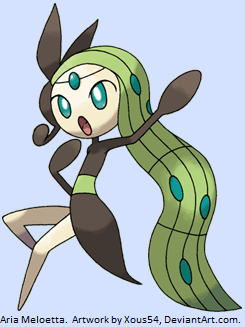 Meloetta is a dainty humanoid Pokémon with powers related to music. Her arms and hands, as well as part of her headdress, are shaped like musical notes, and her wavy hair is reminiscent of a musical score. She can influence the emotions of people with her song, helping them to achieve the right state of mind for composing music, and could well be based on the Muses, the ancient Greek goddesses of inspiration, or possibly on less ancient interpretations of the same concept. There were traditionally supposed to be nine Muses, but Meloetta has only two forms (I’m not particularly bothered by this, incidentally; nine forms would be interesting but it would have been difficult to achieve enough differentiation between them to make it worthwhile), which are related to the two main ways humans can participate in music: song and dance. In her “Aria” form, Meloetta’s hair is green and flows out behind her, while in her “Pirouette” form, her orange hair is wrapped up around the top of her head like a turban and her skirt blows up around her like a ballerina’s tutu. Meloetta can switch from her Aria form, in which she is a Normal/Psychic dual-type, to her Pirouette form, in which she is a Normal/Fighting dual-type, by using an attack called Relic Song, a technique she forgot long ago but which she can remember with the help of a musician in Castelia City who will also tell you Meloetta’s story.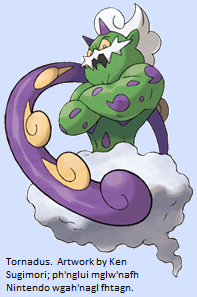


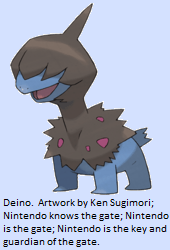 Remember Dragonite? I liked Dragonite; Dragonite was nice and enjoyed helping people. Not all Dragon Pokémon are nice, of course; Flygon, Haxorus and Altaria are, but Kingdra and Druddigon are basically crazy old men shouting at the kids to get off their lawns, Garchomp is ill-tempered though not malicious, and Salamence is just slightly insane and prone to extremes of anger and joy.
 Pokémaniacal