
Today’s Pokémon are… not bees. We think.

As their species designation – the Bee Fly Pokémon – attests, Cutiefly and Ribombee are based (in Ribombee’s case, somewhat loosely and with the addition of fairy-like traits) on bee flies. Bee flies, as their remarkably inventive name suggests, are a family of insects within the fly order, Diptera, that pollinate flowers and look like bees, though they are usually smaller. They are related to predatory robber flies, and despite their fuzzy appearance, most bee flies are parasites that will lay their eggs on the larvae of other insects, typically beetles or solitary bees, resulting in the slow and gruesome death of the larvae. There are over 5000 species of bee fly around the world (because clearly the world needed that many), but the particular one referenced by Cutiefly is the adorable internet celebrity Anastoechus nitidulus, a rare species that lives only in southwest Japan, in the area around the city of Okayama. As far as I can tell, this species is so rare, and bee flies in general are so poorly studied by entomologists, that it doesn’t even have an English name – I’ve seen them called “tiger bee flies,” which I think is an attempt to translate the Japanese name toratsuri-abu, but in English the name “tiger bee fly” ought to refer to a different species of bee fly, the larger, blacker and more sinister-looking Xenox tigrinus, which can be found throughout North America. Thankfully, Cutiefly already represents a fully adult bee fly, so we don’t have to observe first hand the family’s parasitic tendencies; instead we see only the adults’ more palatable diet of nectar, which they harvest with their mosquito-like proboscises. Cutiefly and Ribombee express this through their flavour text, through the Honey Gather ability they share with Combee, and through their in-game distribution in the areas in and around Alola’s Oricorio meadows.
Continue reading “Cutiefly and Ribombee”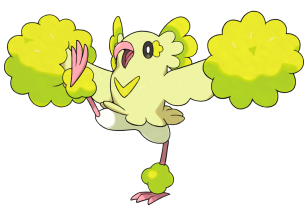

 Kyurem is a mysterious and powerful Dragon Pokémon who lives hidden in a crater known as the Giant Chasm, near Lacunosa Town in north-eastern Unova. The people of Lacunosa Town don’t know what lives in the Chasm, but they regard it as a place of ill omen and are afraid to go near it. The town is surrounded by a wall to keep out whatever lives there, and the people of the town normally stay inside their homes at night, since old legends warn of a monster that fell from the sky long ago and takes away people and Pokémon at night to eat them. Their fear is understandable; Kyurem’s hard, almost skeletal visage is not a welcoming sight. As far as I can make out, though, he just wants to lurk in his dark cave at the back of his meteor crater and be left alone. The information we have on Kyurem from the Pokédex seems to suggest that he’s unwell – maybe sick, injured, or just plain old – and can’t control his own ice powers properly anymore. His own body has long since been frozen by his own chilling aura, leaving him a shadow of his former self. So, what was his former self like? The air is thick with speculation.
  Okay, sure, there are differences. Genesect was the brainchild of Team Plasma (and presumably of their de facto leader, Ghetsis), the villains of Black and White, who enhanced the deadly prehistoric insect with metal armour and a devastating portable photon cannon, while Mewtwo, who was commissioned by Team Rocket’s shadowy master Giovanni, gained his incredible psychic abilities courtesy of a truly frightening amount of gene splicing (although, in the TV show, Giovanni does also equip him with a suit of armour designed to focus and augment his powers). Also, it seems pretty clear that Genesect was always a vicious hunter even before Team Plasma got to it, whereas Mewtwo’s predecessor, Mew, is one of the most peaceful and carefree Pokémon you’ll ever find. As I alluded earlier, though, the similarities are striking, to say the least. The Genesect project was actually shut down, since Team Plasma’s spiritual leader, N, held a very different attitude towards Pokémon to Giovanni’s; specifically, N believes that Pokémon are perfect beings, and came to the conclusion that the technological enhancements made to Genesect by his scientists were a corruption of its natural purity. The lab where Genesect was developed was not abandoned, though; a couple of scientists continued to haunt the place and eventually brought their creation to a state resembling completion.
  Meloetta is a dainty humanoid Pokémon with powers related to music. Her arms and hands, as well as part of her headdress, are shaped like musical notes, and her wavy hair is reminiscent of a musical score. She can influence the emotions of people with her song, helping them to achieve the right state of mind for composing music, and could well be based on the Muses, the ancient Greek goddesses of inspiration, or possibly on less ancient interpretations of the same concept. There were traditionally supposed to be nine Muses, but Meloetta has only two forms (I’m not particularly bothered by this, incidentally; nine forms would be interesting but it would have been difficult to achieve enough differentiation between them to make it worthwhile), which are related to the two main ways humans can participate in music: song and dance. In her “Aria” form, Meloetta’s hair is green and flows out behind her, while in her “Pirouette” form, her orange hair is wrapped up around the top of her head like a turban and her skirt blows up around her like a ballerina’s tutu. Meloetta can switch from her Aria form, in which she is a Normal/Psychic dual-type, to her Pirouette form, in which she is a Normal/Fighting dual-type, by using an attack called Relic Song, a technique she forgot long ago but which she can remember with the help of a musician in Castelia City who will also tell you Meloetta’s story.

 Pokémaniacal