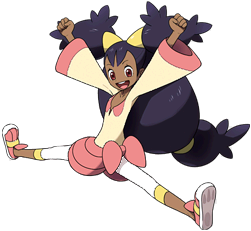
As odd a time as this is to be talking about Iris, my next post is going to be on Diantha, which would otherwise make Iris the only Champion I haven’t written about, having discussed all the previous ones about two years ago now, a possibility that makes me feel a little twinge of unfairness in my normally blackened iron heart. For the sake of completeness, then, let’s give some thought to the fifth generation games’ portrayal of the dragon master Iris, our second female and first dark-skinned Champion (yay diversity!).
Iris first shows up when the player reaches Castelia City in Black and White, where she enthusiastically volunteers to be Bianca’s bodyguard after the latter’s Munna is abducted, and takes part in the standoff with Team Plasma. She is here portrayed as passionate and firm in her convictions, reacting with anger and dismay when she learns of Team Plasma’s theft and bewilderment when the rest of the group agrees to let Ghetsis and his minions leave without a fight, but is also extremely ready to help people in need, and perhaps a little naïve (Burgh suggests that Iris will need Bianca’s help finding her way around the huge city as much as Bianca will need Iris’s protection). On White, Iris is subsequently revealed to be the Gym Leader of the ancient, traditionalist version of Opelucid City; on Black (and I say this as a player of Black version) one is rather left wondering what the point of her is supposed to be. In both games, she also helps Drayden narrate of the story of Reshiram and Zekrom. Since they’re both Gym Leaders of Opelucid City, it makes sense to look at Drayden in Black and White as something of a foil to Iris. Compared to her older mentor, Iris stands out for her excitable speech patterns, liberally peppered with exclamation marks, and her emotional, evocative language. Both are idealistic, but Iris is much more liberal in showing it. On Black, the Opelucid Gym gives Drayden, as its leader, the epithet “the Spartan Mayor,” announcing him to be hardworking, physically strong and austere, as well as reminding challengers of the respect he commands as Mayor of Opelucid City (also, almost uniquely for these titles, it makes no reference to his elemental specialisation). On White, where Iris is the Gym Leader, she is referred to as “the Girl Who Knows the Hearts of Dragons,” a description that focuses instead on her capacity for empathy and intuition, her deep connection with one of the most mysterious Pokémon types, and possibly her raw talent as a Pokémon trainer. It may also be worth comment, in connection with Iris’ characterisation as energetic and youthful, that the only difference between the teams they deploy as Gym Leaders (aside from the gender of their Pokémon – Drayden’s are male; Iris’s are female) is which abilities their Druddigon possess; Drayden’s has Rough Skin, reflecting endurance and severity, while Iris’s has Sheer Force, suggestive of potency and vitality. A minor difference, but when everything else about their Pokémon is kept the same, one little change feels that much more purposeful. Even the city itself may contribute. Drayden is the Gym Leader of a futuristic, technologically advanced Opelucid City, the result of industrious dedication to progress, while Iris’ Opelucid City is peaceful, quiet and very traditional, in keeping with her emphasis on closeness to Pokémon and nature (though her ‘nature girl’ traits, it must be said, are much less noticeable than in her anime incarnation).

At some point before the events of Black and White 2, Iris replaces Alder as Unova’s Champion. As it did for Wallace in Hoenn, this apparently occasions a change of costume, with Iris’ relatively plain beige sweater being replaced by a frilled pink dress like something out of a fairy tale (appropriately enough, given her specialisation), complete with a golden, emerald-studded tiara. We first encounter her, again, in Castelia City. She retains her desire to help people in need, immediately volunteering to assist in your search for Team Plasma despite her belief that they are no longer a threat – but in a pointed contrast to her last appearance suggestive of her greater experience and maturity, she now appears to know the city very well, and is immediately able to direct the player to the most likely site of any suspicious activity, namely the Castelia Sewers. She does very little else in that game, however, appearing again only in Opelucid City for a brief and not especially revealing conversation about Drayden (if nothing else, we learn here that although she calls Drayden ‘grandpa,’ they aren’t actually related). At the time of Black and White 2, Iris was the only Champion since Blue not to take an active role in fighting the primary villains (she is now joined by Diantha), which, given her keen interest in the legends of Reshiram and Zekrom, is baffling. Her initial scepticism at the possibility of a Team Plasma comeback goes some way towards explaining this, but the flying battleship shelling Opelucid City with ice cannons must have been one hell of a wakeup call. Having said that, I’m not sure what her presence would have added other than opportunities for characterisation – unlike Alder, whose own personal flaws and troubled past complicate his opposition to Team Plasma, Iris’s involvement in that plot would have been fairly straightforward, so in some ways it’s perhaps better that she wasn’t there to take the spotlight from Hugh.
Probably the most interesting bit of characterisation Iris gets in Black and White 2 is not actually in the events of the games themselves but through a Memory Link scene (if you’re not familiar with these, they’re scenes which take place between the original Black and White and the sequels, which you can only view if your Black 2 or White 2 game is associated with the same Global Link account as a Black or White game which has completed certain parts of the storyline). In Opelucid City, you can hear from Drayden about how Iris became his student and eventually the Champion – a position she has apparently been groomed for by Drayden since she first came to Unova as his successor. In fact, having the opportunity to challenge Alder and become Champion was apparently her condition for leaving her home in the distant Village of Dragons, hinting at ambition, vigour, and possibly (as we’ve already seen from her) a touch of naïveté about the magnitude of this goal, though it appears she was an exceptionally talented trainer even before she met Drayden. The fact that Alder, in consultation with Drayden, apparently chose his successor is interesting, although it appears that actually defeating him was still a requirement for Iris to take up the position and, far from considering it a formality, Alder actually put himself through a special training regimen (“ghastly,” according to Drayden) to prepare himself for this final duty, intent on pushing Iris to her limit. Now that she’s there, Iris declares that her mission as Champion will be to help people and Pokémon continue to grow ever closer (a pledge that is not without resonance in the overarching themes of the fifth generation). We also see in this flashback that the enormous pink dress Iris wears as the Champion was actually Drayden’s idea, a gift from him upon the completion of her training; now that she’s the Champion, he tells her, it’s okay to dress up – her hard work has earned her the right to a little frivolity now and then.
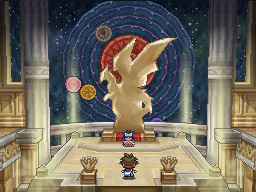
When we finally meet Iris again in the palace of the Elite Four and battle her for the championship, the game pulls out all the stops. Not only is Iris’ chamber particularly spectacular in comparison to those of past champions, with a huge throne in the shape of a dragon silhouette and a rotating circular backdrop apparently meant to represent the planets in orbit around the sun, the battle scene itself is marked by eye-catching streaks of rainbow light flashing across a twilight background. The battle scenery of X and Y, of course, put it all to shame, but it was quite spectacular compared to everything that had preceded it, making the battle with Iris a unique and memorable one. Nor does Iris herself let us down. The game designers, apparently ashamed at their decision to neuter Ghetsis’ Hydreigon with a bizarre physical attacker moveset, have Iris open with a proper special attacker Hydreigon, as deadly a foe as any you’re likely to face in this game. The rest of her team illustrates nicely that it’s quite easy to design a varied and balanced line-up for a Dragon master, simply because there are so many ‘dragon’ Pokémon who aren’t actually Dragon-with-a-capital-D Pokémon. Iris uses three of them: Aggron, Lapras and Archeops. Lapras ensures that she has an answer to Water- and Ice-type Pokémon who think they can sweep her team with Ice attacks, while Aggron covers up her defensive weakness to opposing Dragon Pokémon, and Archeops is simply vicious, and even carries Endeavour to help compensate for the Defeatist ability that normally renders him harmless when his health is low. Druddigon would be the weakest member of her team, but the designers apparently realised this and gave him a Life Orb (making him the only member of her team aside from her partner to use a held item) so as to abuse the way Life Orb and Sheer Force work together – Sheer Force negates Life Orb recoil damage, but only on attacks that Sheer Force applies to normally. Finally her partner, a Pokémon that needs no introduction, is a Dragon Dance Haxorus, complete with an Earthquake that can bring down even Levitating Pokémon thanks to Mold Breaker. With the possible exception of Lapras, all of Iris’ Pokémon and their movesets are ones which emphasise overwhelming force; no stalling Spiritomb, Recover-spamming Milotic or defence-buffing Vanilluxe for her (even her Lapras exploits its powerful special movepool in preference to, say, a more sedate and arguably more effective Rest/Sleep Talk strategy). Iris is all about enthusiasm and passion, and her first priority is to jump right in and blast away from start to finish.
Iris may still be an AI trainer, but as AI trainers go, she’s very much at the top of her game. As a character, she has an odd relationship with the story, spending as little time directly interacting with it as possible but managing to snatch a fair bit of characterisation anyway, courtesy of the greater screen time Black and White gave to most of their Gym Leaders. Her beliefs and goals as Champion also make a very clear statement about the central theme of the games – whether humans should become closer with Pokémon or move further apart. While I remain a bigger fan of Alder and Cynthia, she’s a neat character, and has little trouble stepping into the larger-than-life boots of her predecessors. Will her successor, Diantha, measure up? Only one way to find out…

 Kyurem is a mysterious and powerful Dragon Pokémon who lives hidden in a crater known as the Giant Chasm, near Lacunosa Town in north-eastern Unova. The people of Lacunosa Town don’t know what lives in the Chasm, but they regard it as a place of ill omen and are afraid to go near it. The town is surrounded by a wall to keep out whatever lives there, and the people of the town normally stay inside their homes at night, since old legends warn of a monster that fell from the sky long ago and takes away people and Pokémon at night to eat them. Their fear is understandable; Kyurem’s hard, almost skeletal visage is not a welcoming sight. As far as I can make out, though, he just wants to lurk in his dark cave at the back of his meteor crater and be left alone. The information we have on Kyurem from the Pokédex seems to suggest that he’s unwell – maybe sick, injured, or just plain old – and can’t control his own ice powers properly anymore. His own body has long since been frozen by his own chilling aura, leaving him a shadow of his former self. So, what was his former self like? The air is thick with speculation.
  Okay, sure, there are differences. Genesect was the brainchild of Team Plasma (and presumably of their de facto leader, Ghetsis), the villains of Black and White, who enhanced the deadly prehistoric insect with metal armour and a devastating portable photon cannon, while Mewtwo, who was commissioned by Team Rocket’s shadowy master Giovanni, gained his incredible psychic abilities courtesy of a truly frightening amount of gene splicing (although, in the TV show, Giovanni does also equip him with a suit of armour designed to focus and augment his powers). Also, it seems pretty clear that Genesect was always a vicious hunter even before Team Plasma got to it, whereas Mewtwo’s predecessor, Mew, is one of the most peaceful and carefree Pokémon you’ll ever find. As I alluded earlier, though, the similarities are striking, to say the least. The Genesect project was actually shut down, since Team Plasma’s spiritual leader, N, held a very different attitude towards Pokémon to Giovanni’s; specifically, N believes that Pokémon are perfect beings, and came to the conclusion that the technological enhancements made to Genesect by his scientists were a corruption of its natural purity. The lab where Genesect was developed was not abandoned, though; a couple of scientists continued to haunt the place and eventually brought their creation to a state resembling completion.
  Meloetta is a dainty humanoid Pokémon with powers related to music. Her arms and hands, as well as part of her headdress, are shaped like musical notes, and her wavy hair is reminiscent of a musical score. She can influence the emotions of people with her song, helping them to achieve the right state of mind for composing music, and could well be based on the Muses, the ancient Greek goddesses of inspiration, or possibly on less ancient interpretations of the same concept. There were traditionally supposed to be nine Muses, but Meloetta has only two forms (I’m not particularly bothered by this, incidentally; nine forms would be interesting but it would have been difficult to achieve enough differentiation between them to make it worthwhile), which are related to the two main ways humans can participate in music: song and dance. In her “Aria” form, Meloetta’s hair is green and flows out behind her, while in her “Pirouette” form, her orange hair is wrapped up around the top of her head like a turban and her skirt blows up around her like a ballerina’s tutu. Meloetta can switch from her Aria form, in which she is a Normal/Psychic dual-type, to her Pirouette form, in which she is a Normal/Fighting dual-type, by using an attack called Relic Song, a technique she forgot long ago but which she can remember with the help of a musician in Castelia City who will also tell you Meloetta’s story.


 Pokémaniacal