
Hmm. Ambivalent. The anime starts to follow the games more closely from the Johto series onward, so although Ash never, say, encounters Giovanni at Silph Co., he does help Lance fight Team Rocket at the Lake of Rage. He never meets Mr. Fuji or battles Gary himself in the Kanto series, but he does spend episodes with Kurt, the Kimono Girls, Eusine, and Jasmine’s Ampharos. There’s a lot more overlap in terms of what the anime has done already, so I’m kind of lukewarm about the whole prospect. There’d be material for an episode at the Goldenrod Radio Tower, it’s true, but a hypothetical Origins: Gold, Silver, Crystal series would still need to have an episode in Mahogany Town to introduce Lance – either that, or completely gloss over the Champion battle, which (though not unthinkable) would be weird. An extended treatment of Ethan’s battle with Clair and her subsequent refusal to hand over the Rising Badge might be neat though. I think the big draw would have to be the opportunity to cover Ethan’s battle with Red on Mount Silver, but how to present that in a way that makes sense with Red’s characterisation in Origins? There might be other sequences that could possibly be dealt with in interesting ways, but overall… meh.
Month: Mar 2014
Why do you think retconning is such a big issue with Game Freak’s Pokemon games?
Is it?
I assume you’re referring to their reluctance to introduce new evolutions for old Pokémon with existing evolution methods, presumably in order to provide consistent explanations for why those Pokémon hadn’t been available before (i.e. if Eevee could be evolved with a Leaf Stone, Leafeon should have been obtainable in Red and Blue). The reason I find this so odd, though, is that there are lots of other changes which apparently aren’t ‘big issues’ at all – things like which moves a Pokémon learns as it levels, or Magnemite’s type, or the minor adjustments to their base stats received by many Pokémon in X and Y. Heck, you could even argue they’ve retconned an evolution method by what they did with Feebas and Milotic. I think the reason this particular aspect is so privileged is probably because obtaining Pokémon is a central objective of the game – they’re not so much interested in providing a reason why we couldn’t get Leafeon (or whatever); they’re interested in providing a reason why Professor Oak didn’t require us to. That’s just a guess, though.
Champions of the Pokémon League, (Belated) Part 7: Iris
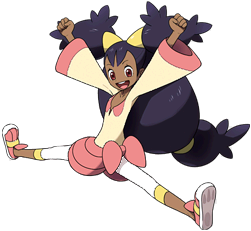
As odd a time as this is to be talking about Iris, my next post is going to be on Diantha, which would otherwise make Iris the only Champion I haven’t written about, having discussed all the previous ones about two years ago now, a possibility that makes me feel a little twinge of unfairness in my normally blackened iron heart. For the sake of completeness, then, let’s give some thought to the fifth generation games’ portrayal of the dragon master Iris, our second female and first dark-skinned Champion (yay diversity!).
Iris first shows up when the player reaches Castelia City in Black and White, where she enthusiastically volunteers to be Bianca’s bodyguard after the latter’s Munna is abducted, and takes part in the standoff with Team Plasma. She is here portrayed as passionate and firm in her convictions, reacting with anger and dismay when she learns of Team Plasma’s theft and bewilderment when the rest of the group agrees to let Ghetsis and his minions leave without a fight, but is also extremely ready to help people in need, and perhaps a little naïve (Burgh suggests that Iris will need Bianca’s help finding her way around the huge city as much as Bianca will need Iris’s protection). On White, Iris is subsequently revealed to be the Gym Leader of the ancient, traditionalist version of Opelucid City; on Black (and I say this as a player of Black version) one is rather left wondering what the point of her is supposed to be. In both games, she also helps Drayden narrate of the story of Reshiram and Zekrom. Since they’re both Gym Leaders of Opelucid City, it makes sense to look at Drayden in Black and White as something of a foil to Iris. Compared to her older mentor, Iris stands out for her excitable speech patterns, liberally peppered with exclamation marks, and her emotional, evocative language. Both are idealistic, but Iris is much more liberal in showing it. On Black, the Opelucid Gym gives Drayden, as its leader, the epithet “the Spartan Mayor,” announcing him to be hardworking, physically strong and austere, as well as reminding challengers of the respect he commands as Mayor of Opelucid City (also, almost uniquely for these titles, it makes no reference to his elemental specialisation). On White, where Iris is the Gym Leader, she is referred to as “the Girl Who Knows the Hearts of Dragons,” a description that focuses instead on her capacity for empathy and intuition, her deep connection with one of the most mysterious Pokémon types, and possibly her raw talent as a Pokémon trainer. It may also be worth comment, in connection with Iris’ characterisation as energetic and youthful, that the only difference between the teams they deploy as Gym Leaders (aside from the gender of their Pokémon – Drayden’s are male; Iris’s are female) is which abilities their Druddigon possess; Drayden’s has Rough Skin, reflecting endurance and severity, while Iris’s has Sheer Force, suggestive of potency and vitality. A minor difference, but when everything else about their Pokémon is kept the same, one little change feels that much more purposeful. Even the city itself may contribute. Drayden is the Gym Leader of a futuristic, technologically advanced Opelucid City, the result of industrious dedication to progress, while Iris’ Opelucid City is peaceful, quiet and very traditional, in keeping with her emphasis on closeness to Pokémon and nature (though her ‘nature girl’ traits, it must be said, are much less noticeable than in her anime incarnation).

At some point before the events of Black and White 2, Iris replaces Alder as Unova’s Champion. As it did for Wallace in Hoenn, this apparently occasions a change of costume, with Iris’ relatively plain beige sweater being replaced by a frilled pink dress like something out of a fairy tale (appropriately enough, given her specialisation), complete with a golden, emerald-studded tiara. We first encounter her, again, in Castelia City. She retains her desire to help people in need, immediately volunteering to assist in your search for Team Plasma despite her belief that they are no longer a threat – but in a pointed contrast to her last appearance suggestive of her greater experience and maturity, she now appears to know the city very well, and is immediately able to direct the player to the most likely site of any suspicious activity, namely the Castelia Sewers. She does very little else in that game, however, appearing again only in Opelucid City for a brief and not especially revealing conversation about Drayden (if nothing else, we learn here that although she calls Drayden ‘grandpa,’ they aren’t actually related). At the time of Black and White 2, Iris was the only Champion since Blue not to take an active role in fighting the primary villains (she is now joined by Diantha), which, given her keen interest in the legends of Reshiram and Zekrom, is baffling. Her initial scepticism at the possibility of a Team Plasma comeback goes some way towards explaining this, but the flying battleship shelling Opelucid City with ice cannons must have been one hell of a wakeup call. Having said that, I’m not sure what her presence would have added other than opportunities for characterisation – unlike Alder, whose own personal flaws and troubled past complicate his opposition to Team Plasma, Iris’s involvement in that plot would have been fairly straightforward, so in some ways it’s perhaps better that she wasn’t there to take the spotlight from Hugh.
Probably the most interesting bit of characterisation Iris gets in Black and White 2 is not actually in the events of the games themselves but through a Memory Link scene (if you’re not familiar with these, they’re scenes which take place between the original Black and White and the sequels, which you can only view if your Black 2 or White 2 game is associated with the same Global Link account as a Black or White game which has completed certain parts of the storyline). In Opelucid City, you can hear from Drayden about how Iris became his student and eventually the Champion – a position she has apparently been groomed for by Drayden since she first came to Unova as his successor. In fact, having the opportunity to challenge Alder and become Champion was apparently her condition for leaving her home in the distant Village of Dragons, hinting at ambition, vigour, and possibly (as we’ve already seen from her) a touch of naïveté about the magnitude of this goal, though it appears she was an exceptionally talented trainer even before she met Drayden. The fact that Alder, in consultation with Drayden, apparently chose his successor is interesting, although it appears that actually defeating him was still a requirement for Iris to take up the position and, far from considering it a formality, Alder actually put himself through a special training regimen (“ghastly,” according to Drayden) to prepare himself for this final duty, intent on pushing Iris to her limit. Now that she’s there, Iris declares that her mission as Champion will be to help people and Pokémon continue to grow ever closer (a pledge that is not without resonance in the overarching themes of the fifth generation). We also see in this flashback that the enormous pink dress Iris wears as the Champion was actually Drayden’s idea, a gift from him upon the completion of her training; now that she’s the Champion, he tells her, it’s okay to dress up – her hard work has earned her the right to a little frivolity now and then.
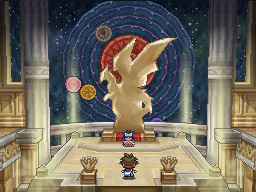
When we finally meet Iris again in the palace of the Elite Four and battle her for the championship, the game pulls out all the stops. Not only is Iris’ chamber particularly spectacular in comparison to those of past champions, with a huge throne in the shape of a dragon silhouette and a rotating circular backdrop apparently meant to represent the planets in orbit around the sun, the battle scene itself is marked by eye-catching streaks of rainbow light flashing across a twilight background. The battle scenery of X and Y, of course, put it all to shame, but it was quite spectacular compared to everything that had preceded it, making the battle with Iris a unique and memorable one. Nor does Iris herself let us down. The game designers, apparently ashamed at their decision to neuter Ghetsis’ Hydreigon with a bizarre physical attacker moveset, have Iris open with a proper special attacker Hydreigon, as deadly a foe as any you’re likely to face in this game. The rest of her team illustrates nicely that it’s quite easy to design a varied and balanced line-up for a Dragon master, simply because there are so many ‘dragon’ Pokémon who aren’t actually Dragon-with-a-capital-D Pokémon. Iris uses three of them: Aggron, Lapras and Archeops. Lapras ensures that she has an answer to Water- and Ice-type Pokémon who think they can sweep her team with Ice attacks, while Aggron covers up her defensive weakness to opposing Dragon Pokémon, and Archeops is simply vicious, and even carries Endeavour to help compensate for the Defeatist ability that normally renders him harmless when his health is low. Druddigon would be the weakest member of her team, but the designers apparently realised this and gave him a Life Orb (making him the only member of her team aside from her partner to use a held item) so as to abuse the way Life Orb and Sheer Force work together – Sheer Force negates Life Orb recoil damage, but only on attacks that Sheer Force applies to normally. Finally her partner, a Pokémon that needs no introduction, is a Dragon Dance Haxorus, complete with an Earthquake that can bring down even Levitating Pokémon thanks to Mold Breaker. With the possible exception of Lapras, all of Iris’ Pokémon and their movesets are ones which emphasise overwhelming force; no stalling Spiritomb, Recover-spamming Milotic or defence-buffing Vanilluxe for her (even her Lapras exploits its powerful special movepool in preference to, say, a more sedate and arguably more effective Rest/Sleep Talk strategy). Iris is all about enthusiasm and passion, and her first priority is to jump right in and blast away from start to finish.
Iris may still be an AI trainer, but as AI trainers go, she’s very much at the top of her game. As a character, she has an odd relationship with the story, spending as little time directly interacting with it as possible but managing to snatch a fair bit of characterisation anyway, courtesy of the greater screen time Black and White gave to most of their Gym Leaders. Her beliefs and goals as Champion also make a very clear statement about the central theme of the games – whether humans should become closer with Pokémon or move further apart. While I remain a bigger fan of Alder and Cynthia, she’s a neat character, and has little trouble stepping into the larger-than-life boots of her predecessors. Will her successor, Diantha, measure up? Only one way to find out…
Pokémon: Twitch Version
In memory of the recent astonishing victories of Twitch Plays Pokémon, now you too can experience the frustration and insanity of the hit stream on your very own Nintendo 3DS! (If someone with more programming skills than me actually wants to make this into a hacked rom, I will love you forever)
Features:
– Choose your starter Pokémon: Pidgey, Rattata or Nidoran!
– Start the game with a powerful item to provide guidance in times of need: the Helix Fossil! Consult the Helix Fossil to learn whether this is the right time to use an item, or which move to use against your opponents!
– No more Pokéballs – instead, wild Pokémon will join your party at random! Be careful – if your party is full, you might need to brave the PC to retrieve them!
– A surprise around every corner when learning new moves – you never know what your Pokémon are going to forget!
– Bill’s PC – the classic villain of Twitch Plays Pokémon is back, with some all new tricks! Deposit one Pokémon, get one back – but if you want to choose which ones those are, you’d better be prepared to make a sacrifice! What’s more, the longer you spend using the PC, the more likely it is to demand blood – make sure you release Pokémon regularly, or Bill may take matters into his own hands!
– Classic RBY mechanics – the Special stat! 15 types! No held items, abilities or breeding! No decent attacks for Bug, Grass, Flying, Ghost or Dragon Pokémon! TMs of powerful moves like Teleport, Dragon Rage and Razor Wind!
– Meet all your favourite characters from the original Twitch Plays Pokémon, like ABBBBBBK( and JLVWNNOOOO!
– Powerful new skills for certain Pokémon: Pidgeot gains a boost to all base stats; Venomoth can learn all HM moves; Rattata’s level-up move pool is expanded with attacks like Thunderbolt and Bubblebeam; Gastly starts with Sing and Rollout – explore the game and find out what all your Pokémon can do!
– Pokémon with field moves like Dig and Teleport will use them on their own initiative to get you out of tight spots, back to the safety of the Pokémon Centre – but be careful, or you might end up leaving a dungeon before you’re done!
– Hours of play time in every area with engaging ledge-jumping puzzles!
– Listen for Bulbasaur’s cry to help find hidden items and areas! Make sure to play it from your Pokédex regularly so you remember what it sounds like!
– Beat Misty, the Cerulean City Gym Leader!
– And much, much more (or less, depending on your perspective)!
With seven exciting game modes to unlock! Switch between modes at a Pokémon Centre, or when the Helix is pleased with your progress!
– Anarchy – The default setting. All Pokémon disobey orders, regardless of the number of their trainer’s badges, and movement commands in the overworld are scrambled. When you try to use an item, there is a 50% chance of tossing it instead.
– Democracy – All Pokémon disobey orders, regardless of the number of their trainer’s badges, and gameplay speed is reduced by 80%. When you try to use an item, there is a 33% chance of tossing it instead. Unlock Democracy mode by finding the mysterious Dome Fossil!
– Dictatorship – For online play only. Connect your game to the controls of a random player on the internet and let the blind lead the insane! Unlock Dictatorship mode by resurrecting Kabuto!
– Capitalism – Every step costs money, and Pokémon centres charge for healing. Pokémon will charge for using their attacks, and become more expensive at higher levels – hey, you can’t expect them to put in all that effort for no reward, right? Unlock Capitalism mode by amassing 50,000 Pokédollars!
– Communism – All Pokémon share experience equally, including those in Bill’s PC, you cannot earn money or buy items, and gameplay speed is reduced by 60%. Unlock Communism mode by evolving Eevee into Flareon!
– Theocracy – Choose one of three divine patrons – the Helix, the Dome or the Amber – and give yourself over to your god’s will. Each one has exciting Intervention powers that allow them to take a hand in battle when you least expect it, rewarding you for your good decisions by resurrecting your defeated Pokémon or improving their stats, and punishing you for your sins by cursing your Pokémon with weaker moves or striking them with confusion. Unlock Theocracy mode by resurrecting Omanyte!
– Monarchy – Tired of all this bull$#!t? Just switch to Monarchy and control your game normally for a while. Unlock Monarchy mode by connecting to Nintendo Wi-Fi while no-one else in the world is online!
A gripping psychological plot, focusing on Red’s spiral into insanity as he loses control over his own actions and watches his friends perish!
– Seek out the eight Gym Leaders and lose to them in battle to gain precious insights into your condition!
– Obtain the SS Ticket and help Aaabaaajss lead his loyal disciples to the promised land!
– Climb the 101 floors of Pokémon Tower and rescue Mr. Fuji!
– Find Flareon, the False Prophet, and through your actions decide how his story ends!
– Relive the events of Bloody Sunday from the perspective of Dux, X(araggbaj and AAJST(????, and experience the horror first hand!
– Learn the forgotten origins of the Pokémon world, and the hidden truths of the Helix and the Dome!
– Descend into the depths of the PC to battle Bill himself and reclaim the souls of your fallen! Will you recover your precious Pokémon? Or will you only fall prey to the PC’s horrifying snares yourself?
Discover the epic story of madness, grief, perseverance and triumph! Get Pokémon: Twitch Version today!
Pokémon Origins: Episode 4

With Giovanni and Viridian City behind him, Red’s journey takes him to Indigo Plateau and the headquarters of the Pokémon League. He narrates, briefly, his conquest of the Elite Four, accompanied by only brief clips from each battle, and is finally sent through by Lance to meet the Champion, who turns out to be – spoiler alert – Blue. Red is surprised, but seems almost pleased to find him there. Blue gives an adapted version of his classic overconfident and egomaniacal entrance speech, complete with his line about being “the most powerful trainer in the world,” and hurls his Pidgeot’s Pokéball to start the battle. We skim through most of it in a few seconds – Blue’s team is the same as he would use with Blastoise in the games, while Red uses Jolteon, Lapras, Persian, Scyther, Dodrio and Charizard. Eventually, of course, the battle comes down to their starters. Although Blastoise shrugs off Charizard’s initial Mega Punch and then nearly ends the battle with Hydro Pump, Charizard is able to endure the damage, trap and weaken Blastoise with Fire Spin, and finally nail him with what I imagine to be a critical hit with Fire Blast. Blue is confused and upset by his loss, but covers it up quickly – and then Professor Oak arrives. Professor Oak’s lines in this scene were sort of forgivable in the games, where all the dialogue was pretty simplistic, but a lot more jarring in this medium: he initially ignores his grandson completely to give embarrassingly glowing praise to Red instead, and when he finally does acknowledge Blue, his first words are a condescending “what a shame…” Blue shrugs that off – and gets accused of forgetting to treat his Pokémon with trust and love, something which rings a little hollow given that we’ve never really seen the way Blue treats his Pokémon. Once Professor Oak has finished being a douchebag, he leads Red backstage to enter him in the Hall of Fame. Red is a little self-conscious here, but is assured by Professor Oak that he’s earned it, so he vows to uphold the honour of the position.
Continue reading “Pokémon Origins: Episode 4”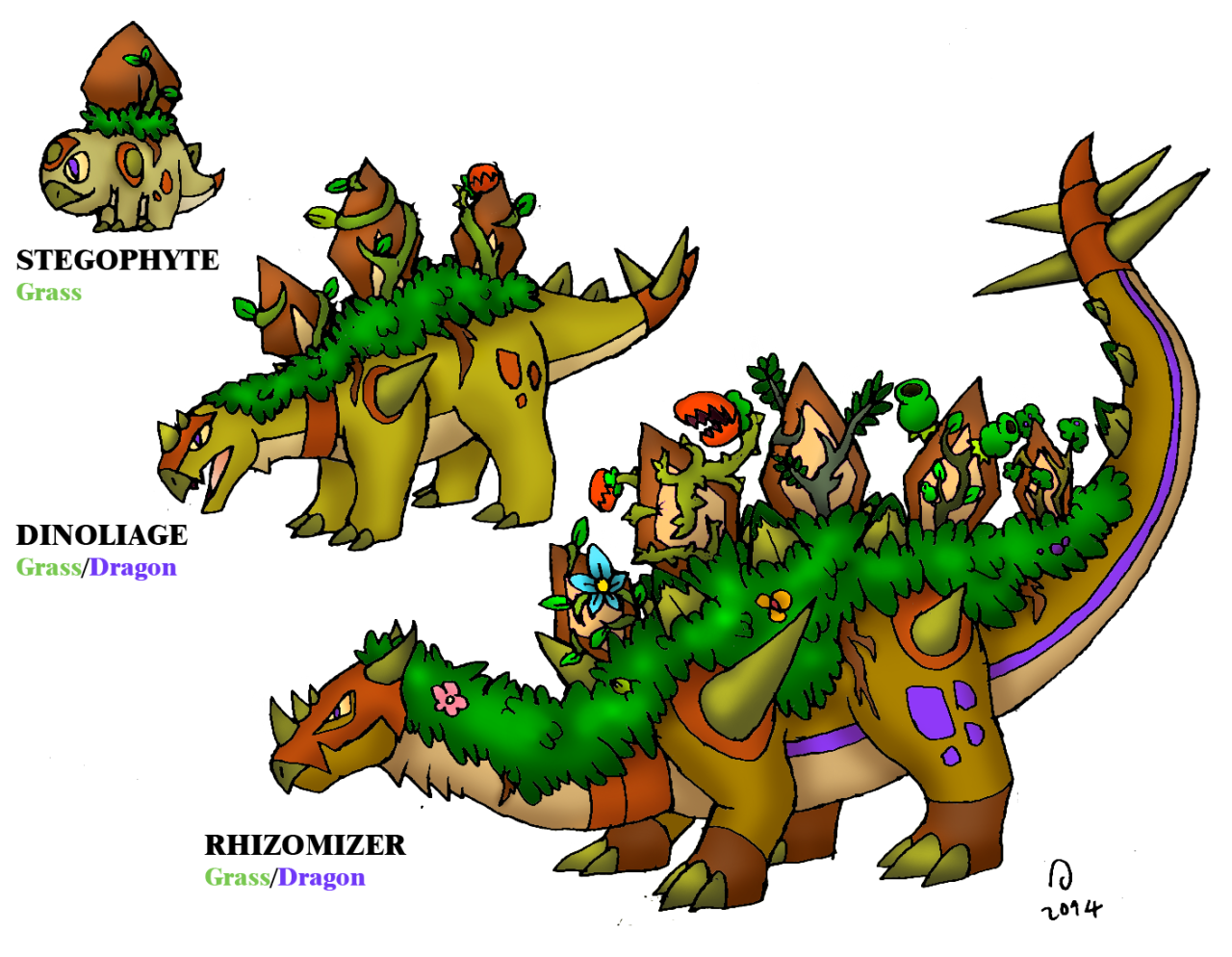
Stegophyte (Stegosaurus+Ephiphyte)
– Plated PokémonDinoliage (Dinosaur+Foliage)
– Plated PokémonRhizomizer (Rhizome+Thagomizer)
– Grove Back PokémonOne thing I’ve noticed was that most of the Grass starter entries focused primarily on the stegosaur design itself rather than tying it to any specific myth. So for mine, I decided to build upon an idea originally described by Pokémaniacal, specifically a giant dragon with plants growing on its body. Combining this with the stegosaur basis, I came up with the idea of the plates being used as a trellis (which has been used before with a fakemon on deviantART, but that one is based on an Edaphosaurus so it doesn’t quite count). The specific dragon I used as influence was Fafnir, that guy from Norse mythology who was slain by Sigurd and whatnot. Rhizomizer’s neck came out a little long for a stegosaur, but then again, we do have Miragia…
Stegophyte begin their lives as small, vulnerable creatures – the single bony plate on their backs offers little protection. Thus, they rely on camouflage to survive in their forest habitat, covering their bodies with moss and lichen. It is easy to mistake a hiding Stegophyte for a plant root covered in vegetation even with that large back plate, especially since it doesn’t take long for some of the seeds it has planted on itself to sprout, covering the otherwise conspicuous feature. Over time, the plants on its back take root on the Stegophyte itself, giving it a source of extra nutrition to go with their original function. Once it evolves, Dinoliage becomes large and strong enough that it can be a little more picky with the plants it grows on itself, preferring the tastiest or most interesting ones it can find. The plants on its back somehow wrap around its back plates as they grow, and by turning its plates to face the sunlight streaming through the forest canopy, it can warm up its body and give its plants the energy to keep growing. Dinoliage is very protective of its plant life, and it can and will put its powerful tail to use if it feels that its mobile garden is threatened.
Rhizomizer (I wanted to call him Dragomizer, but that name was taken by another fakemon on dA) were among the first Grass-types to be featured in folklore, often as a forest-dwelling horror that emerged along with the sun to terrorize the land. Though this portrayal was somewhat unfair, it was somewhat understandable at the time, for although these Pokémon are exclusively herbivorous, they are also aggressively territorial. These dragons are dedicated to protecting the diversity of forest life, so they see it as their mission to collect and preserve the rarest and most valuable plants they find, like a living seed bank for endangered flora. Of course, many of the plants that grow on their backs are highly sought after by collectors as well, and it does not help that anyone dumb enough to bother the Rhizomizer that’s protecting them will inevitably have to deal with tail spikes as long as a man’s arm, among other issues.
According to legend, the first Rhizomizer was not originally a Pokémon, but a transfigured prince. The king of the land had collected a treasure trove of exotic flora from distant lands, some of which were rumored to possess magical powers. When the king passed away, his jealous sons fought over their collection, and in his attempt to gain ground, the eldest transformed himself into a huge Dragon-type, who promptly hid all the plants between his scales and fled the kingdom, setting his lair deep within the dark forest nearby. This did not deter the hero of the myth who would later be convinced by the younger brother to obtain the vanishingly rare flower that grew upon the dragon’s head, and although it would be wiser to simply pack up and move elsewhere, conventional wisdom did not deter the hero from defeating the otherwise well-protected Dragon-type with a combination of a well-placed Dig and an Icicle Spear to the heart. It is said that the younger prince, who had also planned to steal the flower, tried to transform into another Rhizomizer, but was also slain before he could get that far.
Even in modern times, this famous myth has permeated the modern consciousness, portraying the Stegophyte line as savage, untameable abominations, and Rhizomizer were thus both persecuted and exploited to the point that they no longer existed in the wild. However, with the conservationist movements of the recent decades, a number of biologists took a second look and, upon realizing how subjective the original story was, decided to begin raising orphaned Stegophyte in captivity to see what would happen. Perhaps unsurprisingly, the myth of the killer Stegophyte was proven wrong when the little Grass-types proved to be as docile and affectionate as any other Pokémon, even in their adult forms. To this day, the captive breeding of the Plated Pokémon is considered a blessing by the public, scientists, and Pokémon trainers alike, for a properly raised Rhizomizer is not only an Arceus-send for forest conservation and the species itself, but an immensely powerful and invaluable ally in competitive battling as well.The standard ability is Overgrow of course; I’ll let the community decide the Hidden ability but possible suggestions include Intimidate, Mold Breaker, Grass Pelt, Harvest, Multiscale, or Sap Sipper.
I love it when the internet draws things for me. Shout out to SkarmorySilver for making this pretty thing, and to the Latea Region, which you should check out if you haven’t already so you can get in on the ground floor. Some interesting-looking entries in the Grass-type starter category…
Well, looks like Twitch finally managed to beat the Elite Four. Now that that it has ended I have two questions for you. First, how was the experience, and two, did you have any doubts they would manage to complete the game?
Are you kidding me? I still can’t believe they got through Victory Road! I guess that just goes to show how godlike Zapdos was in RBY – nothing really stops him but Rhydon, Golem or Onix.
I haven’t spent much time actually watching the stream, but a friend has been regularly sending me links to all the interesting nonsense that it generates in its wake. It’s a very neat exercise in pareidolia, the human propensity for recognising patterns in randomness. Red’s chaotic flailing and regular tragic mishaps have prompted some very creative interpretations of what’s been going on – the whole helix fossil religion, of course, but also the various ‘heresies’ of that (like dome-worship, or the alternate interpretations of Flareon), the depictions of Venomoth as an all-terrain vehicle, the way the Anarchy/Democracy system has turned into some kind of weird allegorical social commentary… it’s meaning crafted from meaninglessness, which actually says something very profound about the human condition, I think.
And now there’s a countdown to the next game. I wonder whether the next one will be as popular. I do hope so – but how will the mind hive find its way without the guidance of the Helix?
Here’s an ask I’ve thought of after re-reading some of your past Pokemon reviews… If you had to design an evolved form for one single-stage Pokemon (not counting the ones for whom you’ve already discussed ideas for evolutions, e.g. Pachirisu in your Top 10 Worst Pokemon list), which one would you choose and how would you pull it off in a meaningful fashion? Conversely, which single-stage would you give a PRE-evolution?
Hmm… well, outside of the ones I already talked about in that series, the one I most want to see evolved is easily Dunsparce; the problem is that Dunsparce is such a weird and unique creature that it’s difficult to know what to do with him, stylistically. I feel like he should have the head of a Chinese dragon with the whiskers and antler-like horns, a feathery body, still small wings but multiple pairs (which he uses to ‘swim’ through the ground; yes I know that doesn’t make sense), a larger, more vicious-looking drill, and his existing yellow/black/white colour scheme. Normal/Dragon type, Levitate in place of Run Away, keeping Serene Grace. It’s said that if you catch a wild one with your bare hands and hold onto it while it tunnels through the earth to escape, this Pokémon will grant you a wish.
I often have difficulty with pre-evolutions; I don’t always see the point of them. Manktyke I get, because I like how the unique evolution method ties him to Remoraid. Tyrogue I get because they wanted to link Himonchan and Hitmonlee. Munchlax I get because he actually makes an interesting contrast with Snorlax’s inactivity. In many cases, though, they’re just smaller, cuter versions of Pokémon that were small and cute to begin with; I don’t see why that’s necessary. I guess if I had to do one, I’d go with a baby form of Druddigon – soft and cute on the outside, but just as bad-tempered on the inside, with a conniving streak that it uses to trick prey into its cave.
 Pokémaniacal