Go Follow This. I Command It.

The BoltBeam project is a new blog by two crazy people who want to create Pokémon to fill all of the unused type combinations.  They only officially started today, and there is only one Pokémon so far, but I know one of the creators from an unrelated project of his and I am pretty confident that this will not be one of those flash-in-a-pan things that dies after one week.  They’re planning to come up with new stuff every Monday, Tuesday, Thursday, and Friday.  Now go, minions.  Do my bidding.

boltbeam:

Day 1: Normal/Fire

Accumand -> Jerimand

Alright, here is our first set of pokémon. A little rough around the edges perhaps, but I like it.

Normal type is always a little tricky to pair other types with, since you have to figure out a way to make it apparent that it isn’t just a straight example of the other type. With this one, I decided to do that by creating a pokémon that lives around hot climates, but initially has no innate fire powers of it’s own, instead simply borrowing from its environment to get the job done.

Accumand here is based on a mix of a skink and a mythological salamander (with some lava lamp thrown in.) Instead of storing fat in its tail, it stores thermal energy. Perhaps it doesn’t truly eat at all, but instead just goes around sticking its tail in volcanoes or thermal vents for sustenance. By the time it evolves into Jerimand, the tail falls off, so instead he goes around swallowing enormous amounts of lava, which is visible in that big lava lamp-tummy of his.

In terms of ability, I think Flame Body and Thick Fat are both sensible options. Any other ideas?


Anonymous asks:

What would be your dream competitive pokemon team and why? Also what would be your ideal pleasure pokemon team ( just for fun)

[Disclaimer: this blog should not be your first port of call for competitive Pokémon advice, as I am a horrendous battler]

I’ve always said that, if there’s one Pokémon I’d want with me in a fight more than any other, it’s Starmie.  Of course, Starmie doesn’t like Pursuit, so I need something to murder Dark-types, something like Breloom.  I love Poison Heal Breloom, and Poison Heal Breloom loves me.  I want a Porygon 2 in there, because Porygon 2 with an Eviolite pretty much counters everything, right?  Let’s throw in a Dragon Dance Gyarados to ‘drop the hammer,’ as it were, and… what’s missing?  Stealth Rock!  Need something with Stealth Rock.  Let’s use Bronzong for that.

Oh, and it just doesn’t look right if you don’t have a Dragonite.  Bitches love Dragonite.

If I want a team just for fun, it’s going to be all Grass-types.  This is because Grass-types are the best.

Vileplume gets in because Vileplume is my favourite Pokémon and can Stun Spore things like nobody’s business.  Next is Whimsicott because Whimsicott is ridiculous and fun and a huge pain for your enemies.  Ludicolo is important so I don’t get completely squashed by Fire- and Ice-types (yeah, like he’s really going to help) and Cradily is bizarre and awesome.  Exeggutor is too slow to do much of anything, but packs a hell of a punch.  I want to finish by sticking Virizion in there, because I need someone to clean up with Swords Dance, right?

Pokémon and Food

Food, you may have noticed, is important.

You wouldn't eat dear old Milky, would you?
You wouldn’t eat dear old Milky, would you?

While I look forward to the day when I shall no longer have any need of food, and shall be able to sustain my bodily functions by means of philosophy alone, I am for now bound, like most people, by the need to consume carbohydrates, proteins and fats on a regular basis in order to keep myself from, y’know, dying of starvation.  Food isn’t just important to each of us on a personal level, though, it’s important to society as a whole because, as a rule, when a population has more food than it needs, it gets larger, and continues to get larger until the food supply becomes an issue again.  Entire schools of political and economic thought are based around this simple problem, and it’s likely that civilisation as we know it came into being because we figured out how to produce a food surplus by growing crops in a regular and systematic fashion.

Continue reading “Pokémon and Food” →

I am very confused on the Poison Type… I like Nidoran for example, a mammal with poisonous hairs for protection… It makes sense. I don’t like Muk or Weezing because they’re built off waste, which isn’t poisonous, it’s just unhealthy. Why are Bulbasaur and Bellsprout part poison? What’s poisonous about them? Why would Zubat want to be poisonous when he thrives on leeching the blood off living hosts? I understand Steel resisting an Arbok’s bite, but why resist Acid? What IS the Poison Type?

Few of these things are as problematic as you seem to be suggesting.

Go go gadget Oxford English Dictionary.

Poisonous, adjective. (Of a substance or plant) causing or capable of causing death or illness if taken into the body.  (Of an animal) producing poison as a means of attacking enemies or prey; venomous.

Waste can, in fact, be poisonous.  Many kinds of waste are conducive to the spread of disease as well as being poisonous, but they are still quite poisonous on their own – that is, the chemical properties of the substance itself are damaging to health, irrespective of the presence of any disease-causing organisms.  Bulbasaur and Bellsprout (and Oddish) are Poison-types because they, too, are poisonous, as many real plants are.  If you eat them, you will get sick and possibly die.  Zubat can happily use poison because most animals (and plants) are immune to their own poisons (incidentally, vampire bats are actually poisonous/venomous – their saliva stops blood from congealing in the same way as a mosquito’s bite; this is technically a venomous effect).  Snakes, likewise, can pump an animal full of venom and then suffer no ill effects when they eat it afterwards.

Acid, on the other hand, is a problem.  Many acids are in fact poisons as well, but it seems clear that the attack, Acid, causes damage by virtue of being an acid – that is, the substance your Pokémon is producing has corrosive properties because it is, chemically speaking, what’s called a ‘proton donor.’  Metals, generally speaking, do not like acids.  Most metals, when exposed to a strong acid, will react to form salts.  Salts, as the name might suggest, are very much less robust than metals.  Unless they’re all plated with a very inert metal like gold, Steel-types should not like Acid any more than other Pokémon do.

Honestly, I think this is just because the designers didn’t think it through in this much detail.  If it were up to me, I would say that Acid should be a Water attack with a chance to cause a burn, but unfortunately that’s what Scald does.  I guess the only reasonable in-universe explanation is that Steel-types have all developed extremely high resistance to corrosion, maybe by including a very thin layer of something like chromium in their skins, which is why they don’t rust either.

I’m probably a generic question asker (seeing as my previous question asked of you is something you’ve been asked hundreds of times apparently :P). But anyways, since everyone is always like “OMG Generation I iz teh besttt, evryting elz sux!” is there any Pokemon (singular or plural) of the First Generation that you “deny the right to exist?” You don’t have to go into huge detail about it or whatever, but if you can think of a few I’d be interested to hear you opinion!

Hmm.  Which one were you…?

Oh, right; you were the one who asked what I thought of the 5th generation Pokémon, right?  Yeah, it’s not that lots of people have asked me about it, it’s that it was originally the whole purpose of this blog.  That’s why I started writing, and that’s what the whole of last year was about.

Anyway, this question.

This question is tricky, not so much because there are no first generation Pokémon that are badly designed – there are – but because, counterintuitive as it seems, I don’t think you can hold them to the same standard.  They were created in a very different context.  First of all, there was nothing to compare them to.  This is particularly important when you consider that one of the biggest problems I had with many fifth-generation Pokémon was “well, this is just [Pokémon X] with a new paint job and a haircut.”  There’s no way you can reasonably make that complaint about Red and Blue (well, not without attributing some mystical foresight to Game Freak).  Second, the designers themselves weren’t that experienced.  Game Freak was only founded in 1989; it wasn’t that old when Pokémon was first released and they’d only ever made one or two other games for Nintendo, which never achieved any great notoriety.  Black and White were released when Game Freak had been designing  Pokémon for over fifteen years, and I am sometimes startled at how little they appear to have learned in that time (not that they don’t still produce some good stuff – they do – but that was true of the first generation as well).  Third, no-one ever anticipated that Pokémon would become the global phenomenon it has.  There was no guarantee that Red and Green would even be released outside of Japan.  Even when the games were remade into the Red and Blue that we played, you can see how low standards were for fixing problems in the code.  Today, Pokémon games are guaranteed an international release, and Pokémon is the second most profitable video game franchise on the planet, behind Mario (which, incidentally, means a much bigger budget).

What I am by slow degrees trying to say here is that mistakes were made in Red and Blue, and I’m okay with that.  I’m not okay with the exact same mistakes being made, repeatedly and often quite insistently, in Black and White.  The phrasing “I deny this Pokémon’s right to exist” was deliberately over-the-top, and meant to convey that if I had been on the design team, I would have scrapped the Pokémon in question.  I would never use it of any Pokémon from an older iteration of the franchise, and in fact I probably wouldn’t use it of a fifth generation Pokémon either, if I redid all of those reviews now – we’ve got them, and we may as well work with them.

WHERE HAVE ALL THE QUESTIONS GONE

If you’re looking at the front page of this blog, you’ll see that all the question-and-answer entries have disappeared.  WHAT COULD HAVE HAPPENED?

I haven’t deleted them or anything.  They still exist.  You just can’t see them on the front page anymore.  Because I am an incredible egotist and want my own entries to appear more prominently without getting swamped by questions, I have decided to create an entirely separate section of the blog to store the questions people send me and the answers I give.  You can see it up there at the top, labelled “questions,” right next to the Ask button.  If you’re following me on Tumblr, you’ll still see these posts on your dashboard; they just won’t appear on the main blog page itself.

An annoying side effect of this is that, since questions still count towards the limit of 15 posts that can appear on the front page at a time, even though we can’t see them, only a few entries at a time will appear if you’re moving backward through my past work.  Still, I’m fairly happy with the system.

I’d like to thank my website designer friend, Nick, for once again doing an amazing job of bludgeoning Tumblr into behaving the way I want it to.  Everyone say “thank you, Nick!”

This may seem like an odd question, but how do *you* play Pokemon? I mean, we hear all of your philosophical and abstract stuff which of course is amazing, but when you actually sit down to play one of these games, what do you do? Do you like to catch everything you see, or are you selective? Does your play-style change if you are replaying a game? Do you take competitive strategies into account or do you just brawn your way through?

*shrug* Sorta depends what I’m doing.

The very first time I played Black version, I caught every new species I encountered because I wanted to figure out what made them tick.  I also chose Pokémon to use without really having any idea what I was looking at or how it would evolve (when I decided to train my Larvesta, Invicta, I knew she’d be worth it in the end, but had no idea what she’d actually become or how long that would take – turned out the answer was “a while” but at least I had an Eviolite).  You only get one chance to play like that, and I think it’s a lot of fun because it really pushes the theme of discovery that’s so important to the series.

When I replay a game, sometimes I like to impose rules on myself, because Pokémon is a lot of fun but (let’s face it) not all that difficult.  The ‘Nuzlocke Challenge’ is one set of rules, but there are other ways you can do it – sometimes I limit myself to using Pokémon of only one type, other times I get my best friend to pick out a team for me and provide me with a bunch of eggs.  The Pokémon he picks are invariably awful, because he is a sadistic bastard – on one memorable occasion, I played through Leaf Green with a Beedrill, a Farfetch’d, a Lickitung, a Primeape (easily the strongest member of my team), a Tangela, and a special attacker Rhydon.  And you know what?  That Farfetch’d kicked ass.  Relatively speaking, anyway.  Sometimes I’ll just limit myself to using Pokémon I’ve never seriously used before.  That led to an interesting Ruby version playthrough with a four-man team of Masquerain, Armaldo, Solrock and Kecleon (since Masquerain was going to be my only Pokémon for a while, I prepared for this one by breeding a Surskit with Hydro Pump, because seriously, it’s Surskit).

As for competitive strategies… well, the thing to realise is that a lot of stuff that you have to think about when you’re preparing for a Battle Tower run or a battle against another person just doesn’t apply to a playthrough.  Trying to EV-train your Pokémon is just a waste of time, you’ll have limited access to TMs, you probably won’t be breeding your Pokémon so egg moves are out, you won’t have access to move tutors, and your opponents will rarely switch, which means that moves like Spikes and Stealth Rock are much less useful unless you plan to spam Whirlwind.  The other thing is that, since the AI opponents’ Pokémon never have any EVs until you get to Battle Tower type facilities, later in the game your own Pokémon will almost always be faster than them unless they have a massive advantage in level (which, granted, the Elite Four and Champion often will), which drastically changes the value of fast and slow Pokémon.  In short, I think it’s good to be aware of good competitive strategy because a lot of the properties that make Pokémon competitively strong do still apply, but you also need to remember that you’re actually not playing the same game.

Now that it’s been a while since Black and White came out, have you realized that Garbodor is, in fact, lovable and awesome in every single way? I spend about a dozen paragraphs explaining why, point-by-point, over on Bogleech, if you haven’t been there. Also, did you know that your hated Kricketune isn’t even modeled on a cricket? It’s a violin beetle!

You know, funnily enough, someone sent me a link to that article just a few days ago.

For the benefit of readers, here is Bogleech’s take on Garbodor

http://bogleech.com/pokemon/trash.html

and my (admittedly over-the-top) article from last year.

http://pokemaniacal.tumblr.com/post/17760677860/trubbish-and-garbodor

I still think Garbodor is absurd and horrific.  What didn’t occur to me at the time was the point you make in your article that some people might actually like things that are absurd and horrific.  Honestly I still kinda have trouble wrapping my head around that one, but I suppose it is a valid position to take.  I do really like the point you make about Garbodor forming a land/water/air triad with Muk and Weezing, because that does alleviate my concern that Garbodor is just Muk 2.0 (personally I’m still not sure I give the designers that much credit, but it’s difficult to make an argument from that kind of assessment).  I guess the thing to take from this is that, as much as I try to be objective about things and excise my own personal taste from my assessments, I can never really get rid of it.

As for Kricketune…
Go go gadget Google images…
Huh.  That is now a thing that I know.
It doesn’t make me think Kricketune is any less dumb, ‘cause all the things I hate about Kricketune are still things that they’ve changed from the violin beetle, not copied from it.  Also, from what five minutes’ of Googling can determine, violin beetles don’t actually ‘sing’ the way Kricketune and some other insects do, so crickets are still important for the idea (hence the name).

EDIT: Bogleech’s response on Kricketune:
Yeah, while I like him well enough, I’m just adding that in addition to other criticisms, Kricketune lives a shameful taxonomic lie. Technically, we still have no cricket pokemon, or even a grasshopper or other true Orthopteran. Kricketune wouldn’t even be able to jump with those nub-feet, and jumping is even more integral to being a cricket than singing. There are mute crickets, but if any can’t jump, I haven’t heard of them, and a cricket I haven’t heard of is hardly a cricket at all. 

Rereading your entry on Stunfisk, a thought just hit me: you said “and it would actually make sense because he’d no longer be an aquatic Pokémon with a weakness to Water!” in regards to Stunfisk not having Water Absorb. This got me thinking: do you think ‘water’ is the same as ‘Water-type’? I mean, Water Pokémon damage from Water moves, but many live in the water nonetheless. So the question is this: is the water in Water attacks the same as the water in the oceans/rivers/lakes?

The entry, for those who are interested: http://pokemaniacal.tumblr.com/post/17760688728/stunfisk

Well, it’s true that most Water Pokémon do still take damage from Water attacks, but they do resist it.  In much the same way, all Pokémon take at least some damage from Gust and Air Slash.  I do think that Water attacks are, for the most part, using ordinary water (there are a few exceptions; clearly Bubblebeam is more than just bubbles, but trying to explain specific attacks is just asking for trouble) and that the damage is primarily in the force with which they fire it; for most Pokémon, it’s the impact of a Water Gun that’s doing the damage, not the water itself.  For Pokémon that are weak to Water, obviously there’s no reason the water should be physically hitting them harder, so it seems likely that they are in some sense vulnerable to water as a substance.  Fire Pokémon, obviously, do not take kindly to being dampened.  As to the other two types, Ground and Rock… I vaguely recall reading a fan-fic once which suggested that Ground- and Rock-types possess a sort of exoskeleton made of a porous ceramic material, which can absorb a lot of damage (hence their traditionally high physical defence) but can become waterlogged, slowing them down and taxing their energy.

In short, I think that a Pokémon who is neutral to Water attacks simply takes damage from the crushing force of the water hitting it, while a Pokémon who is actually weak to Water attacks is somehow harmed by water itself, and has no business living an aquatic lifestyle.

On Fossil Pokémon

Let’s talk about fossil Pokémon.

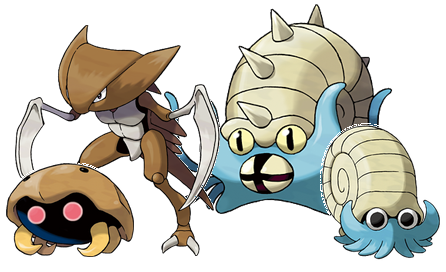
Official art of (left to right) Kabuto, Kabutops, Omastar, and Omanyte, by Ken Sugimori; quoth the raven "copyright Nintendo!"
From left to right: Kabuto, Kabutops, Omastar and Omanyte

Ever since the glory days of Red and Blue, the scientists of the Pokémon world have been trying to resurrect ancient, extinct species of Pokémon from their fossilised remains – and, in many cases, they’ve succeeded.  Every generation except for the second has brought a new set of fossil Pokémon with it; Omastar, Kabutops and Aerodactyl from Red and Blue, Cradily and Armaldo from Ruby and Sapphire, Rampardos and Bastiodon from Diamond and Pearl, and now Archeops and Carracosta from Black and White.  One could also include, as an honourable mention, Ruby and Sapphire’s Relicanth, who, like his inspiration the coelacanth, is an extremely archaic species believed for many years to be extinct until a few were unexpectedly found very much alive in the deep ocean.  I talked about Archeops and Carracosta at some length when I was reviewing the Unova Pokédex last year, so there’s little point in discussing them further, and I’m not especially anxious to do detailed reviews on all of the others either when there are so many other projects on my list, but I do think it would be worthwhile to talk about them as a group, since the whole concept of a ‘fossil Pokémon’ is quite interesting, particularly with reference to the context in which Game Freak started using these ideas in the first place.

Continue reading “On Fossil Pokémon” →