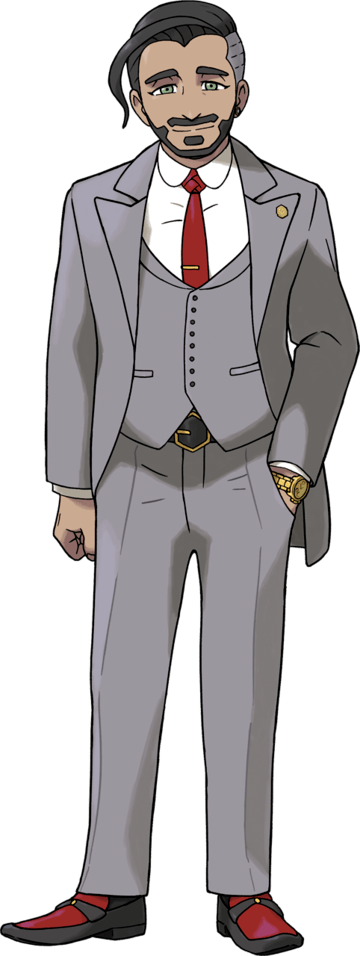
Hop

This one isn’t going to be super heavy on sweeping themes and allegory; I don’t have, like, a hot take about how Hop’s character arc is actually a commentary on British masculinity, or anything like that. Nor (thank Arceus) do we need to get especially deep into the lore of any particular legendary Pokémon to understand what Hop’s deal is; Zacian and Zamazenta are relevant to his story, but we can do this without them. That means I can just… talk about what Hop does in the story, then say what I think about it, like I used to do back when I was still pretending that my life made sense. The theme here isn’t even all that complicated or particularly unusual in a Pokémon game: Hop’s story is about growing up in other people’s shadows and learning to find your own path and excel in your own way, not comparing yourself to the achievements of others. It’s sweet, it’s uplifting, let’s talk about it.

Continue reading “Hop”

Mewitti asks:

Have you seen the dialogue in Sword/Shield revealing that Dynamax Pokémon don’t actually physically change size in real life when they Dynamax? I saw an NPC mention it in the postgame content, and it’s also mentioned by Shigeru Ohmori in an interview “101 Rapid-Fire Questions About Pokémon Sword And Shield” at around 2:10:

Interviewer: So does Dynamax, is that like a projection, or a physical transformation?
Ohmori: It’s actually just a visual projection.
Interviewer: So is the real Pokémon still just on the ground doing these moves and it’s like just a big version of that?
Ohmori: Yeah, so the actual Pokémon is in that projection.

May or may not ultimately change anything, but I thought it was an odd reveal that has some interesting implications for worldbuilding.

Yeah, I am aware of this.  I thought it was… odd, because I’d actually considered the possibility beforehand and decided that it wasn’t necessary for Dynamaxing to make sense.  I mean, we already know that Pokémon can do a magical thing that can drastically change their size in an apparent violation of conservation of matter – evolution.  And evolution is permanent; once I’ve bought into that, I don’t have any problem believing that Dynamaxing can temporarily increase the size of a Pokémon’s physical body.  The animations for Dynamaxing also have this feel of mass and physicality to them that I think is weird if it’s meant to be just a projection.  I guess there is, like… a square-cube law argument that a size increase like that would definitely kill most Pokémon, but since when does Pokémon care about anatomical plausibility?  It makes some thematic sense, I’ll give them that, because of Sword and Shield’s interest in spectacle – Dynamaxing is actually all about appearances, style over substance, which would be a weird take on this generation’s flagship mechanic, but actually fits in the context of the story of Piers and Spikemuth.  I feel like it raises more questions than it answers, though.  Like, if the gigantic form is just a projection, why does it make them more powerful?  How does Gigantamaxing fit into this, why is it any different to Dynamaxing, and why can so few Pokémon do it?  Is there a reason Galar needs huge stadiums, if the Pokémon doesn’t physically get larger; like, can the Pokémon not just have the power without the size increase?  And, well, this was a question I had anyway, but what does Eternatus have to do with any of this?

Also, apropos of nothing, I believe this is the same interview where they are asked “are Pokémon sentient?” and Shigeru Ohmori replies “they’re just getting by,” which frankly is an answer that resonates with me much more than it should. Like, sentient? B!tch, today I slept until midday and then played six hours of Fire Emblem; I’ll work on “sentience” next week.


Thoughts on the recent Pokémon Direct

If you’re interested to get my thoughts and reactions on the Pokémon Direct broadcast from a couple of days ago, which announced two upcoming downloadable expansions to Sword and Shield, I just wrote something on it for PokéJungle, which you can find here: https://pokejungle.net/2020/01/11/in-depth-breakdown-of-pokemon-direct-and-what-it-revealed-about-sword-shield-dlc/. I will say that I wrote this in Denver airport, near the end of a 36-hour-long Saturday, as I was beginning to hear colours, so if I have missed something you’d like to know my opinions on, do bring it up in the comments on this post. Please also be aware, however, that I now intend to sleep for approximately seventeen days.

Chairman Rose

Chairman Rose.

Today we’re going to be looking at another pivotal character of Pokémon: Sword and Shield: Chairman Rose, the… [SPOILERS… obviously???] main antagonist of the game’s climax.  Even more so than Lusamine, Rose spends a lot of the game being obviously suspicious but never actually doing anything untoward that we can see, until suddenly he flips out and does something completely ludicrous that I am probably going to spend the entire duration of generation VIII trying to puzzle out.  Exactly what he does is swathed in some weird deep-lore $#!t that I don’t think we have the full picture of, even from our vantage point at the end of the game, and anyway I’m going to talk more about it when I cover Sonia’s storyline, and eventually when I review the relevant legendary Pokémon.  For Rose, I think it’s more important that we look at who he is and what his motivations are.

So what’s Rose’s deal?

Continue reading “Chairman Rose”

Don’t Call Me Bradley [Patreon Cultist] asks:

Which of the Gen VIII Pokemon have taken your fancy early-on? Before all the research and all the fun stuff that comes with the reviews have any peaked your interest as fascinating right out-the-gate? Have you accepted our lords and saviors Falinks into your heart yet?

Y’know, I have weird issues with Falinks that are probably specific to me in particular, because I look at Falinks and think that it was probably designed for the British region, and plonked down in an “ancient ruins” area next to the town which is clearly based on Bath, as a reference to soldiers of the Roman Empire. And that’s great and all, but I’m a classicist and Falinks’ design and English name scream to me “classical Greek hoplite phalanx,” which is not the same thing, god damn it, so now I have to read this bit from Falinks’ Bulbapedia article:

and “Spartan helmets during the period of Ancient Rome” is… kind of a phrase that hurts my soul in a way that maybe will not be immediately apparent to a non-specialist

so yeah Falinks is a “no” from me, sorry

Continue reading “Don’t Call Me Bradley [Patreon Cultist] asks:”

Tapu Wooloo asks:

Could the Chairman Rose arc be a commentary on modern-day capitalism? Real-world competitive sports is a lucrative business full of shady sponsors. And Dynamaxing seems to be an investment that is extremely gimmicky yet highly profitable (larger stadiums and audiences become necessary), so it would make sense for the chairman to invest in it. Like the decisions of many real world corporations, the decision to put Dynamaxing front and center has left behind towns like Spikemuth. And like real world corporate bosses, Chairman Rose is willing to risk destroying the entire world in pursuit of his investment.

Just giving a very quick and brief answer to this here because I’m actually working on my article on Chairman Rose right now, and am working through how I want to do my full-length take on this. The short answer, though, is “yes, that is absolutely how I see this story as well.”

jeffthelinguist asks:

Why do Pokemon post game stories suck (aside from Johto’s, and even that doesn’t have much for story)? The more casual fans might stop after the credits so really they should be for the hardcore fans; it’s really a chance for Game Freak to step up their storytelling and give us some good lore. Instead we get Looker (arguably the best thing other than Johto’s and that says a lot), Team Rainbow Rocket (minor nostalgia dump with huge plot holes), and now Squidward and Sherbet (I refuse to ever use their real names).

Well, I should start by saying that I actually quite like Sword and Shield’s post-championship storyline in spite of Swordface and Shieldbutt (who are clearly not meant to be sympathetic characters), as detailed here (this question landed in my inbox before that entry was published). Their enmity towards Sonia for “changing history” actually does feel to me like a natural continuation of her story and an interesting perspective on the events of the main plot. So I sort of disagree with the premise of the question, which is a thing I do a lot.  I also liked Fire Red and Leaf Green’s Sevii Islands storyline, and while I consider Looker himself a personal enemy who should be flung into outer space, I don’t actually have any issues with the Lumiose City storyline featuring Emma and Xerosic in X and Y.  I have problems with the endgame stories that feel tacked onto a game that was already finished – the worst offenders in my view being Platinum’s Charon subplot (the main plot is about ancient mythology and seizing control of terrible cosmic powers to rewrite reality and change the nature of life, the universe and the soul; and then Charon, who’s been built up as this incredible genius for the entire game, just wants to blow up a volcano in order to extort lots of money from the people of Sinnoh) and the Team Rainbow Rocket saga of Ultra SMoon (which… well, we’ve been there). Also, frankly, even though this isn’t actually postgame material, I think the Ultra Recon Squad subplot counts as this too; it’s not actually bad in isolation but it doesn’t belong in the story it’s attached to.  And, well, that’s kind of the answer to your question: because they’re tacked onto games that were already finished, in some cases (as I understand it – fact-check me on this) by different writers than the ones responsible for the original story.  I’m inclined to blame the rampant corporate greed that dictates an annual release cycle for Pokémon, whether there’s actually a worthwhile game to be made or not – but then, I blame a lot of things on rampant corporate greed these days, so you can argue this is just my baseline.

Marnie, Piers and Team Yell

Okay; let’s get cracking!  New generation, renewed sense of purpose, momentary spike in my will to live… aaaaaand it’s gone.

Oh well.

I’m going to begin with my character studies of the major players in the plot of Sword and Shield, rather than Pokémon reviews like I’ve done in the past, partly because I want to get my thoughts on the story out there while the games are fresh in people’s minds and it’s more immediately relevant… and partly because I was still doing Pokémon reviews for generation VII just a couple of months ago and frankly I need a minute (also I am kiiiiinda thinking I should go back and do the characters from Sun and Moon that I missed out).  Let’s start with the, uh… pseudo-villains… of Sword and Shield – Team Yell – and their reluctant “leaders” Piers and Marnie.  In more ways than one, Team Yell are a continuation of things we saw in Sun and Moon with Team Skull.  Team Skull are arguably not “villains” in Sun and Moon, and certainly not the main antagonists.  They’re set up as troublemakers and petty criminals, but if anything we’re supposed to come to sympathise with them by the end of the game, and their leaders earn redemption in the epilogue.  Team Yell are the same, but more so: they’re obstructive and annoying, but they never really hurt anyone as far as we see, and once we learn their true nature, it’s clear that their motives are – if not exactly “pure” – certainly understandable.

Continue reading “Marnie, Piers and Team Yell”

jeffthelinguist asks:

So I have some theories but I want to hear what you have to say on this.

So the latest “fossil” Pokémon clearly never actually existed (nor should they now, either), but the most interesting thing about them is none of them are rock type. In your standard reputation of reading heavily into this as world building and not Game Freak not giving a $#!+ about maintaining any sense of consistency, what would be your reasoning for this and why? If you have multiple theories, feel free to share more than one!

Continue reading “jeffthelinguist asks:”