One lunatic's love-hate relationship with the Pokémon franchise, and his addled musings on its rights, wrongs, ins and outs. Come one, come all, and indulge my delusions of grandeur as I inflict my opinions on anyone within shouting distance.
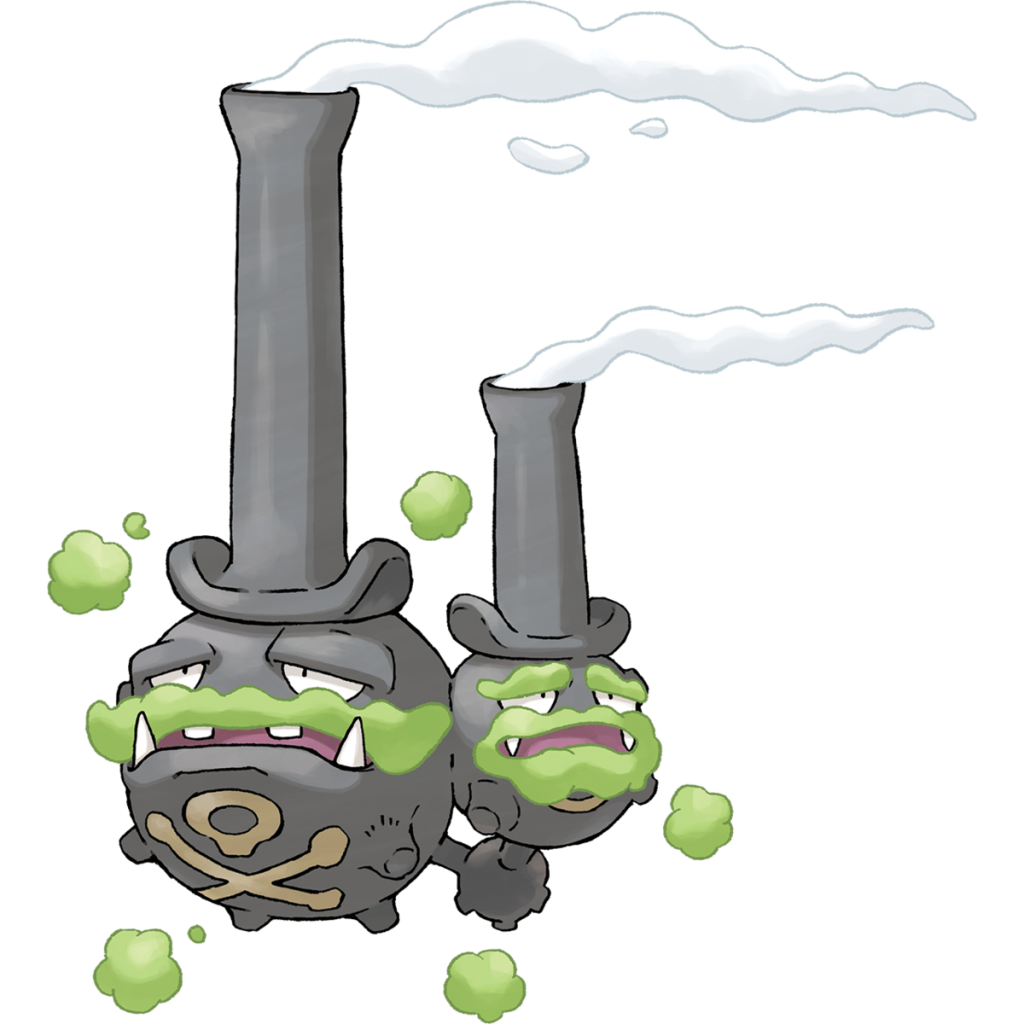
I’ve been doing the regional variant Pokémon up until now as blocks of two or three, but I don’t think that’s going to work for the rest of them – I’ve been stuck for weeks trying to do another set, and I’m not sure there are useful themes I can use to tie them together. There’s also just… a lot more to say about the Galarian forms than the Alolan ones, partly because some Galarian forms evolve into totally new Pokémon, partly because the design changes are more radical. So let’s not do that – let’s just talk about Galarian Weezing, the steampunk capitalist keeping Galar’s air fresh and clean!
What would You think if Game Freak released an Ultra Beast game? You would play a member of the Ultra Recon Squad traveling between ultra wormholes, stopping hostile Beasts from rampaging, and training your own Beasts. All the old Ultra Beasts would return, plus about 100 new ones.
I just saw the YouTube video “Trope Talk: Dragons” from the channel “Overly Sarcastic Productions”. Basically a brief summary about how a dragon is defined (or rather how they lack a concrete definition) and how they play an important role throughout almost every human culture in the world. If you have seen the video (or probably more accurately, decided to see it after reading this) I’m curious if you have thoughts on it regarding how these ideas might apply to the variety of the dragon type in Pokemon.
Lore-wise, how is aura sphere a fighting type move if other pokemon besides Lucario (Togekiss, Clawitzer, Zeraora to name a few) can also learn it? And why is aura wheel electric?
Well, Aura Wheel is a different thing from Aura Sphere, because if you go back to the original Japanese, the “Aura” of Aura Wheel is オーラ, ōra – just the English word “aura” written in katakana. This is, I have to assume, a reference to the new-age/pseudoscience concept of auras, visible, colourful energy fields that represent your personality or mood (which is why Aura Wheel changes type according to Morpeko’s mood). The “Aura” of Aura Sphere, also mentioned in Lucario’s flavour text, is はどう/波動, hadou, which means something like “wave energy” (see also the classic Street Fighter move Hadouken, or “Wave Motion Fist”). Despite the English translations, the two are completely unrelated.
As for the other Pokémon that learn Aura Sphere – the move is supposed to represent, basically, weaponised spiritual energy (it’s… well, it’s a Dragonball Z ki blast; there’s no other way to put it). Lucario gets it because of the mastery of spirit produced by intense martial arts training. Other than Fighting-types, it’s primarily learned by Pokémon with what you might think of as “strong souls”; Togekiss, Mewtwo, the Sinnoh space-time trio, Magearna. Clawitzer and Blastoise, on the other hand, get it because of their Mega Launcher ability, which powers up things with hadou in their Japanese names (the “Pulse” moves).
Have you ever considered starting a discord chat for this blog? I feel like your blog attracts a very specific type of Pokemon fan, and we constantly flood your inbox with thoughts of our own since we have nowhere else to share ’em. Maybe you could herd us into a groupchat so we could bounce our absurd ideas off of each other, instead of making you respond to each one yourself?
Well, I have considered it. I don’t regularly use Discord and I’m honestly not sure I really “get” it, and by setting up something like that I’d kinda be taking some responsibility for moderating it and being a regular presence there, which… as a long-term commitment I’m honestly notwild about. On the other hand, there are a lot of things people seem to want to say to/about me for which the question-and-answer inbox is simply not a useful or effective outlet. So I guess I’m not really against it, just unsure whether/how it would work.
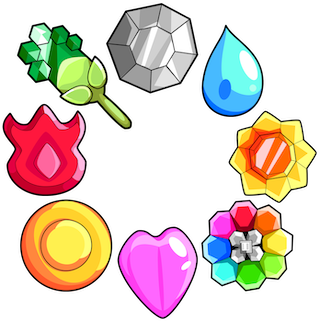
The eight Kanto region badges. Clockwise from top: Boulder, Cascade, Thunder, Rainbow, Soul, Marsh, Volcano, Earth.
One of the seemingly immutable fixtures of the Pokémon games is the system of gyms and badges. In each game (barring the Alola generation) the main challenge set before you, as a young trainer, is to visit eight Pokémon gyms, battle and defeat their leaders, and earn their badges – little bits of metal and brightly-coloured enamel that you pin to the inside of your coat, so you can flash them at people to get into clubs and impress boys. I assume. Today, in this article brought to you by the Dark Council of my Patreon supporters, we’re going to talk about badges and their history and meaning. I honestly don’t know how that’s going to go, but that’s what’s happening, so let’s get to it!
There is a venerable video game trope of “Travel the World, Raid the Dungeons, Defeat the Bosses, Collect the Things” that provides a useful structure to hang your story on. There’s multiple Things of a single class that you’re trying to collect, or perhaps multiple pieces of a single Thing, and they’re in different places being guarded by different enemies. This means developers can do things like, say, create a series of thematic dungeons with thematic boss fights, without having to come up with a unique story rationale for why you’re going to each one – it’s more gameplay mileage out of a single story element. That sounds lazy, but creating a video game is essentially about training players to do something, then presenting them with more and more variations and twists on that thing, so some amount of repetition can be part of good game design. Arguably the most straightforward and best-known examples are from Japanese games – Pokémon Red and Blue are themselves classic examples by now, but there’s also things like the elemental crystals of early Final Fantasy, or pieces of the Triforce in the Legend of Zelda series, as well as plenty from western games.
So, last time we talked a little bit about signature Pokémon and how (ever since Ruby/Sapphire) most Gym Leaders’/Elite Four members’/Champions’ signatures are always newly-introduced Pokémon. Let’s talk about that more. I’m of two minds about this paradigm.
On the one hand, I do think new generations *should* showcase new Pokémon in major battles, since that is the major draw of new Pokémon games. On the other hand, I feel like it’s gotten to the point where Game Freak design certain Pokémon specifically to fit a particular character they’ve come up with, regardless of the Pokémon’s own merits. XY was particularly bad with this: Vivillon was the only new Bug-type introduced in Gen VI and half of its raison d’être was just to be Viola’s signature. I would argue a similar case for Heliolisk/Clemont, Avalugg/Wulfric, and to a lesser extent Pyroar/Lysandre. SwSh may have begun moving away from this somewhat, but I still get the same impression with Drednaw/Nessa, Centiskorch/Kabu, Coalossal/Gordie, Alcremie/Opal, and like the entirety of Bede’s teams. Don’t get me wrong, I’m not saying those are badly-designed Pokémon necessarily; I’m just saying it seems to me they only exist to be the signatures of their respective Trainers, and not much else. What are your thoughts?
Why do you think Poison-type Pokemon were so commonplace and widespread in Gen I and since then have been relatively scarce since?
Honestly, maybe the fact that it’s true is the reason for the thing itself? Like, if balance of the number of Pokémon in each type is something that Game Freak cares about at all, then you could fairly look at the 33 first-generation Poison-types and say “okay, we have more than enough of these.” Per Bulbapedia, Poison is still the 8th most common type out of 18, despite gaining only three new members in generation II, four in III and just two (Skrelp and Dragalge) in VI.
I think Poison is just… a weird thing to even be a type, frankly. It’s like Flying, in that it’s more something a Pokémon does than something a Pokémon is (except arguably in the case of industrial waste Pokémon like Muk and Weezing), and it’s not hard to imagine its abilities being given fairly freely to Pokémon who aren’t actually members of the type. And… well, think of other JRPGs. Poison is always a status effect; off the top of my head I can’t think of any games that have a concept of status effects where poison isn’t one of them. However, I think I’m justified in saying that it’s very rarely, if ever, a trait of monsters that affects their general strengths and weaknesses. Having Poison as a type at all is a very weird decision, both conceptually and in terms of mechanical game design, and generation I also slaps it on several Pokémon for whom poison is… arguably not a very strong part of their identity – Bulbasaur, Golbat, Nidoran? I’m really going out on a limb here, but it’s sort of plausible to me that Game Freak’s designers genuinely didn’t know what to do with the Poison type for quite a while after the first games.
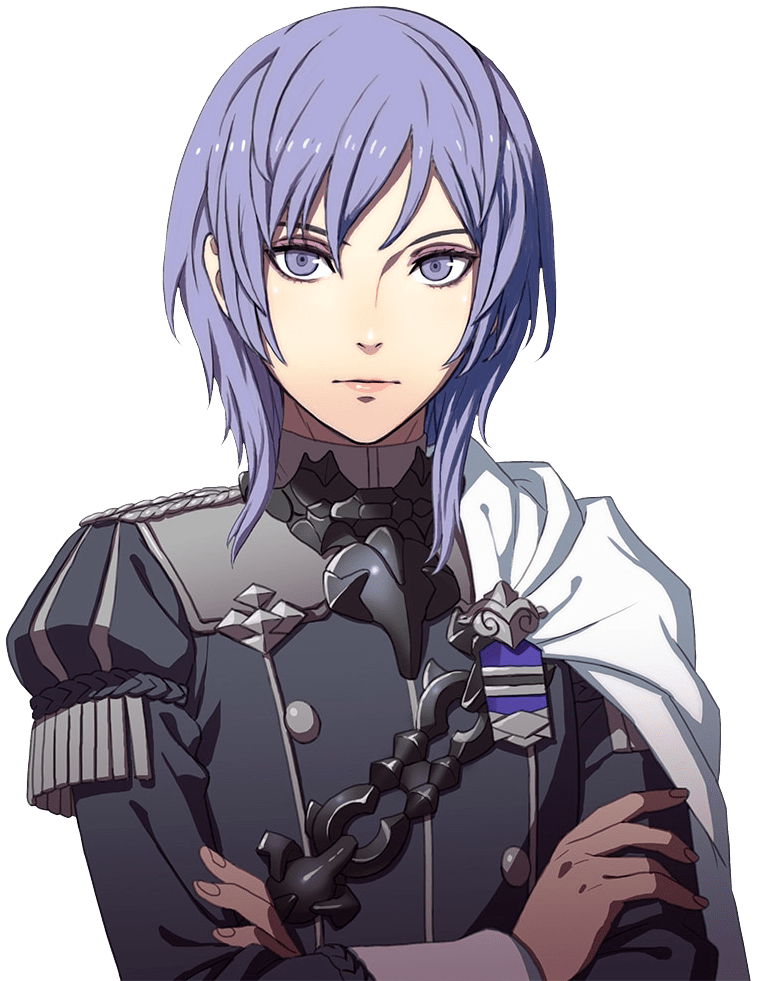
Well, there’s only four characters left, so here they are: the Ashen Wolves. They’re the “secret fourth house” that live in the basement and never talk to anyone. There’s apparently an entire hidden town called “Abyss” hidden underneath the school/monastery/fortress where you and all the other characters live, filled with outlaws, refugees, dispossessed nobles and assorted other fugitives who collectively decided that the best place to hide from the law was literally in the Pope’s basement. These four kooky kids can join you no matter which of the other “houses” you’re aligned with, as long as you’ve bought the “Cindered Shadows” DLC and completed an extra chapter of the story focused on them. And here they are:
Yuri Leclerc
Commoner adopted by a minor noble family, grew up to become some kind of mob boss
Basically runs Abyss in the absence of any more reasonable authority figure
Could probably arrange for you to be murdered in your sleep
Has definitely thought about it
Is too gay to put up with your bull$#!t
Kind to children; will shank you if you find out about it
Difficult to be friends with, but extremely worth it
He is perfect and I love him
Favoured types: Flying, Dark, Normal Yuri’s mob nickname is “the savage mockingbird,” and if you teach him magic (which you probably will, since his “default” class is a hybrid caster) he mainly learns wind spells. He was born a commoner and is still devoted to helping ordinary people, hence Normal, but regularly does so through… less than ethical means, hence Dark.
Disfavoured types: Fairy, Ground, Bug Yuri’s biggest mob rival is a gang that identifies its members with scorpion tattoos. He’s not good with Fairy-types since he’s so cynical, and doesn’t like the bulky, solid nature of Ground-types.
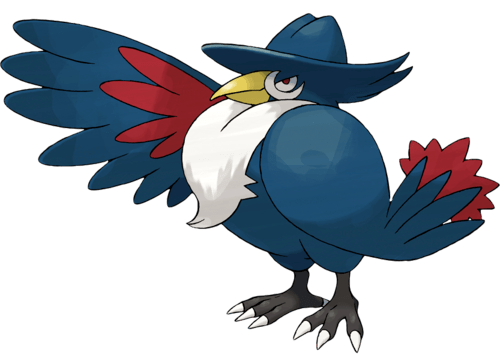
Partner: Honchkrow Honchkrow is a bird who is a mob boss, which is basically Yuri’s entire aesthetic; they’re made for each other.
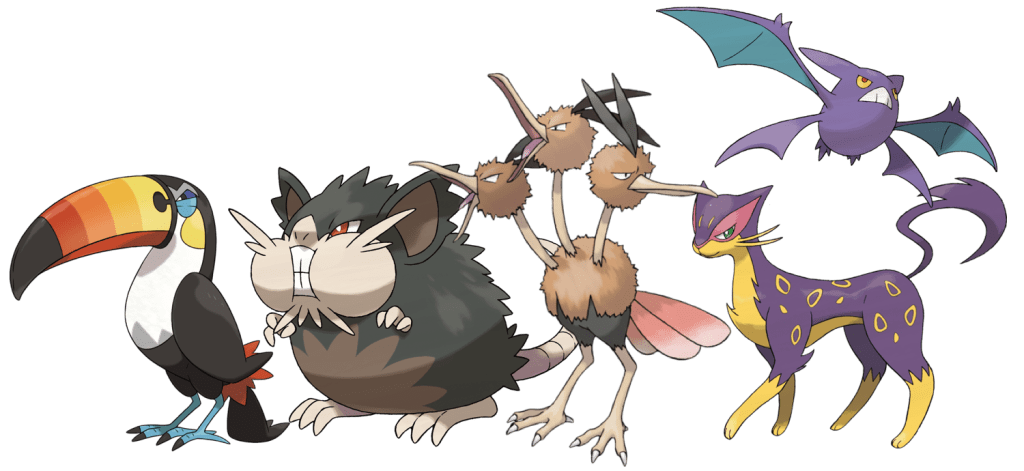
Other Pokémon: Toucannon, Dodrio, Crobat, Raticate (Alolan), Liepard
Yuri likes Flying Pokémon with great speed, manoeuvrability and physical power. Raticate is another mobster Pokémon to help him run his gang, and Liepard is just very good at shanking people.
you were the dumbest Pokémon of the generation for two generations running, which by all rights shouldn’t even have been possible
you’re a moai, but you’re also a compass, and you have a terrible moustache, and for some reason you have small flying noses, and I won’t say there’s nothing clever or interesting or redeemable in there, but at the end of the day you’re a big red nose with a stone idiot hanging off it

 Pokémaniacal